
EU Long-Term Resident Permit in Wroclaw
ONE PLUS helps foreign nationals obtain EU long-term resident status in Wroclaw and throughout Poland. We check your five-year residence history, time spent outside Poland, income, health insurance, accommodation and proof of Polish at B1 level. We then prepare your documents, complete the MOS 2.0 application and support you until the Voivode issues a decision.
The Voivodeship Office will review more than your current residence card. The case officer examines your full history in Poland, including the legal basis for each period of stay, any gaps between permits, your travel record and whether your income met the requirements over the relevant years. Missing evidence or an invalid B1 document may lead to additional requests or refusal.
ONE PLUS has more than 11 years of experience in Polish immigration matters. Our office is in Wroclaw, but we assist clients across Poland. More than 405 Google reviews reflect the experience of people who have already used our services. Before you apply, we assess your case honestly, explain which periods can count towards the required five years and identify anything that should be corrected or added.
Packages and prices
You can choose from three levels of support: ONE, PLUS or PRO. The right package depends on whether you only need help preparing the application or want us to handle the case until it is completed.
ONE: prepare and apply
Price: PLN 1,000
ONE is designed for applicants who are comfortable managing their case after submission. We begin with a consultation, review your immigration history and assess the main risks. We then check your existing documents and prepare a personalised list of anything still required.
The package includes completion of the application form, preparation of the supporting file and assistance with submission through MOS 2.0. You can contact us through your client account during business hours until the application is filed. Correspondence with the case officer and support after submission are not included.
PLUS: support until the decision
Price: PLN 2,500
PLUS includes application preparation, MOS 2.0 submission support and ongoing case management. We monitor official correspondence, track deadlines, prepare replies to requests from the case officer and help submit additional evidence to the Voivodeship Office.
You will have a dedicated case manager throughout the proceedings. If the authority does not act within a reasonable time, we assess the available legal options and prepare a formal request to move the case forward. Our support continues until the Voivode issues a decision.
PRO: complete legal support
Price: PLN 2,700
PRO provides end-to-end support with an EU long-term resident permit application. In addition to reviewing your eligibility and preparing the MOS 2.0 application, we can represent you under a power of attorney, manage correspondence and prepare any further documents requested during the proceedings.
Where necessary, we help obtain ZUS records, review PIT returns and check other proof of income. We can also attend your appointment at the Voivodeship Office and assist with the collection of your residence card.
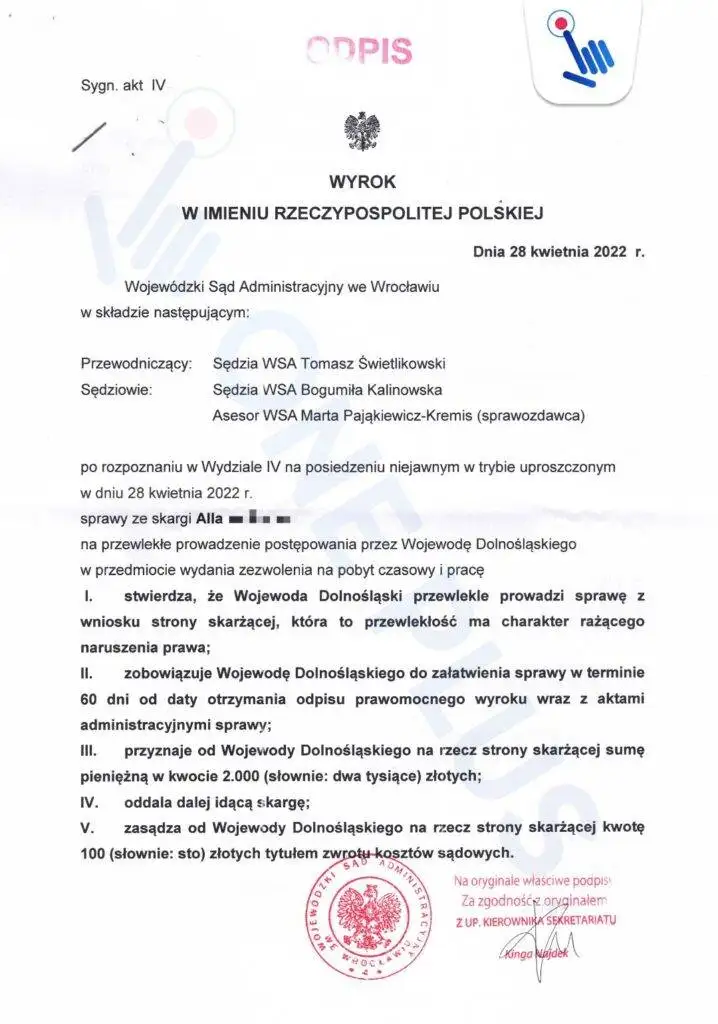
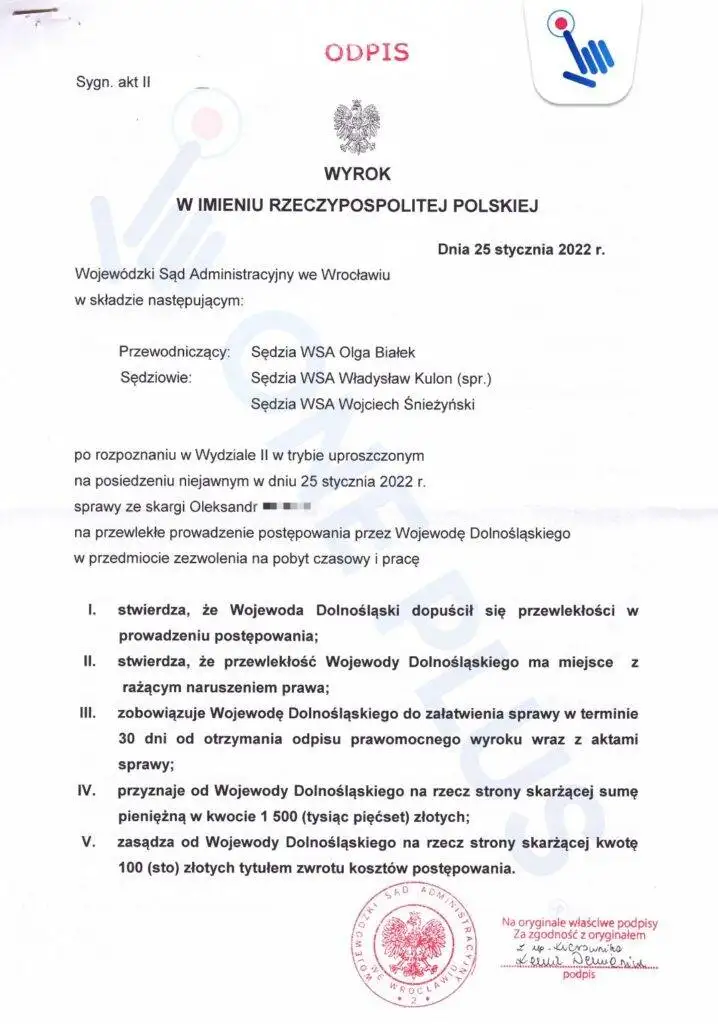
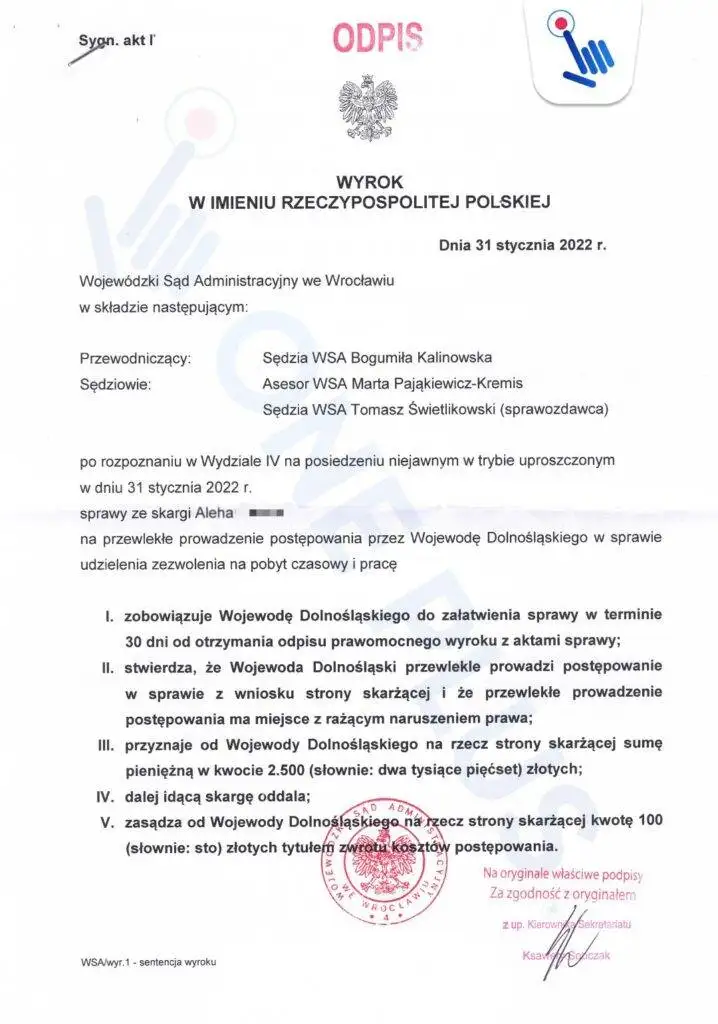
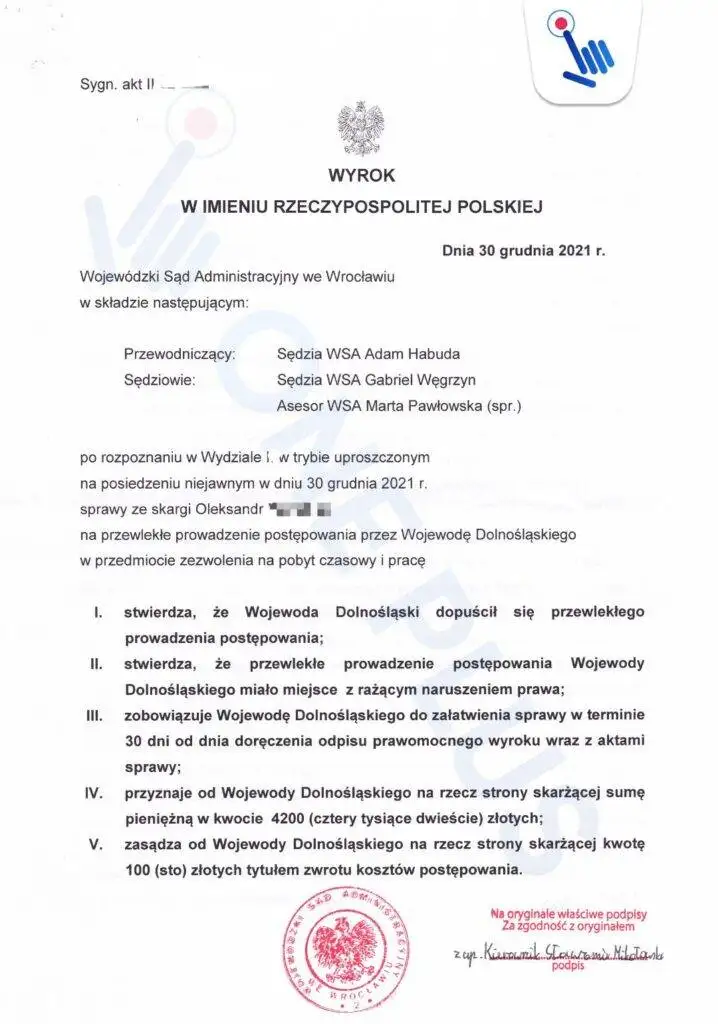
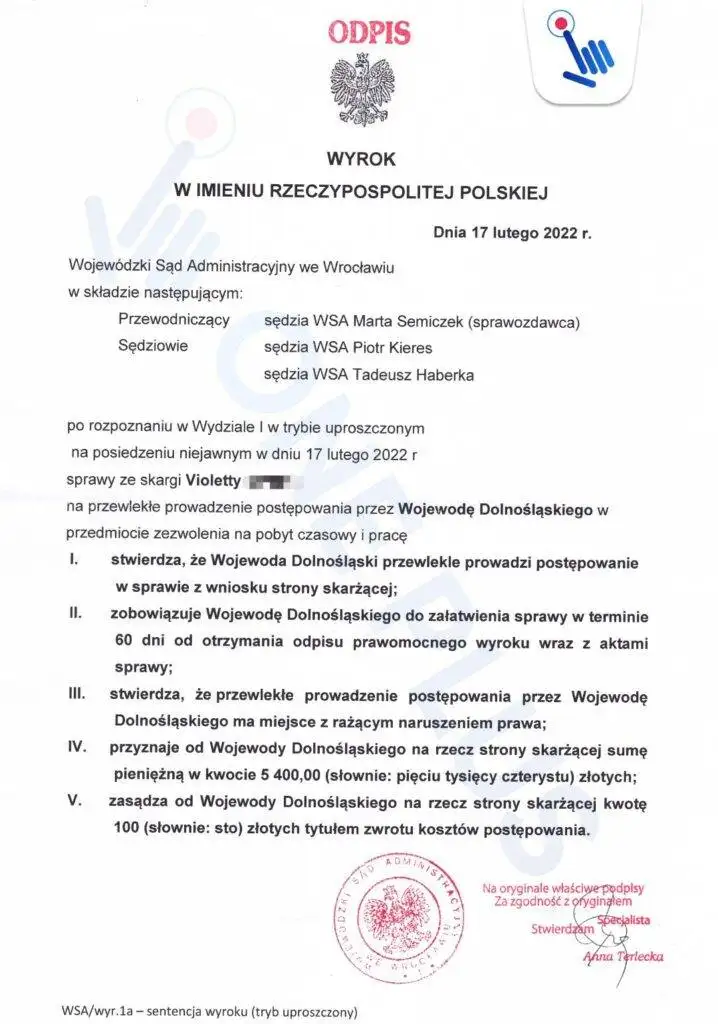
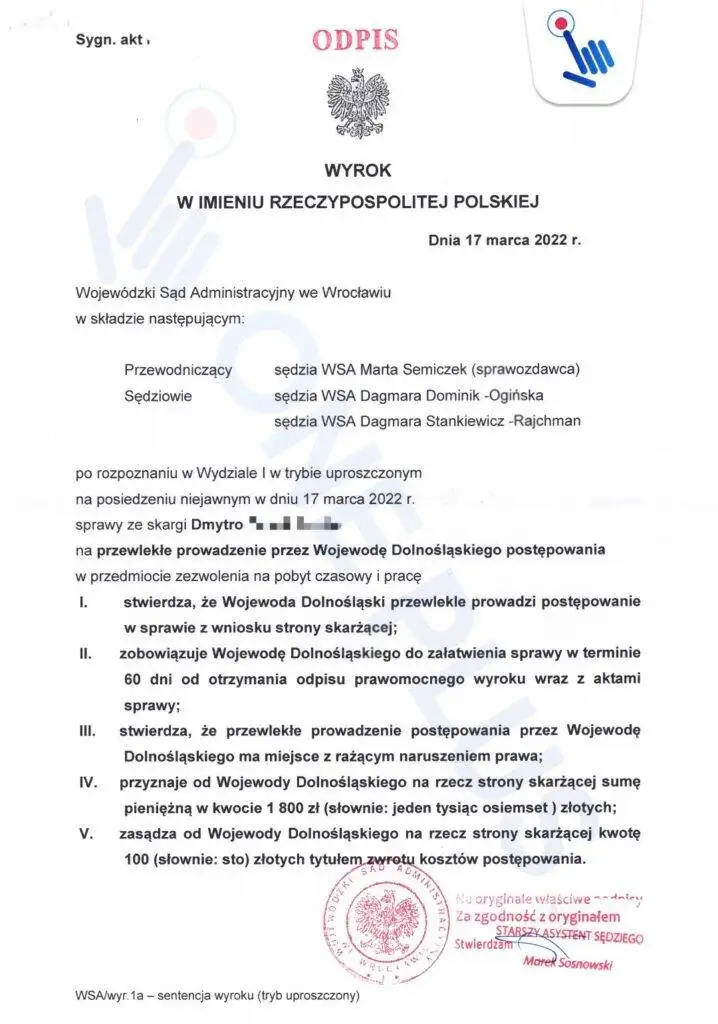
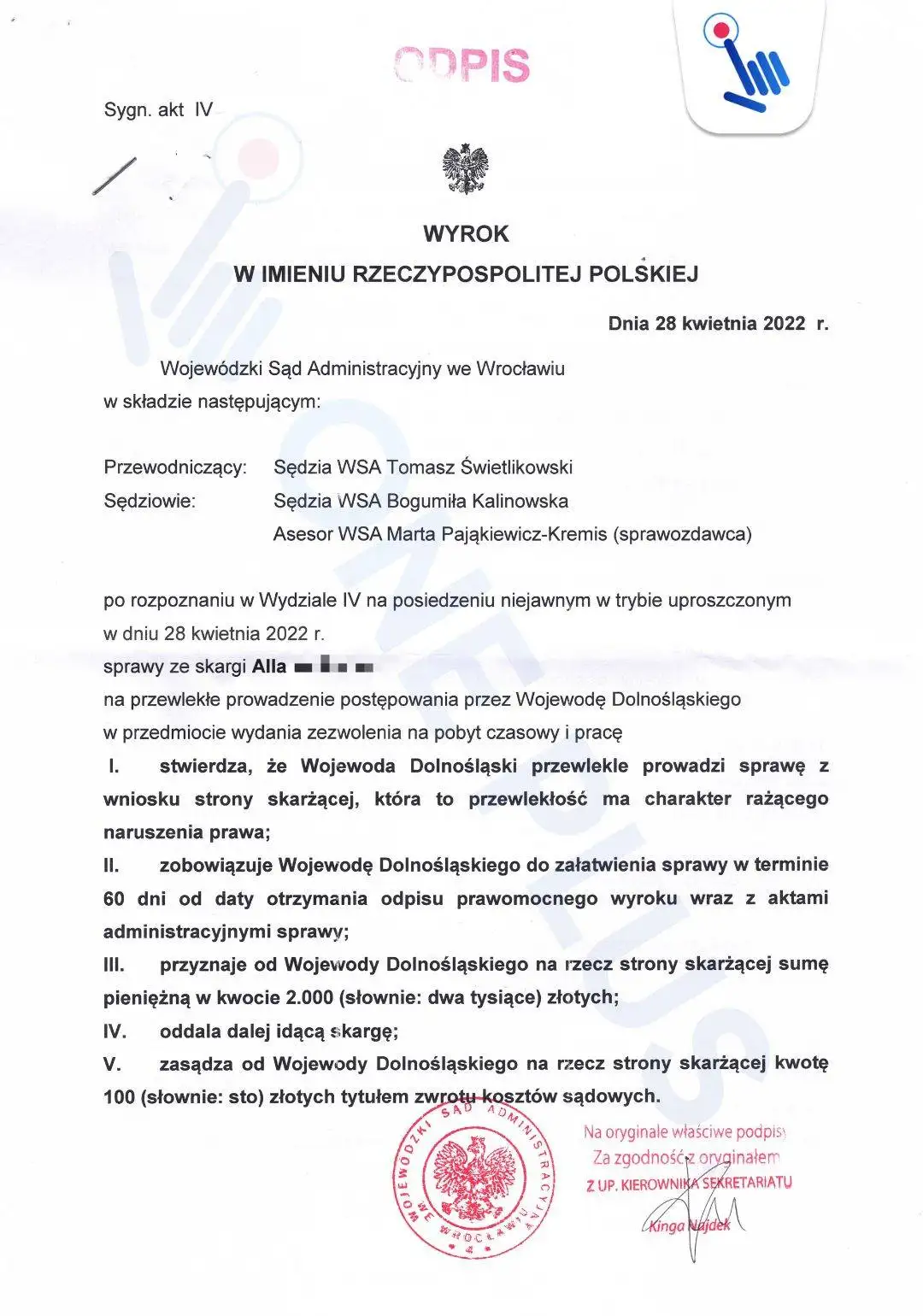
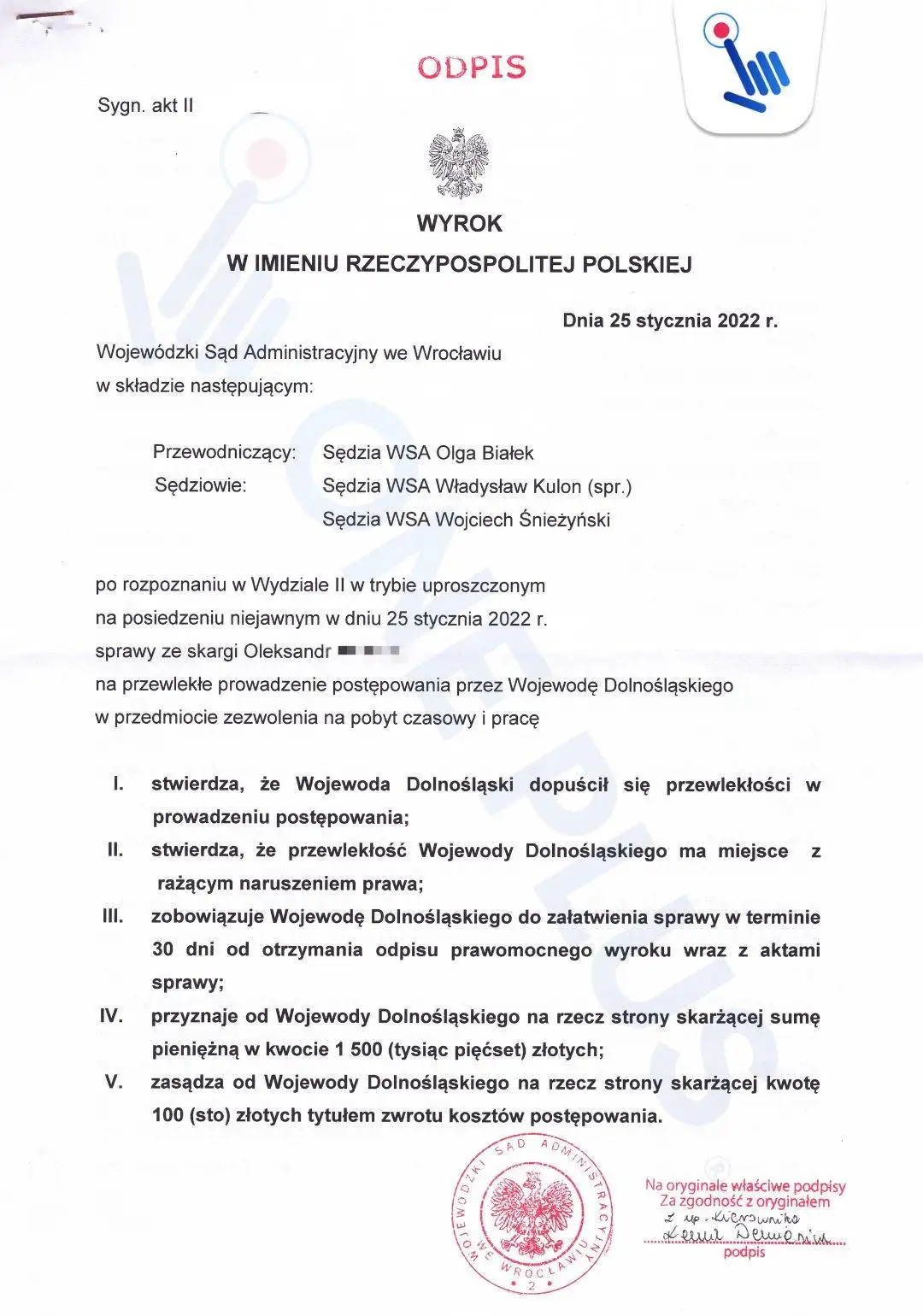
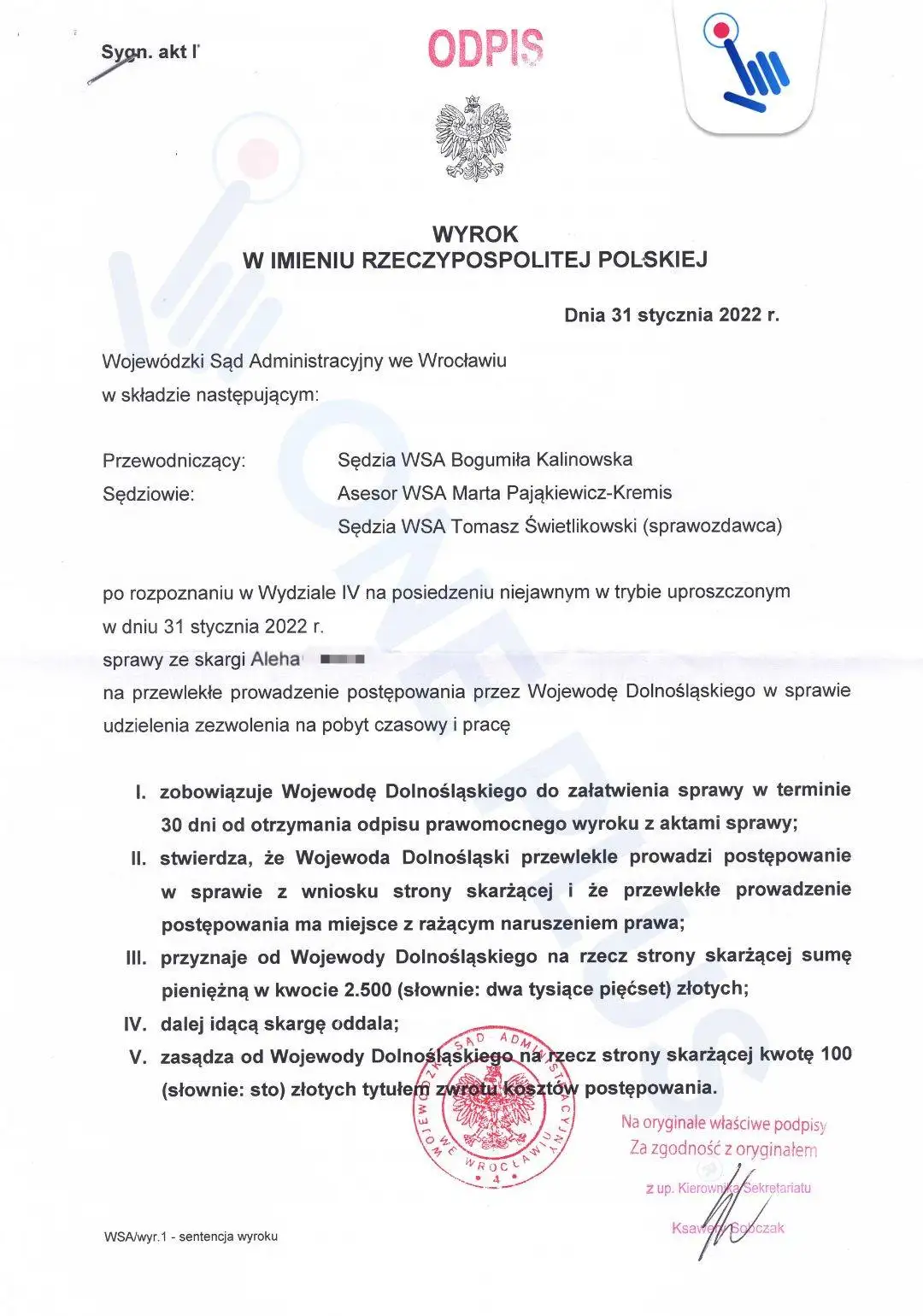
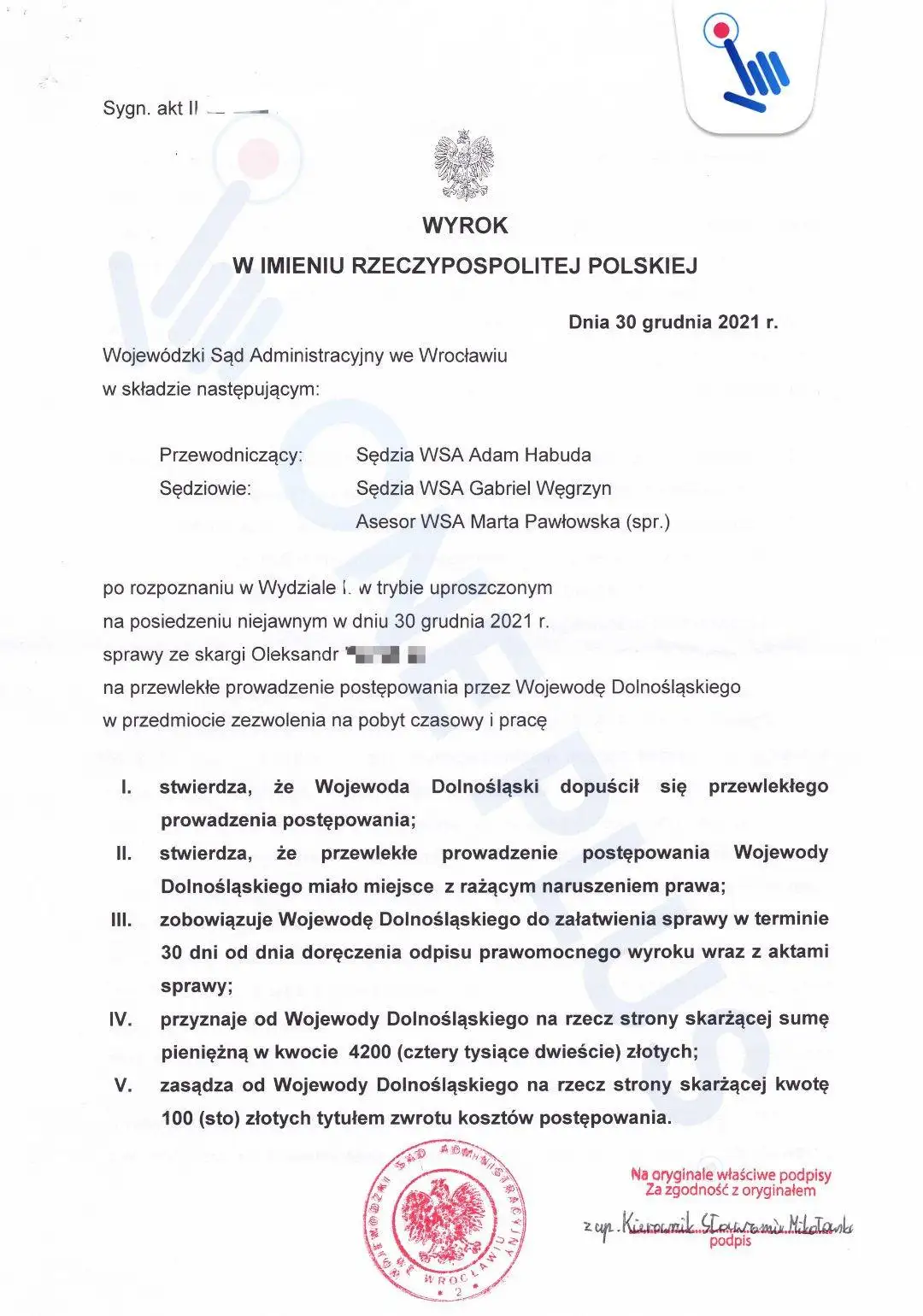
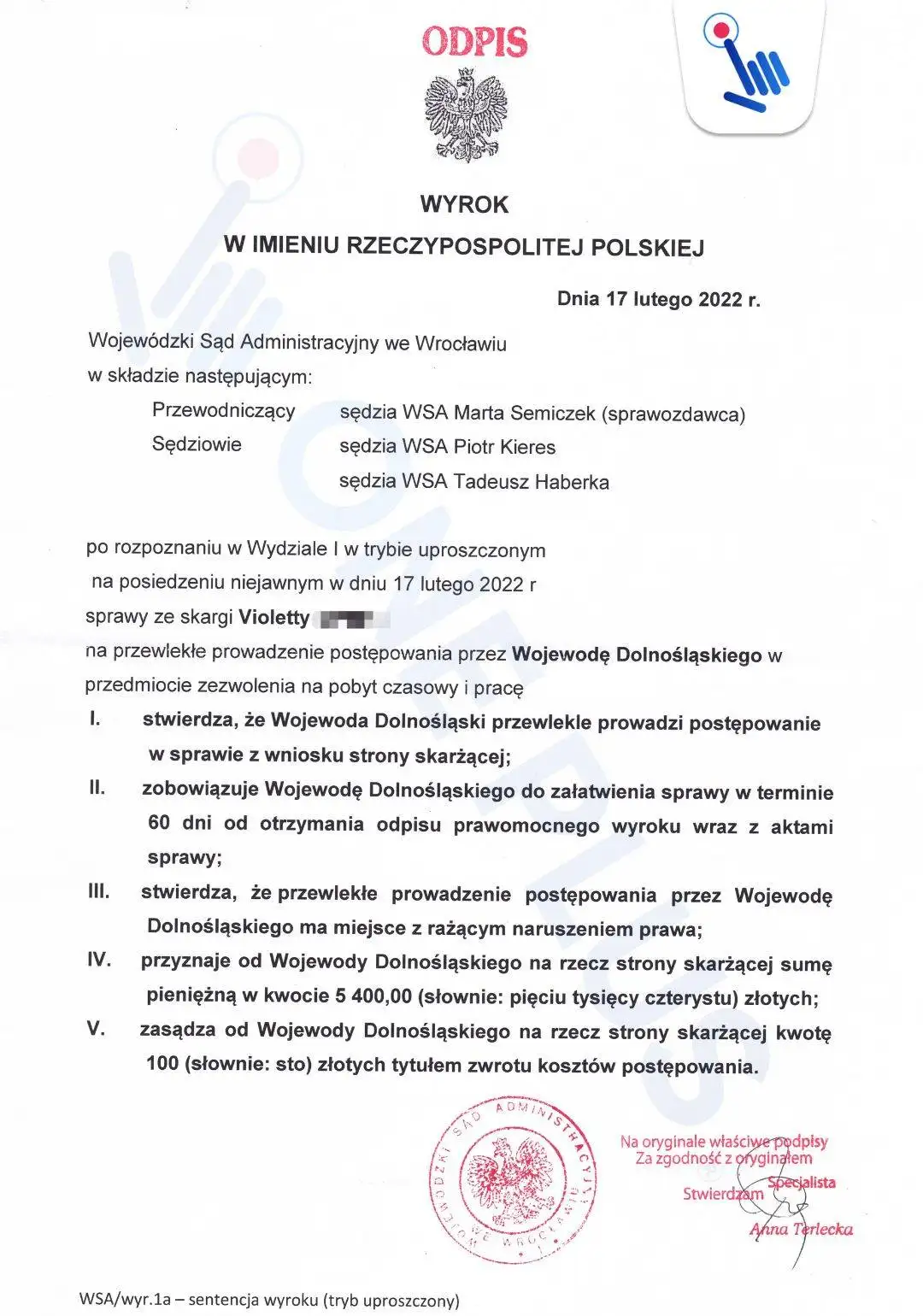
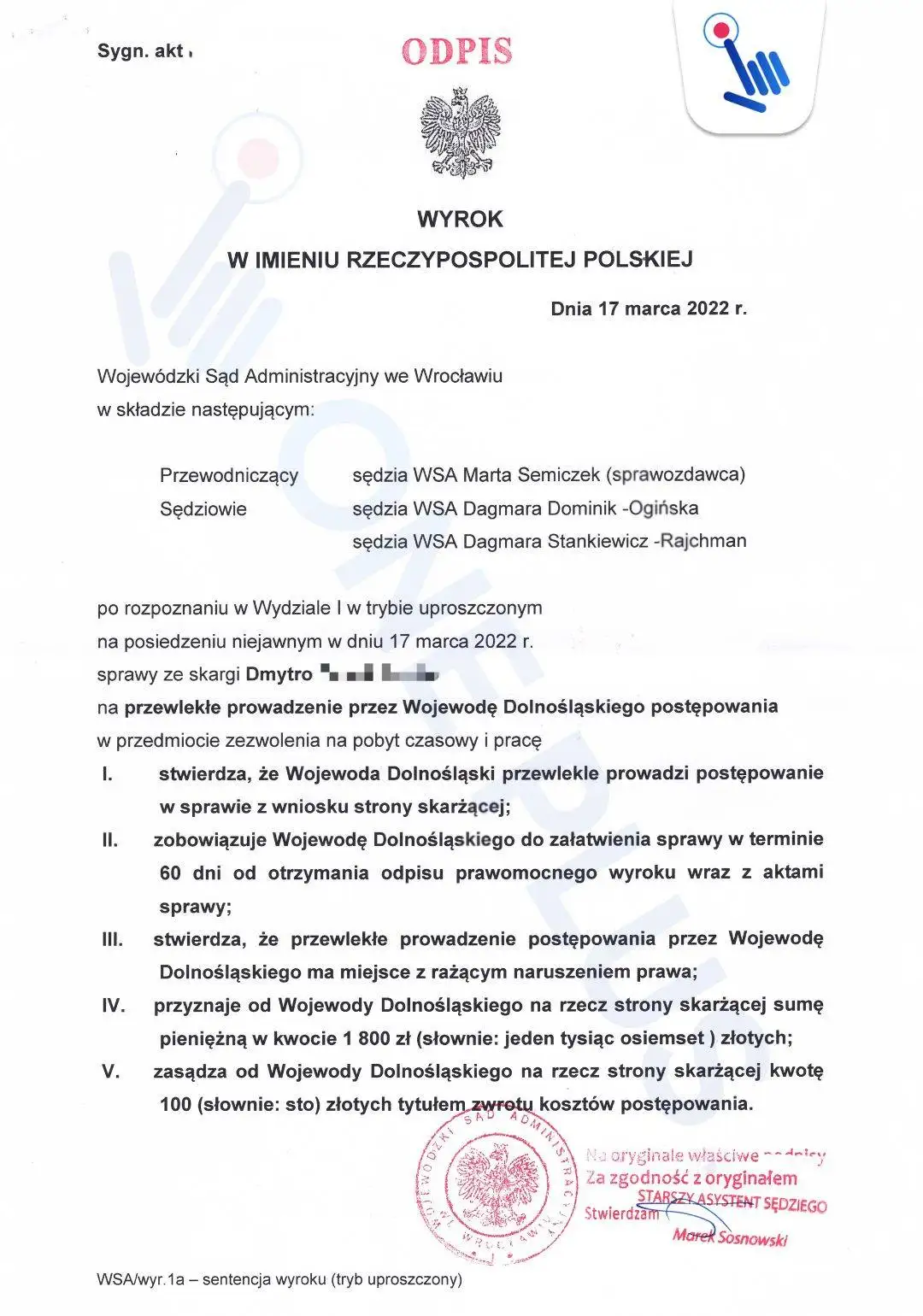
If the case is delayed, we can prepare a formal request for action. Where there are sufficient legal grounds, we may also file a complaint with the Voivodeship Administrative Court. If your application is refused, we review the reasons and prepare an appeal.
A practical timeline often starts at around eight months, although the actual waiting time depends on the relevant Voivodeship Office, the complexity of the case and whether further evidence is required. Government fees, sworn translations, notarial services, paid certificates and court costs are not included in the package price.
What is EU long-term resident status?
An EU long-term resident permit is a separate residence status for non-EU nationals who have built their lives in Poland and meet the legal requirements.
The permit is granted indefinitely. The physical residence card is valid for five years and must then be replaced. When replacing the card, you do not normally need to prove the original five-year residence period, income or Polish language level again.
This status is intended for people who have lived legally in Poland for several years and plan to remain here. Once it has been granted, you no longer need to renew a temporary residence permit every few years or continue relying on the same employment, business or family-based reason for your stay.
EU long-term resident status is not Polish citizenship. It also does not give you an automatic right to live and work permanently in every EU country. If you move to another Member State, you must follow its immigration rules, although a separate route may be available to recognised EU long-term residents.
Who can apply?
In most cases, you must have lived legally and continuously in Poland for at least five years immediately before submitting your application. Reaching five calendar years is not enough on its own.
You must also show that you have a legal, stable and regular income, valid health insurance and the legal right to live at your address. You will usually need recognised proof that your Polish is at least B1 level.
All requirements must be met at the same time. Five years of residence will not replace a valid B1 document, while a good salary at the time of filing will not make up for missing income evidence from previous years. The safest approach is to review the entire case before completing the application.
During an individual legal consultation, we can check your documents, calculate your qualifying residence period and explain what should be done before submission.
The five-year residence period
The five-year period is calculated backwards from the application date, not from the date of the future decision. The case officer examines the legal basis for every part of your stay in Poland.
The calculation may require visas, previous residence permits and decisions, old passports, border stamps and records of visa-free travel. The purpose of each stay, periods spent waiting for earlier decisions and any gaps between immigration statuses may also be relevant.
Not every period counts in full. Time spent in Poland on the basis of work, business activity, family reunification and many other permits may count fully. University study usually counts at half its actual length, so two years of residence for study may add only one year to the required period.
Some periods do not count at all. These may include temporary protection, certain short-term arrangements, intra-corporate transfers and other categories excluded by law.
Time spent in Poland solely under PESEL UKR temporary protection does not automatically count. If you later obtain a CUKR card or another residence permit, the new period must be assessed separately from the date on which that status began.
A mixed immigration history requires a detailed calculation. If you have used a visa, visa-free travel, PESEL UKR, a student permit, a work permit and periods of lawful stay while waiting for decisions, simply counting five calendar years will not give a reliable answer.
ONE PLUS prepares a complete residence timeline and checks it against the available evidence. This allows us to determine whether the five-year condition has been met and whether any period needs further explanation.
Time spent outside Poland
Continuous residence does not mean that you must remain in Poland for five years without travelling. Under the general rule, no single absence should exceed six months, while all absences during the five-year period should not exceed ten months in total.
Different limits may apply to some EU Blue Card holders. Depending on the applicant’s residence and mobility history, an absence of up to 12 consecutive months and up to 18 months in total may be permitted.
A longer absence does not always break continuous residence. An exception may apply if you worked abroad for an employer established in Poland, completed a compulsory placement connected with your studies or travelled because of exceptional personal circumstances. The reason and length of the absence must be supported by evidence.
The case officer may look beyond the stamps in your current passport. Previous passports, tickets, employer letters, medical records or written explanations may be required. If you have travelled frequently, prepare a detailed record of every departure and return before applying.
Income requirements
Your income must be legal, stable and regular. The Voivodeship Office checks whether you can support yourself and any dependent family members without relying on social assistance.
In a standard case, income is reviewed for the three years immediately before the application and may continue to be assessed while the case is pending. A two-year review period may apply to a category of highly qualified workers defined by law.
In 2026, the minimum threshold is more than PLN 1,010 net per month for a person living alone and more than PLN 823 net per month for each person in a family. These figures are only the starting point. The authority also checks the source of the income, how regularly it was received and whether the supporting records are consistent.
Evidence may include PIT returns, employment or civil-law contracts, ZUS records, employer certificates and proof of payment. Together, these documents should present a clear and accurate picture of your financial position over the relevant period.
Minor changes in monthly income do not automatically lead to refusal. Problems are more likely when there were long periods without work, earnings fell below the required threshold, payments were undeclared or the contracts, tax records, social insurance data and bank transfers do not match.
Income does not have to come only from an employment contract. Depending on the circumstances, earnings from a civil-law contract, business activity, a company role or another lawful source may be accepted. The key question is whether the documents prove that the income was genuine, regular and sufficient.
Using your spouse’s income
In some cases, the income requirement can be met using the earnings of a husband or wife. This may be possible when the spouses live together, share a household and their matrimonial property arrangements allow their income to be considered jointly.
The application may then require a marriage certificate, the spouse’s tax returns, contracts, proof of payment, social insurance records and information about the household. If the spouses have separate property arrangements or do not live together, the situation must be assessed individually.
Before filing, ONE PLUS checks whose income can be relied on and whether the evidence is sufficient to present the family’s financial position clearly.
Proof of Polish at B1 level
Applicants normally need recognised proof of Polish at B1 level or above. Living in Poland for several years, speaking Polish with the case officer or presenting a certificate from an ordinary language school is not enough.
Accepted evidence may include a state B1 certificate, another certificate included in the current official list, a Polish school certificate where the language of instruction was Polish or a degree from a Polish university completed in Polish. In some cases, education completed in Polish outside Poland may also be accepted.
A certificate from a post-secondary school is no longer treated as standard proof of Polish for new applications. The type of document, its issue date and the rules in force when you apply should be checked carefully.
Applicants who are under 16 on the date of filing are exempt from the B1 requirement. Everyone else should secure suitable evidence well in advance, as waiting for an examination and the final certificate can take several months.
Health insurance and accommodation
You must have health insurance that gives you access to necessary medical treatment in Poland. This may be public insurance through employment or business activity, voluntary public insurance or a suitable private policy.
An insurance card or policy number alone may not be sufficient. The Voivodeship Office may ask for current ZUS confirmation, proof that contributions have been paid, evidence of registration for insurance or the full terms of a private policy.
You must also prove that you have the legal right to live at the address stated in the application. This may be shown through a tenancy agreement, ownership records, a loan-for-use agreement or another document that gives you the right to occupy the property.
The document should be current and clearly identify the parties, address and duration. If it was signed by someone other than the owner, the case officer may ask for evidence that the person had authority to provide the accommodation.
Documents for the application
The exact list depends on your residence history, sources of income, family circumstances and how you prove your Polish language level. A typical application may require:
- a completed application in MOS 2.0;
- a valid passport and copies of all relevant pages;
- previous passports, visas, residence cards and decisions;
- evidence covering the full five-year residence period;
- a complete record of travel outside Poland;
- PIT returns, contracts, employer certificates and ZUS records;
- proof of valid health insurance;
- evidence of your legal right to live at your address;
- a B1 certificate or another accepted language document;
- proof that the government fee has been paid;
- family documents where they affect the income calculation.
Documents issued in another language generally need to be submitted with a Polish translation prepared by a sworn translator. ONE PLUS can arrange sworn translations and check that the translated documents are consistent with the rest of the application.
A large number of unorganised scans will not make an application stronger. The file should clearly prove the five-year residence period, absences, income, insurance, accommodation and language requirement.
Applying through MOS 2.0
Applications for EU long-term resident status are submitted electronically through MOS 2.0.
You must create your own account, verify your identity through the government login system, complete the form in Polish and upload the required files. Once everything has been checked, you must sign and submit the application electronically yourself. The system will then issue an official confirmation of receipt.
A representative can prepare the form and review the supporting documents but cannot log in or use your electronic signature on your behalf. You should never share your login details or electronic identification methods with another person.
ONE PLUS helps prepare your MOS 2.0 residence application, checks every field and attachment, and guides you through the signing and submission process.
After an initial review, the Voivodeship Office will arrange an in-person appointment. You will need to present your original passport and other requested documents, provide fingerprints and submit a specimen signature.
What happens after filing?
The Voivodeship Office checks whether the formal requirements have been met and whether the evidence proves each condition. If anything is missing or unclear, the case officer will send an official request and set a deadline for your reply.
The request may relate to income, insurance, accommodation, travel, an earlier period of residence or the B1 document. If the proceedings take a long time, the office may also ask for an updated contract, a new employer certificate, current social insurance records or recent proof of address.
A request for additional evidence does not necessarily mean that the original application was incorrect. Some documents need to be updated because the applicant’s circumstances have changed or the case has been pending for several months. The important thing is to understand the request, provide a complete response and meet the deadline.
ONE PLUS monitors official correspondence, prepares replies and checks each document before it is sent to the case officer. If your employment, income, address, insurance or family circumstances change, we explain what needs to be reported and how it may affect the case.
Legal stay while waiting
If you apply no later than the final day of your lawful stay and correct any formal deficiencies within the required time, your stay in Poland may remain legal until the proceedings are finally concluded.
The electronic filing receipt is not a visa, residence card or travel document. Before leaving Poland, check whether your passport, visa-free allowance, valid residence card or another legal basis will allow you to return.
Your right to work must also be checked separately. A lawful stay while waiting for the decision does not always authorise you to begin work for a new employer or continue working after your employment conditions have changed.
Applying in Wroclaw
Applications from people living in Wroclaw and the Lower Silesian Voivodeship are handled by the Lower Silesian Voivodeship Office in Wroclaw. After electronic filing, the office will provide information about your in-person appointment and the original documents you need to bring.
Your application should allow the case officer to understand your full residence history without having to reconstruct it from unrelated documents. It should clearly show your legal basis of stay, which periods count towards the required five years, when you travelled and how you meet the income, insurance, accommodation and language requirements.
ONE PLUS is based in Wroclaw and regularly handles cases before the Lower Silesian Voivodeship Office. We also assist clients throughout Poland. Outside Lower Silesia, the application is decided by the Voivode responsible for the applicant’s actual place of residence.
How we manage your case
We begin by reviewing your previous decisions, residence cards, visas, passports, waiting periods, employment history and travel. We then prepare a complete timeline and determine which periods can be included in the five-year calculation.
Next, we examine your income. We compare tax returns, contracts, social insurance records and actual payments. If there were periods without work, changes of employer or several sources of income, we decide how they should be documented and explained.
We review your B1 evidence, health insurance and right to occupy your home separately. You receive a personalised document list explaining what must be obtained from your employer, ZUS, the tax office, an educational institution or another authority.
Once the file is ready, we complete the MOS 2.0 application and check every attachment. You log in, sign and submit the form yourself. Depending on your package, we then monitor correspondence, prepare replies and update supporting documents when required.
After a favourable decision, we explain how to pay for and collect the residence card. If the application is refused, we review the reasons and assess whether there are grounds for an appeal. The final decision is made by the competent authority, so no result can be guaranteed before the entire case has been examined.
Reasons for delays or refusal
A common mistake is counting five calendar years without checking the legal basis for each period. After filing, an applicant may discover that study counts only at half its length, temporary protection does not count or there was an undocumented gap between two permits.
Travel calculations can cause similar problems. Even when each trip was short, the total time spent outside Poland may exceed the permitted limit. Missing previous passports or insufficient evidence for a particular journey can also make continuous residence difficult to prove.
Income-related requests often result from differences between tax returns, ZUS records, contracts and bank payments. The case officer may also examine months without earnings, unpaid leave, changes of employer or undeclared payments.
Other problems include an unacceptable B1 document, expired insurance, an unsuitable accommodation agreement and incomplete scans. Some issues can be corrected during the proceedings, but in other cases it is safer to obtain the missing evidence or wait until every requirement has been met before applying.
Benefits of the permit
The permit allows you to live in Poland indefinitely and work without a separate work permit. Because the status is not tied to one employer, you can change jobs without applying for a new employment-based residence permit.
You may also register as a sole trader and run a business under the rules available to long-term residents. You will not need to renew a temporary residence permit every few years or continue proving the same original reason for your stay.
A valid residence card and passport allow short visits within the Schengen Area under the 90-days-in-180 rule. Moving permanently to another EU country still requires a local permit, although EU long-term resident status may give you access to a separate immigration route there.
The permit does not guarantee a mortgage, bank loan, social benefits or permanent residence in another country. Banks and public authorities assess these matters separately.
Long-term resident or permanent residence?
Both permits are indefinite, but they have different eligibility rules.
EU long-term resident status usually suits someone who has lived legally in Poland for at least five years and can prove stable income, health insurance, accommodation and Polish at B1 level. The physical residence card is valid for five years.
A Polish permanent residence permit is granted on a specific legal basis, such as a valid Karta Polaka, Polish ancestry, marriage to a Polish citizen or another ground defined by law. There is no single five-year residence rule or three-year income review that applies to every permanent residence category. The physical card is valid for ten years.
The right option depends on your documents, immigration history and plans. Before filing, it is worth comparing every available route and choosing the one supported by the clearest evidence.
EU Blue Card holders
Special residence and absence rules apply to some EU Blue Card holders. In certain cases, periods spent under an EU Blue Card in other Member States can be included in the five-year calculation.
Additional conditions must still be met, including a required period of residence in Poland immediately before applying. If you have held EU Blue Cards in more than one country, your complete timeline and each national permit must be reviewed.
Fees and processing time
The government fee for considering the application is PLN 640. A further PLN 100 is payable for the physical residence card. If you appoint a representative, a PLN 17 fee for the power of attorney will usually apply. Sworn translations, notarial services and paid certificates are charged separately.
The statutory processing period may be up to six months, but it does not always begin when the electronic application is submitted. The in-person appointment, fingerprints, correction of formal deficiencies and submission of all evidence required to confirm eligibility may affect when the period starts.
Actual waiting times depend on the workload of the Voivodeship Office and the complexity of the case. A decision date cannot be guaranteed. A complete, well-organised application will not produce an immediate decision, but it can prevent avoidable requests and delays.
Polish citizenship later
EU long-term resident status may support a future application for Polish citizenship, but citizenship is not granted automatically.
The available route and required residence period depend on continuous residence, family circumstances, income, accommodation and the citizenship procedure used. Official proof of Polish language ability is also required when applying for recognition as a Polish citizen.
If Polish citizenship is part of your long-term plan, it is worth considering the future requirements while preparing your EU long-term resident application. ONE PLUS also provides support with Polish citizenship applications.
Get help with your application
If you have lived in Poland for around five years, start with a detailed review of your immigration history. ONE PLUS will determine whether you have enough qualifying residence, whether your absences are within the permitted limits, whether your income meets the requirements and which documents still need to be obtained.
We prepare the MOS 2.0 application, review every attachment, help you get ready for the in-person appointment and, depending on your package, manage correspondence with the case officer until the decision. We work from Wroclaw and assist clients throughout Poland.
Contact ONE PLUS for a clear application plan and an objective assessment of your eligibility for EU long-term resident status in Poland.
Book a consultation






 4,7
4,7