Poland Residence Guide for UK & Irish Citizens 2026

Residence in Poland for UK and Irish Citizens
Poland remains a popular destination for people moving from the United Kingdom and Ireland. It offers a strong labour market, growing business opportunities, competitive living costs and convenient access to the rest of Europe.
However, British and Irish citizens follow different immigration procedures. Ireland is a member of the European Union, so Irish citizens benefit from EU freedom of movement. Since Brexit, most UK citizens have been treated as third-country nationals. Separate rules apply to British citizens and their family members who are protected by the EU–UK Withdrawal Agreement.
Understanding which rules apply to you is the first step towards living and working legally in Poland and planning your long-term residence.
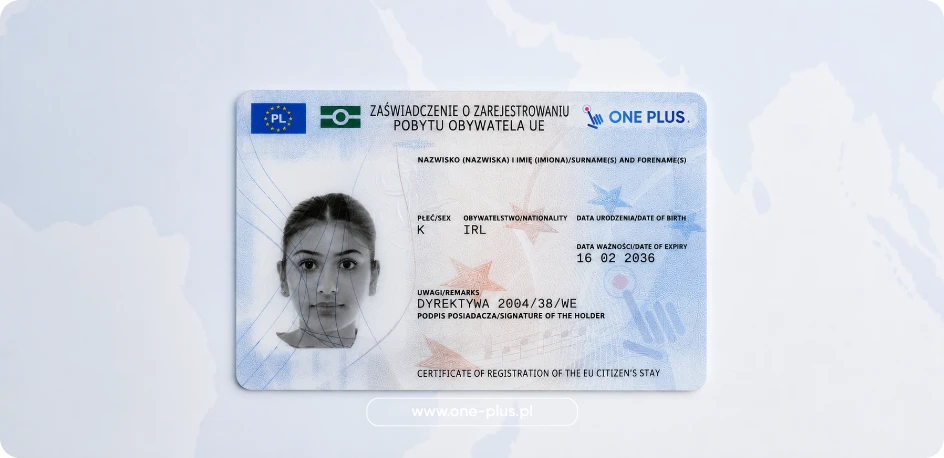
The term Temporary Residence Card, or TRC, is often used informally to describe both a temporary residence permit and the residence card issued after approval. Irish citizens do not normally apply for a standard TRC because they follow the EU residence registration procedure.
Residence Rights of Irish Citizens in Poland
Irish citizens can enter Poland using a valid Irish passport or Passport Card. They may live, work, study or run a business in Poland without obtaining a work permit.
Staying in Poland for Up to Three Months
A stay of up to three months does not normally require residence registration. A valid Irish passport or Passport Card is sufficient.
During this period, an Irish citizen may look for accommodation, start work, register a business or complete other formalities connected with moving to Poland.
Staying in Poland for More Than Three Months
Irish citizens planning to remain in Poland for longer than three months must register their residence as an EU citizen with the Voivodeship Office responsible for their place of residence.
EU citizen registration is not the same as a temporary residence permit. The certificate confirms a right of residence that already exists under EU law. Registration itself does not create that right.
Grounds for EU Citizen Registration
An Irish citizen may register their residence on the basis of:
employment in Poland;
self-employment or business activity;
sufficient financial resources and valid health insurance;
studies or vocational training with sufficient funds and health insurance;
marriage to a Polish citizen;
residence as an eligible family member of an EU citizen.
The required documents depend on the selected ground. An employee will usually need an employment contract or confirmation from their employer. A self-employed person may need company registration documents and evidence that the business is active. Students normally provide confirmation from their university, health insurance and proof of sufficient funds.
After five years of legal and continuous residence, an EU citizen generally acquires the right of permanent residence in Poland and may apply for a document confirming this status.
Residence Rights of UK Citizens After Brexit
The rules for British citizens depend mainly on when and under what conditions they began living in Poland. There are two principal routes.
UK Citizens Protected by the Withdrawal Agreement
British citizens may qualify under the EU–UK Withdrawal Agreement if they exercised their right of residence in Poland under EU law before the end of the transition period on 31 December 2020 and have continued to live in Poland.
Eligible beneficiaries retain important rights connected with residence, employment and self-employment. These rights arise directly from the Withdrawal Agreement. However, obtaining the appropriate Polish residence document makes it much easier to prove the holder’s status to employers, authorities, banks and border services.
A British citizen who has completed five years of qualifying continuous residence may be entitled to permanent residence under the Withdrawal Agreement.
Anyone relying on this route should keep documents confirming their residence in Poland before the end of 2020 and their continued stay after that date. Employment records, tenancy agreements, tax documents, insurance records and previous registration certificates may all be relevant.
UK Citizens Who Moved to Poland After 31 December 2020
British citizens who moved to Poland after the Brexit transition period, or who do not qualify under the Withdrawal Agreement, are treated as third-country nationals.
They may normally visit Poland and the wider Schengen Area without a visa for up to 90 days in any 180-day period. Visa-free entry does not automatically give them the right to work in Poland.
A British citizen planning to stay in Poland for longer than 90 days will usually need an appropriate visa or residence permit in Poland. The correct route depends on the purpose of the stay, such as employment, business activity, studies or family life.
Residence Permit Applications Through MOS 2.0
Since 27 April 2026, standard applications for temporary residence, permanent residence and EU long-term resident status must generally be submitted electronically through the new MOS system.
A standard paper application that was not received by the relevant Voivodeship Office before 27 April 2026 will generally be left without consideration, even if it was posted earlier. The posting date is not taken into account.
Limited exceptions apply to certain categories, including some applications submitted for a person who is currently outside Poland.
For most British citizens applying from within Poland, the procedure now begins with an electronic residence permit application through MOS 2.0.
How the MOS 2.0 Process Works
The applicant must create a new account in MOS 2.0. Accounts from the previous version of MOS were not transferred to the new system.
The applicant then logs in personally through login.gov.pl, completes the appropriate form and uploads the required documents. The application must be signed using a Trusted Profile, qualified electronic signature or personal signature.
Login details and electronic signature credentials should never be shared with an adviser or representative. Professional support may include preparing the form, checking the information and organising the attachments, but the applicant must personally log in and sign the application.
Depending on the type of residence permit, another person or organisation may also need to complete and electronically sign an attachment. This may be:
an employer for a temporary residence and work permit;
an employer for an EU Blue Card application;
a university for a student residence permit;
an organisation hosting a trainee or volunteer.
The applicant enters the organisation’s email address in MOS 2.0. The system then sends a link that allows the relevant attachment to be completed and signed electronically.
Once the application has been correctly completed, signed and submitted, the applicant receives an Official Confirmation of Receipt, known as UPO. The application can also be downloaded in PDF and XML formats.
After the Voivodeship Office has completed its initial verification, the applicant may be asked to attend an appointment to:
provide fingerprints;
present the original passport;
provide a specimen signature;
show the original documents;
submit missing information or additional evidence.
After the application has been verified and accepted, the applicant may be able to download a certificate confirming that the residence application was submitted. This certificate replaces the passport stamp previously used to confirm a pending application.
If the application is submitted no later than the final day of the applicant’s legal stay and any formal deficiencies are corrected within the required deadline, the applicant’s stay in Poland may remain legal while the case is pending.
However, a pending residence application does not automatically allow the applicant to travel freely throughout the Schengen Area or return to Poland after leaving. It also does not automatically grant the right to work. The right to work must be assessed separately.
Common Grounds for Temporary Residence
Employment
A British citizen working for a Polish employer may apply for a temporary residence and work permit.
The application must show that the employment is genuine and that the contract, salary, working hours, position and place of work comply with Polish law. The information entered by the applicant must match the employer’s electronic attachment in MOS 2.0.
Employment may be based on an employment contract or an eligible civil-law contract. B2B cooperation is normally connected with business activity rather than the standard temporary residence and work procedure.
Business Activity
A business-based residence permit may be available to entrepreneurs, shareholders, company directors, management board members and certain commercial proxies.
Registering a company in Poland is not enough on its own. The applicant must usually show that the business is genuinely operating or has a realistic ability to meet the statutory economic requirements.
The Voivodeship Office may examine the company’s revenue, employees, investments, contracts, business plan and financial position.
Family Residence
Depending on the applicant’s circumstances, a residence permit may be available on the basis of:
marriage to a Polish citizen;
marriage to a foreign national legally residing in Poland;
family reunification;
family life with a Polish or EU citizen;
other legally recognised family circumstances.
The exact procedure depends on the nationality and residence status of the family member in Poland.
A marriage certificate alone may not always be sufficient. The Voivodeship Office may examine whether the relationship is genuine and whether the couple actually shares a family life.
Studies
British citizens admitted to a recognised Polish university may apply for a temporary residence permit for studies.
The university completes the relevant electronic attachment in MOS 2.0. The applicant must also provide confirmation of admission, proof of tuition payment where applicable, health insurance and evidence of sufficient financial resources.
Documents Required for a Residence Permit
The exact list of documents depends on the purpose of residence. A standard MOS 2.0 application may require:
a valid passport;
a digital biometric photograph;
scans or clear photographs of every page of the passport;
proof of payment of the stamp duty;
proof of payment for the residence card;
documents confirming the purpose of residence;
the relevant electronically signed attachment;
proof of health insurance, where required;
proof of sufficient financial resources, where required;
documents confirming family circumstances, business activity or accommodation, if relevant.
Uploading documents through MOS 2.0 does not always remove the need to present the originals. The Voivodeship Office may ask to inspect them during a personal appointment.
Documents issued outside Poland may require a sworn translation into Polish. Depending on the country of issue and the type of document, an apostille or legalisation may also be necessary.
Polish Criminal Record Certificate
A certificate from the National Criminal Register, known in Polish as Krajowy Rejestr Karny or KRK, confirms whether a person has entries in the Polish criminal register.
A criminal record certificate is not a standard mandatory attachment to every residence permit application. However, it may be required in individual immigration cases, regulated professions, employment screening, licensing procedures or applications submitted to authorities outside Poland.
A Polish Criminal Record Certificate can be obtained:
in person at a KRK information point;
electronically through the e-KRK system;
by post;
through an authorised representative.
The correct format depends on where the document will be used. Polish authorities may accept the electronic version, while a foreign employer, embassy or immigration authority may require a paper original, an apostille and a certified translation.
A paper certificate requested in person may sometimes be issued on the same day. Postal applications and cases involving a representative, apostille, translation or international delivery usually take longer.
ONE PLUS assists British and Irish clients with obtaining KRK certificates, arranging apostilles where required, preparing sworn translations and delivering completed documents abroad.
Common Mistakes to Avoid
The most frequent problems include:
assuming that British citizens are still treated as EU citizens;
applying for a residence permit when EU citizen registration is the correct procedure;
trying to register an Irish citizen’s residence through MOS 2.0;
submitting a standard paper residence application after the introduction of MOS 2.0;
relying on the posting date of a paper application;
attempting to use an account from the previous MOS system;
waiting until the final day of legal stay before submitting the application;
uploading incomplete or unreadable passport scans;
entering information that does not match the employer’s attachment;
failing to obtain the employer’s electronic signature in time;
treating visa-free entry as permission to work;
selecting the wrong legal basis for residence;
failing to plan for permanent residence or citizenship.
These mistakes may delay the proceedings, result in requests for additional documents or cause the application to be left without consideration.
Planning a Long-Term Residence Strategy
A residence application should not be treated as an isolated formality. The legal basis chosen today may affect access to the labour market, the ability to change employers, future family applications and eligibility for permanent residence or Polish citizenship.
A proper residence strategy should take into account:
the applicant’s nationality and immigration status;
the date and legal basis of their arrival in Poland;
possible protection under the Withdrawal Agreement;
employment or business plans;
family circumstances;
previous periods of residence;
time spent outside Poland;
long-term plans for permanent residence or citizenship.
For Irish citizens, the long-term process usually begins with EU citizen residence registration. For most British citizens who arrived after Brexit, it begins with a temporary residence permit submitted through MOS 2.0.
Why an Individual Case Assessment Matters
No two immigration cases are identical. A person’s residence history, employment arrangement, company structure, family situation and future plans can change both the correct procedure and the required documents.
This is particularly important for British citizens whose residence may fall under the Withdrawal Agreement, as well as for applicants deciding between employment, business and family-based residence.
Reviewing the case before submitting an application helps identify the correct legal route, prepare consistent documents and avoid unnecessary delays.
ONE PLUS supports UK and Irish citizens with EU residence registration, MOS 2.0 applications, residence permits, KRK certificates and long-term residence planning in Poland.
