

Since 2018
For over 8 years, we've helped clients navigate Polish law, combining our solid legal knowledge with practical immigration experience.
If you are planning to apply for a visa, travel to Poland, return to Europe after a previous immigration issue, or enter any Schengen country, it is important to know in advance whether there is an entry ban or alert connected with your personal data.
Many people discover the problem too late. It may happen at the consulate, during visa processing, at the airport, at the border, or after flights and accommodation have already been paid for. In some cases, the person does not even know that an old deportation decision, return decision or immigration violation may still be visible in the Schengen system.
SIS, or the Schengen Information System, is an official European information system used by Schengen countries. It may contain alerts concerning people who are refused entry or stay in the Schengen Area. Such an alert may be connected with deportation, a return decision, an entry ban, overstaying, unlawful work, administrative proceedings, criminal matters or other grounds assessed by state authorities.
ONE PLUS helps foreigners obtain official information from SIS and check whether their personal data appears in the Schengen database. We provide this service remotely, so the client does not need to come to Poland in person. This is especially useful if you are currently abroad and want to check your situation before applying for a visa, planning a trip to Europe or trying to enter the Schengen Area again.
SIS-related matters at ONE PLUS are reviewed by our team of immigration specialists. In more complex cases, the analysis may involve Tatiana Vyborna, immigration lawyer at ONE PLUS, who has practical experience in cases involving deportation from Poland, entry bans, residence permits and administrative procedures for foreigners.
SIS is not a public website where you can simply type in your name and immediately see a result. It is a restricted European information system used by authorized authorities in Schengen countries. Border guards, police, consular services, immigration authorities and other state institutions may access SIS within the scope of their legal powers.
For foreigners, the most important SIS alerts are usually those connected with refusal of entry or stay. If such an alert exists, it may lead to a visa refusal, refusal of entry at the border or additional problems during document checks in Europe.
In practice, SIS alerts are often linked to return decisions, deportation from Poland, overstaying in the Schengen Area, unlawful employment, unpaid fines, previous administrative proceedings or other situations that became the legal basis for entering the person’s data into the system.
Sometimes the person knows about the decision. Sometimes they only remember that there was a problem at the border or with their stay in Poland, but they do not know whether the ban is still valid, whether it applies only to Poland or whether it affects the whole Schengen Area.
That is why obtaining information from SIS is so important. It allows you to stop guessing and get an official answer that can be analyzed before you take the next step.
A SIS check is not only for people who are sure they were deported. Many clients contact us because they are not sure what happened in the past or whether an old entry ban is still active.
You should consider checking SIS if you previously had a deportation from Poland, a return decision, a visa refusal, a refusal of entry, overstayed in the Schengen Area, worked without proper documents or had any immigration-related issue in Poland or another European country.
It is also worth checking SIS before applying for a new visa, before traveling to Poland or another Schengen country, before accepting work in Europe, before rejoining family members in Poland, or simply before buying tickets if you are not sure whether you can enter safely.
This is particularly important if you are outside Poland. A failed trip may mean lost money, stress at the border and a new negative event in your immigration history.
There is no full public online search for SIS. The Schengen Information System is not open to the public. Any service promising an instant “SIS check in 5 minutes” should be treated carefully, because an official SIS check requires a formal legal procedure.
The legal route is different. A person has the right to request information about whether their personal data is being processed in SIS. To do this, it is necessary to prepare an official request, confirm identity, provide correct personal data and submit the request through the appropriate legal channel.
ONE PLUS helps clients complete this procedure remotely. We explain what information is needed, prepare the request, assist with the power of attorney, submit the documents in Poland and monitor the response. The client may be located in Ukraine, Belarus, Georgia, Moldova, Kazakhstan, Uzbekistan, Turkey, the United Kingdom, the United States, Canada or another country.
After submitting the request, the client may receive an official response. The content of the response depends on the situation, the type of alert, the authority responsible for the data and the legal limits on disclosure.
In simpler cases, the response may confirm that the person’s data is not stored in the system for the purpose of refusing entry. If an alert exists, the response may include information about the duration of the entry, the legal basis and the authority connected with the alert.
However, not every answer will contain full details. In some cases, the authority may limit the information if disclosure could affect public security, ongoing proceedings, investigations, state interests or the rights of other persons. This is why it is not enough to simply receive the document. It must also be interpreted correctly.
ONE PLUS explains what the official response means in practice. We help the client understand whether they can apply for a visa, whether they can plan a trip, whether there is a risk of refusal, whether the data should be removed, or whether the situation must first be resolved through a deportation or entry ban procedure.
Many clients contact ONE PLUS after they have already left Poland. They are abroad, do not have a Polish address, cannot appear before the authority in person and do not know how to obtain an official document.
In such situations, ONE PLUS helps organize the procedure remotely. We can prepare the request, power of attorney and correspondence in a way that allows the client to avoid traveling to Poland only to check SIS.
This is useful if you are preparing a visa application, planning to return to Europe, considering employment in Poland, joining family members, starting studies, opening a business or simply checking whether you may face problems at the border.
The process begins with a review of your situation. We first clarify why you need the SIS check: before a visa application, before travel, after deportation, after refusal of entry, or because you want to remove data from the system.
Then we review the documents and information available. In some cases, a passport and basic travel history are enough to start. In more complex cases, we may need to analyze a deportation decision, visa refusal, return decision, previous residence card, old visas, travel dates, fines or letters from state authorities.
After that, we prepare the request and, if necessary, the power of attorney for representation in Poland. Once the request is submitted, we monitor correspondence and wait for the official response. When the document is received, the client gets not only a scan or copy of the answer, but also an explanation of what it means for their specific situation.
This approach is especially important when the matter is not just a simple check, but involves deportation, an active entry ban, an old SIS alert or possible removal of personal data from the system.
If you plan to apply for a visa to Poland or another Schengen country, checking SIS in advance may help you avoid another refusal.
A consulate may refuse a visa if there is an alert in SIS connected with refusal of entry. The applicant may not always understand which alert caused the problem or whether it can be removed.
A SIS check before a visa application helps identify the risk before documents are submitted. If there is no alert, the client can apply with greater confidence. If an alert exists, it may be necessary to first understand its legal basis, duration and whether there is a possibility to remove or correct the data.
This is much safer than submitting a visa application blindly and receiving another refusal.
Checking the Schengen database may also be important before traveling to Poland, Germany, Czechia, France, Spain, Italy, the Netherlands or any other Schengen country.
If there was deportation, overstaying, refusal of entry or another immigration issue in the past, waiting until the border check is risky. At the border, there is little time, more stress and usually no possibility to calmly explain the entire situation.
By obtaining information from SIS in advance, you can understand whether an alert exists, whether the ban is still valid, whether a separate procedure is needed and whether the trip can be planned safely.
Deportation from Poland is often connected with an entry ban. Depending on the decision, this ban may apply only to Poland or may affect entry into the Schengen Area more broadly.
Common reasons for deportation or return decisions include overstaying, lack of a valid visa or residence card, unlawful work, violation of stay conditions, unpaid fines, administrative return proceedings or other legal grounds.
If you were deported from Poland, the first step is to obtain and analyze the documents. It is necessary to understand which authority issued the decision, how long the ban lasts, whether the data was entered into SIS, whether the ban has already expired and whether there are grounds to remove the data or reduce the consequences.
ONE PLUS helps clients deal with such cases. We do not use one template for every situation. Each deportation case has its own background. One client may have overstayed. Another may have worked without proper documents. A third may have received a return decision. Another may have family, work or residence circumstances that should be analyzed separately.
Yes, in some cases SIS data can be removed or corrected. But first, it is necessary to understand whether an alert exists, who entered it, on what legal basis and whether it is still valid.
Removal of data may be considered if the entry ban has expired, the grounds for keeping the data no longer exist, the original decision was revoked or changed, the data was entered incorrectly, the information is incomplete or outdated, or the storage of the data violates the law.
Sometimes the first step is not removal, but obtaining information. In other cases, the data must be corrected. Sometimes it is necessary to challenge the original decision, such as a deportation decision or an entry ban.
The correct strategy depends on the documents and the person’s history. ONE PLUS helps determine which path is suitable: obtaining information, correcting data, removing the alert, analyzing deportation or preparing a separate legal application.
If the client has a deportation from Poland or an entry ban, ONE PLUS can analyze whether it is possible to cancel, reduce the consequences or request removal of data from SIS.
It is important to understand that not every ban can be removed automatically. The legal basis of the decision, duration of the ban, the person’s conduct after the decision, payment of fines, family circumstances, work, current status and other facts may all be relevant.
In some cases, there are real grounds to apply. In other cases, it may be necessary to wait until a certain stage. Sometimes evidence must be collected first, fines must be paid or documents must be restored. In more complex cases, a separate legal strategy may be needed.
ONE PLUS helps the client understand whether the procedure makes sense and which actions may lead to a practical result.
For an initial SIS check, the most important information usually includes passport data, a scan of the passport, nationality, date of birth, current address and information about previous visas, travel history, refusals, deportation or return decisions.
If you still have documents related to deportation, refusal of entry or visa refusal, they should be reviewed before submitting the request. If you do not have those documents, we can still start with an analysis of the situation and identify which information may be used in the request.
Correct personal data is essential. Mistakes in name spelling, transliteration, passport number or previous documents may make the check more difficult. That is why ONE PLUS carefully verifies the data before submission.
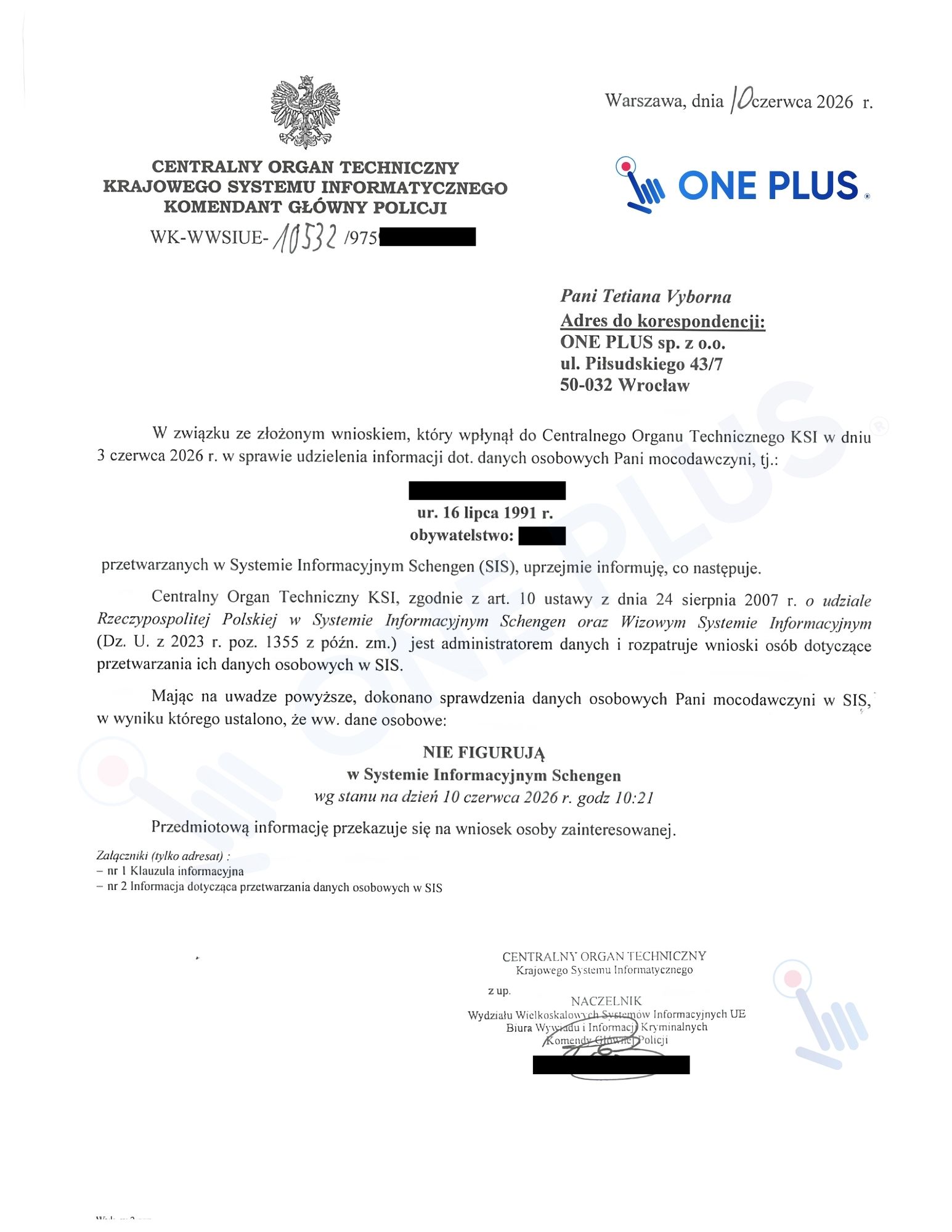
This type of block builds trust. It shows that ONE PLUS works with real cases and has practical experience in procedures involving SIS, entry bans and immigration records.
Waiting until the border is risky. If a SIS alert exists, you may be refused entry, lose money on tickets and accommodation, miss work, studies, a business meeting or an important family trip.
In some situations, the matter may become even more complicated because a new refusal at the border may negatively affect your immigration history.
Checking SIS in advance is safer than trying to “see what happens.” It allows you to assess the risk and choose the right next step: applying for a visa, preparing data removal, resolving deportation consequences or correcting documents before travel.
Clients choose ONE PLUS because they need more than random information from the internet. They need an official document and a clear explanation of what the result means.
We help remotely, without requiring the client to be physically present in Poland. We work with clients from different countries and understand that this procedure can be confusing and stressful for someone who is abroad.
ONE PLUS helps prepare the request, power of attorney, submission package and correspondence. After receiving the response, we explain the next steps. If the client has a deportation from Poland or an entry ban, we analyze whether cancellation, correction or removal of data may be possible.
ONE PLUS has been working with foreigner cases in Poland since 2018. In complex immigration matters, the case may be reviewed with the involvement of Tatiana Vyborna, immigration lawyer at ONE PLUS. She helps assess the risks, choose a legal strategy and explain which steps make sense in the client’s specific situation.
After contacting ONE PLUS, the client receives more than a prepared request. We provide support throughout the process: case analysis, document preparation, submission of the request, receipt of the official response and explanation of the result.
If the answer confirms that no relevant alert exists, the client may use this information before a visa application or travel planning. If an alert exists, we explain what it means and what further actions may be considered.
If the situation involves deportation, we separately analyze whether it may be possible to cancel the ban, remove data from SIS or prepare another legal strategy.
If you want to check whether your data appears in the Schengen database, it is better to do it before applying for a visa or traveling to Europe. This is especially important if you previously had a deportation, refusal of entry, visa refusal, overstay or problems with documents.
ONE PLUS helps obtain an official SIS-related response remotely, without your presence in Poland. We prepare the documents, submit the request, receive the response and explain what it means for your visa, trip or future immigration plans.
If you have a deportation from Poland or an entry ban to the Schengen Area, we can also help review your individual situation and check whether it is possible to remove the data, cancel the ban or prepare another legal path.
The procedure for obtaining information, correcting data and requesting removal of data from SIS is based on European and Polish legal acts. This section may be used as a legal note on the service page.
Main Legal Acts
Obtaining information from SIS means submitting an official request to check whether your personal data is being processed in the Schengen Information System. For foreigners, this is especially important when there may be a risk of an entry ban, deportation record, return decision or refusal of entry to Poland or another Schengen country.
This is not an informal online search. It is an official legal procedure that allows you to receive a written response from the competent authority. The answer may help you understand whether you can safely apply for a visa, travel to Europe or whether you first need to resolve an immigration issue.
There is no public online website where you can enter your name and instantly check whether you are listed in SIS. The Schengen Information System is a restricted database used by authorized state authorities, including border guards, police, consulates and immigration offices.
A legal SIS check requires a formal request, identity confirmation and correctly prepared documents. ONE PLUS helps clients complete this procedure remotely, prepare the request and obtain an official response instead of relying on unofficial or unreliable online checks.
Yes. In many cases, the procedure can be handled remotely, without your personal presence in Poland. This is useful if you are currently in Ukraine, Belarus, Georgia, Moldova, Kazakhstan, the United Kingdom, the United States, Canada or another country and want to check your situation before traveling to Europe.
ONE PLUS can help prepare the request, power of attorney and required documents in Poland. After the response is received, we explain what it means for your visa, travel plans, entry ban or possible further legal steps.
A SIS alert may be one of the reasons why a Schengen visa application is refused. If you apply without checking your situation first, you may lose time, money and receive another negative decision that affects your immigration history.
Checking SIS before applying for a visa helps identify the risk in advance. If there is no alert, you can apply with more confidence. If there is an alert, it is better to understand its legal basis, duration and possible removal before submitting a new visa application.
Not always. Deportation from Poland may lead to an entry ban and a SIS alert, but this depends on the decision, legal basis, duration of the ban and the authority handling the case.
Some decisions may affect only Poland, while others may create problems for entry into the wider Schengen Area. That is why it is important to check the documents and, if needed, request official information. ONE PLUS analyzes deportation decisions, return decisions and entry bans to understand whether there is a risk of a SIS record.
Yes, in some cases SIS data can be removed or corrected, but only if there are legal grounds. For example, removal may be possible if the entry ban has expired, the data is incorrect, incomplete, outdated, entered unlawfully or the original decision has been changed or cancelled.
Before requesting removal, it is usually necessary to understand who entered the data, why it was entered and whether the legal basis still exists. ONE PLUS helps analyze the official response and choose the correct strategy: data removal, correction, deportation analysis or another legal step.
In some cases, it may be possible to challenge the consequences of deportation, request cancellation, reduce the effects of an entry ban or remove related data from SIS. However, this depends on the documents and the individual history of the case.
The authority will consider the reason for deportation, duration of the ban, whether fines were paid, the person’s conduct after the decision, family ties, work situation and other circumstances. ONE PLUS reviews such cases individually and explains whether starting a legal procedure makes sense.
SIS, deportation and entry ban cases are handled by the immigration team at ONE PLUS. In more complex matters, the case may be reviewed with the involvement of Tatiana Vyborna, immigration lawyer at ONE PLUS.
Our team works with foreigner cases in Poland, including deportation, entry bans, residence permits, administrative procedures and communication with Polish authorities. We do not treat every case the same way. First, we analyze the documents and immigration history, then we choose the most practical legal path.
The processing time depends on the authority, the complexity of the case, correctness of the documents and whether additional clarification is needed. In simple cases, the response may arrive faster. In more complex cases, especially when deportation or an entry ban is involved, the procedure may take longer.
ONE PLUS prepares the request carefully, checks personal data before submission and monitors correspondence. This helps reduce unnecessary delays caused by mistakes in the application or missing documents.
If the official response confirms that your data is listed in SIS, the next step is to understand why the alert exists, who entered it, how long it is valid and whether it can be removed or corrected.
You should not immediately apply for a visa or try to enter the Schengen Area without analyzing the response. In some cases, it may be possible to request removal of the data. In other cases, it may be necessary to first resolve the deportation decision, entry ban or return decision. ONE PLUS helps explain the response and prepare the next legal step.

Certified Specialist in the Legalization of Stay and Employment of Foreigners in Poland. Tatiana is a graduate of Uniwersytet Ekonomiczny we Wrocławiu and Uniwersytet Wrocławski, where she completed studies in Legal and Business Consulting, followed by the postgraduate program Legalizacja zatrudnienia cudzoziemców at Uniwersytet Wrocławski.
With more than 12 years of professional experience and daily cooperation with Polish government institutions, Tatiana has developed an effective approach to resolving even the most complex immigration matters. She provides clear legal guidance, assists with document preparation, and supports clients throughout every stage of the legalization process.
Her individual approach, in-depth knowledge of Polish immigration law, and practical experience make the legalization process straightforward, secure, and as smooth as possible for every client.
Needed a certificate of no criminal record for a job offer in Poland. ONE PLUS filed it for me and I collected the document two days later.
My police clearance was for a residence card application. I would have picked the wrong form on my own, they explained which one and it came back on time.
Got my criminal record certificate through ONE PLUS in Wroclaw. They filed the same day I called and told me the real cost upfront. No queues, no guessing which office to visit.
Everything went very smoothly and I’m very grateful. I’ll definitely get in touch with you again if the need arises.
I ordered a sworn translation, everything went quickly and to a high standard, I’ll definitely contact you again.
Comprehensive help with documents in Poland, they prepared Aneks 1, found suitable insurance and did the sworn translations, thank you very much.
Individual consultations on legalisation, advice on how to properly change employers during a case without wasting time.
We asked for help getting a residence permit. From the very start we received detailed advice on legalisation and the documents needed in Poland.
I’m very happy with the help. I needed advice on legalisation and registering my residence card in Poland. They helped me sort out my documents, checked everything and explained what to do and how. Thanks to them the whole process went much more smoothly. I recommend them!
We asked for advice on legalising our stay in Poland and getting a residence card. Everything was explained clearly, they helped with the paperwork and were with us at every stage. They helped us get our residence card fairly quickly, in about 4 months. I’m very grateful for the professional help!
Very useful legal advice. My wife and I came with a few questions about our stay in Poland and got clear, specific answers to everything we wanted to know.
I had to exchange my driving licence for a Polish one. They helped me take care of all the formalities and explained exactly what I needed to do.
I registered my reel through ONE PLUS. I really liked how fast they were, the whole procedure took only 2 days. Great!
Reliable help with handling documents in Poland, they took on all the bureaucracy and communication with the government.
The best company helped me get a residence permit within 4 months.
Excellent help with handling documents in Poland.
Good consultation on legalisation, I’m satisfied.
Fast and efficient processing of the residence card.
High-quality legalisation consultation, every issue was clearly presented, the best basis for submitting the application was chosen.
Very good service. I contacted them about documents in Poland, everything was handled fairly quickly. I particularly liked the attention to detail.
Thank you for your help with the residence card. It’s nice to deal with people who know their job and can explain complicated things well.
I needed a consultation on a residence permit and the subsequent relocation from Poland. The specialist explained the nuances of my situation and pointed out issues I hadn’t thought of before. After the consultation, it became much clearer to me what to do next.
My case in Katowice had been stuck for a long time and I didn’t know how much longer I would have to wait. ONE PLUS helped me resolve the problem and speed up the case. A few months later, I received the long-awaited decision. Thank you for the professional approach.
I contacted ONE PLUS in Wroclaw when I decided to apply for a residence permit. The team supported my case and advised me on what to prepare and when. I got the result about 5 months later. I was happy with the cooperation.
Very useful consultation about the residence permit. I finally understood my situation and received the necessary documents. Thank you for the professional approach.
Thank you for helping me legalise my stay in Poland. Everything was organised professionally, without unnecessary formalities. They prepared the documents, explained everything and stayed in touch.
Good experience working with them. I especially liked that they not only answered questions but also explained why things had to be done that way. That was very important to me.
For a long time I couldn’t sort out the legalisation procedure in Poland on my own. After the consultation everything became much clearer. I got clear answers to all my questions and help with preparing the documents. I recommend them.
I’ve been working in Wroclaw for a few years, but after changing jobs I ran into bureaucratic difficulties, so I turned to them and I don’t regret it!
I needed help with documents for legalisation. At first I didn’t know where to start, but here everything was laid out point by point. Convenient and clear.
Great service for those who value their time. I needed urgent legalisation advice, and the lawyers immediately put together a plan of action.
I asked for help preparing my residence card. The specialists explained everything in detail and suggested the next steps.
I was given advice on legalising my stay in Poland. I received clear answers tailored to my situation. Now at least I understand what to do next.
I contacted this company and I’m satisfied with the service. I needed detailed advice on legalisation because I was having trouble putting my documents together.
I submitted an application for a residence permit. They helped me organise my documents and explained what to do next. I was happy with the consultation.
Fast and convenient insurance registration!
I’m very happy with the cooperation! 🙌 The company really helped me get my residence permit. Everything went quickly and professionally. They were in constant contact and provided all the necessary help at every stage. Thank you for the great work! I definitely recommend them!
Huge thanks to ONE PLUS for fast and efficient help with the paperwork. I was absolutely delighted with everything: the service, the support and the results. They’re true experts in their field!
I asked for a consultation about a residence permit and they answered all my questions. We’ll continue working together.
I had a paid consultation about setting up a company in Poland and got thorough answers to my questions. We look forward to further cooperation. Thank you.
The service was good and fast, the price was fair, and the handling was excellent.
I’m very satisfied with the cooperation! Everything was top notch, thank you for the professionalism and caring approach. Highly recommend!
Thank you very much for helping me get my birth certificate quickly and for always being in touch ♥️
I highly recommend ONE PLUS! I had an apostille and sworn translation of diplomas done with them. The service was done express, without any problems and in a pleasant atmosphere. Full professionalism and a great approach to the client. Thank you very much for your help!
For the second time I turned to ONE PLUS for help, this time with a residence card. The inspector demanded the decision regarding fines, the fines themselves and confirmation of their payment. I had all of that.
Good service and a very convenient process. It’s great that everything can be sorted in one place, including getting an apostille for documents and having them translated into English. The whole process was simple, quick and efficient. Highly recommend.
Thank you very much! Everything was done quickly and efficiently, and most importantly, professionally. I received my residence permit within a few months. Highly recommend!
I am very grateful to ONE PLUS for their help with the legalisation of my stay. Special thanks go to Tatiana , I could always count on clear explanations, quick responses and support at every stage.
I recommend this agency. They were always available, quickly answered questions and helped with everything.
Excellent management and service. They stick to agreed deadlines and procedures, and keep you informed of progress at every stage. I recommend them a thousand times over.
They responded quickly and without any complications. I received the documents even earlier than expected, thank you very much.
I highly recommend this company! Copies of documents and the residence card decision were made for me quickly, efficiently and professionally. I am very satisfied with the service.
Thank you very much for the efficient communication and timely delivery of documents.
Huge thanks to One Plus for helping me get my residence card. They were always available, helped me with the paperwork and explained everything in a simple way, which made the whole process run much more smoothly and easily. We’re glad we got in touch with you.
I contacted this company to add my driving licence to the database of the Ministry of Internal Affairs of Ukraine. The result was positive within two days. Their approach was transparent and professional. I highly recommend them. Thank you, ONE PLUS.
I applied for my TRC card through this lawyer and the whole process was very professional. They were responsive, helpful and clearly guided me at every stage. The case went smoothly and efficiently. I highly recommend their services to anyone applying for a TRC card in Poland.
Many thanks for the professional and kind service. The documents were translated efficiently and very accurately.
Tatiana was incredibly helpful!! She did everything quickly and efficiently!! Thank you, I’ll be back and I’ll recommend you!
Very courteous and professional service. They answered all my questions and helped me with my case very quickly. I will definitely use their services again.
Everything great, great. I’m very pleased. I recommend it.
Thank you, they responded quickly to my request and were always available. They answered all my questions. I recommend them.
I applied for insurance and everything went very quickly! Thank you! 🙏🏼 I highly recommend it!
I’m very pleased with One Plus’s work. In particular, Tatiana helped me move my case to Wrocław and handled it comprehensively. I’m really grateful to them and I recommend them.
Great! I recommend it to everyone! Thank you very much!
I RECOMMEND IT TO EVERYONE!!! ONE PLUS! VERY HIGH QUALITY, FAST AND PROFESSIONAL. I’VE BEEN USING VARIOUS ONE PLUS SERVICES FOR 6 YEARS!!! AND I’M VERY SATISFIED WITH THE RESULTS! P.S. YOU’RE THE BEST ON THE MARKET!!! THANK YOU VERY MUCH!
I received quick and clear advice regarding my driving licence.
I live in Canada and needed a Polish criminal record certificate because I had lived in Warsaw for a while. After contacting several service providers, I ultimately chose OnePlus SP.
Everything was great! I got the apostille here, and the whole process went quickly and without any hassle. I’ll definitely use their services again for further legalisation. I highly recommend them as trustworthy specialists.
Excellent firm. I got answers to all my questions, a competent lawyer. We look forward to working together.
Using One Plus’s help was a wonderful experience. Their professional and timely support streamlined the whole bureaucratic process considerably. I highly recommend them. Thank you very much.
We asked for help adding our driving licence to the MVS service centre database. The remote process took about 10 minutes (maybe even less if you have a faster computer). The convenience was that we didn’t have to drive to Wroclaw.
My third card with One Plus 👌 You can get permanent residence in 4 months if you work with professionals. 📌 Huge thanks to Tatiana, who handled my case and supervised every step! I wish your company continued growth and loyal clients.
I had a very positive experience with this firm. They helped me get a positive decision on my residence card, and throughout the process they were very helpful, professional and courteous.
My whole family , me, my wife and my daughter , submitted an application for a temporary residence permit at One Plus. My wife and child submitted the application in the last days of our child’s stay.
Great! Always fast and professional. I recommend it.
The whole process, from registration to receiving the ID card, went extremely smoothly. Highly recommended.
I would like to give a positive opinion about the company. We have used their services several times. They have competent specialists who do their work quickly.
This is not the first time we have contacted ONE PLUS and they always find positive solutions. I highly recommend them. They are responsive and always ready to help and answer questions.
I needed a duplicate birth certificate with an apostille. These gentlemen helped me with it, got it done on time, and the prices were reasonable. I recommend them.
I really like the way this company handles paperwork. They have a good approach. I recommend them.
One Plus knows their job. They helped me get a residence permit in a short time, for which I am very grateful.
I recommend them to everyone. My problem was solved quickly and professionally. The gentlemen are great.
Very helpful and supportive service. I invited my dad to Poland , they guided me at every step. I recommend them!
I ordered a certificate and other documents in Poland. Prices are fair, fast and efficient service, everything arrived by courier without delays. I recommend ONE PLUS.
I ordered an apostille for my documents. They fulfilled my request within the agreed timeframe and at a very reasonable price. I am fully satisfied with the service.
I express my sincere gratitude to your company for the help and the high level of service provided. All work was completed on time, efficiently and professionally.
I used the services of the insurance company and was satisfied. The contract was drawn up quickly and clearly, the managers were polite and competent, and explained all the insurance terms in detail.
Thank you for the help, I received the decision on the residence card in a month and a half. I will definitely use the company’s services again.
I received a 3-year TRC! Fast and efficient service. The staff were patient and helpful with every question!
I would like to thank the ONE PLUS agency for helping me obtain a residence permit.
ONE PLUS helped me quickly and efficiently exchange my driving licence for a Polish one. I am grateful to the company’s staff for their professionalism and care.
Thank you, everything arrived safely (birth certificate).
Thank you very much for your work 🙏 Everything was on time, always in touch and we didn’t have a single problem. We received the document with an apostille and translation into Polish. We will definitely use your services again!
We are very happy with our cooperation with ONE PLUS , my husband’s rights were added to the MIA database extremely quickly. I would like to note that despite the remote form of communication, you can immediately feel the professional approach, attention to detail and genuine willingness to help. Highly recommended.
Working with this company was a real pleasure for me. I ordered duplicates of documents with apostille and sworn translation. Excellent communication, photo updates at every stage and competitive prices. Highly recommended.
Everything was great!! And most importantly, fast!! I recommend it to everyone!!
Thank you for your help, everything went quickly and without any problems!
Tatiana, working with such a professional person is a pure pleasure. I am very satisfied; the promised deadlines were met, everything was high quality and on time. Thank you very much for the cooperation. Highly recommended.
This is not the first time I have used ONE PLUS services and the result is always positive. I am sincerely grateful to the staff for their responsible and professional approach to the matters they handle. In the end, my son and my wife also use ONE PLUS services and everything went as well as possible.
Thank you One Plus!!! For your work, professionalism and high-quality approach to business. I quickly received the decision and now I am waiting for plastic surgery. Thank you very much and highly recommend to everyone!!!
Thank you ONE PLUS! The help with the documents was professional! Recommended!
Fast service, polite communication, professional problem solving. Recommended.
Huge thanks to ONE PLUS for help with the formalities related to re-registering the car! Everything was handled efficiently, quickly and without any hassle. It is a pleasure to work with such professionals!
I used their service to add my driving licence to the Ministry of the Interior database. Everything went smoothly. I’m happy with it. Thank you!
They helped me quickly and efficiently re-register my driving licence as a Polish one. Thank you.
Working with this company was a real pleasure because the services are top-notch! I received a positive decision on my residence permit and can finally breathe a sigh of relief ☺️ Thank you very much 🙏 I definitely recommend them!
Thank you for the support and care you put into my residence card application. Working with such professionals is a pure pleasure!
Working with ONE PLUS left nothing but the best impressions! The company operates professionally, responsibly and always looks after the client.
Thank you very much for sorting out my residence card! Everything went great and I really liked it.
I’m very grateful to ONE PLUS for helping me get my residence permit. This isn’t the first time I’ve contacted them and, as always, everything is top-notch. I RECOMMEND them.
I’m happy with the work done; I received the decision within about a month.
It’s a good company; they invited me in and are constantly helping me with various matters, consultations and legal assistance.
I’m very happy with this company!!! Everything was quick and well organised!!! I recommend them, very friendly service!!! I was very pleased!!!
I would like to express my deep gratitude to ONE PLUS for their professional help in obtaining my Legal Card. From the very beginning, the process was organised clearly, quickly and to a high standard.
Thank you, One Plus! They helped me with my residence card , everything went quickly and without unnecessary formalities. I am very grateful for their help and support. I highly recommend them!
Thank you very much 🫶🏻 This is the second time I have used your services and I am happy again. Thank you for a 10/10 service.
Thank you to the specialist Tatyana for her quick help in renewing my driving licence. All the documents were quickly translated into Polish and submitted within one day. I received my Polish driving licence within a week.
A professional company with an individual approach to the client. Great communication, commitment and flexibility. Definitely recommend!
Fast, effective and with full commitment. Without this company, I would not have managed the paperwork. Thank you!
I’m very pleased with the result, everything is top notch. I received my residence card after 10 months. Support and advice from start to finish, the staff really know their job. Thank you very much.
I want to thank you for your services, the service is of the highest standard. You are the best!
I would like to sincerely thank ONE PLUS for their professional help in obtaining my residence permit. The team works clearly, quickly and with care for the client. Special thanks go to Mrs Tatyana, the owner of the company.
Excellent service. The helpful staff are always ready to explain any complicated matters. I would particularly like to single out Tatyana , she provided help and advice right up until I received my plastic card.
I was looking for advice on setting up a company in Poland. They explained everything to me clearly and simply, and also helped me sort out the paperwork and the finer points. Thank you ☺️
I’m really happy with the speed and efficiency with which my residence card was processed! Thank you, Tatyana! You’re a magician!
The best legalisation service in Wrocław ❤️ I recommend it ❤️

 4,7
4,7


