

Since 2018
For over 8 years, we've helped clients navigate Polish law, combining our solid legal knowledge with practical immigration experience.

ONE PLUS helps prepare a registered invitation for a foreign visitor, entered by the voivode in the invitation register. We review the host’s status, income, accommodation, trip purpose and duration, guest details and expense obligations, then prepare the application and evidence.
The client receives a document list and filing set with agreed support for authority requests. A registered invitation supports evidence of accommodation and funding, but it is not a visa and does not guarantee a consular decision.
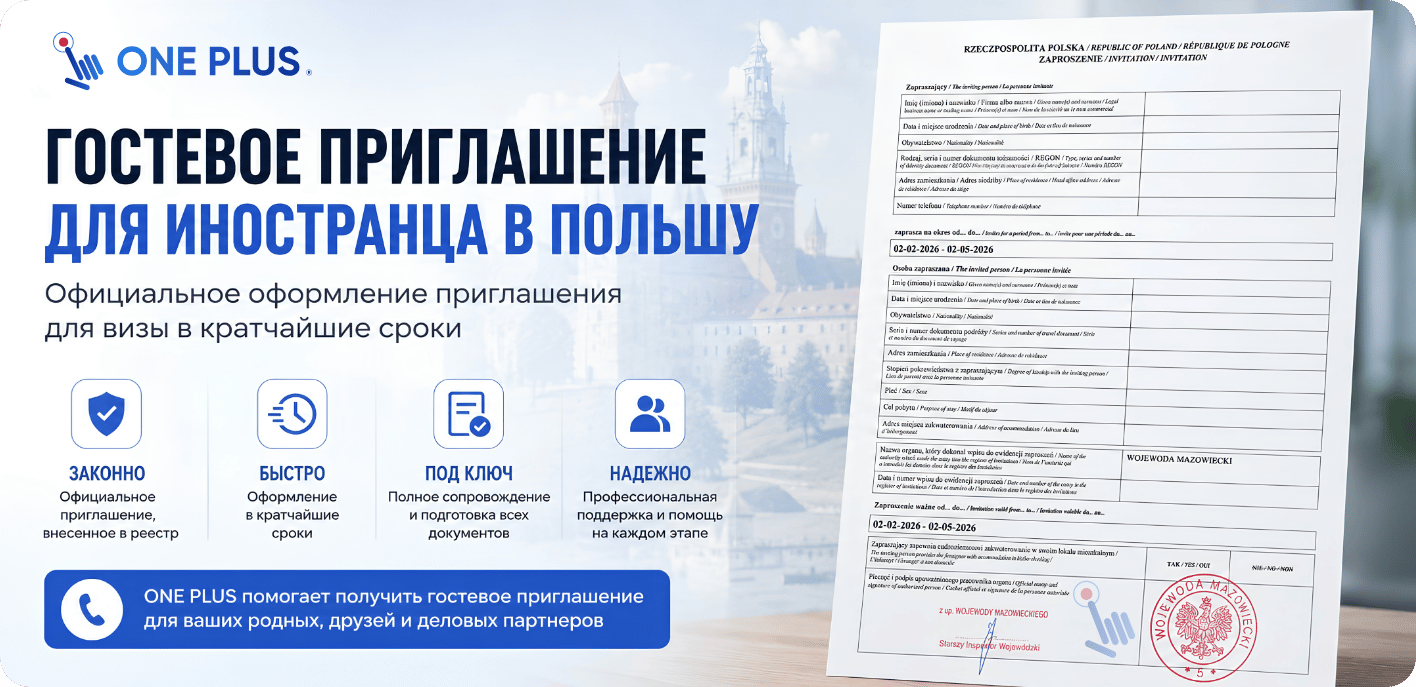
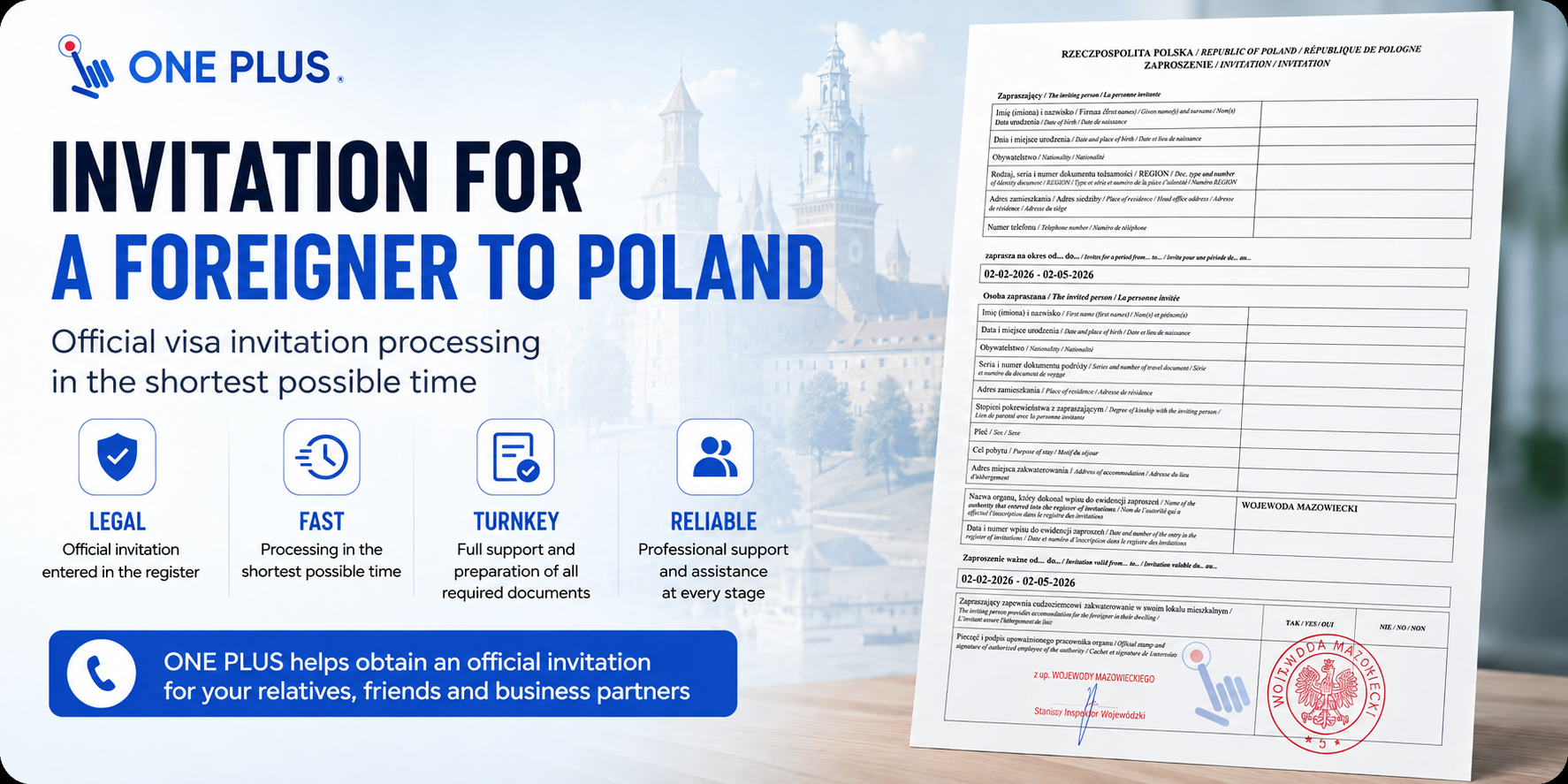
ONE PLUS is a legal support company in Poland that helps clients obtain an official invitation for a foreign national in the shortest possible time. We assist with invitations for wives, husbands, parents, children, relatives, friends, private guests and, where appropriate, business visitors who need to travel to Poland on the basis of a visa or who must confirm the purpose and conditions of their stay before a Polish consulate.
In Poland, a guest invitation for a foreign national is not just a private letter. Officially, it is an invitation entered into the register of invitations by the Voivodeship Office. This is a state document confirming that the inviting person or entity in Poland is ready to provide accommodation and cover the costs related to the foreigner’s stay, including living expenses, food, possible medical treatment and return travel to the country of origin or residence.
Official Polish authorities explain that a registered invitation confirms the availability of funds to cover the foreigner’s planned stay in Poland, including accommodation, subsistence and return travel. In practice, this document is most often used for visa purposes, especially when a husband wants to invite his wife to Poland for a private or family visit.
ONE PLUS helps prepare the application properly, verify the status of the inviting person, review housing and financial documents, pay the official fees, file the case with the competent Voivodeship Office and obtain the final invitation. Before filing, we check common refusal risks: host eligibility, income and accommodation evidence, guest details, trip purpose and dates.
A guest invitation to Poland is not an informal note from a relative or friend. It is an official administrative document registered by the Voivodeship Office. The document includes the details of the inviting person, the details of the foreigner, the purpose of the visit, the intended period of stay and information on who will cover the costs connected with that stay.
This invitation is most commonly used when applying for a Polish visa. It may be needed if a foreign national wants to come to Poland to visit a wife, husband, family member, friend or acquaintance, or for another legitimate private purpose. At the same time, it is important to understand that the invitation itself is not a visa. It is one of the documents that may help the foreigner prove the purpose of travel and the conditions of stay before the Polish consulate.
Polish authorities also clearly emphasize that an invitation for a foreigner does not give the right to work in Poland. If the real purpose of the trip is work, then other documents are required, such as a work permit, a declaration of work assignment or another basis suitable for a work visa.
Many people misunderstand the legal meaning of an invitation. Because of that, problems often begin even before the visa application is filed.
An invitation to Poland is not:
The consul still reviews the foreigner, the purpose of the trip, the financial situation, the visa history, the documents submitted and the general risk of unlawful stay. This means that even a correctly issued invitation does not automatically guarantee a positive visa decision.
Not every person staying in Poland can issue an official invitation. The inviting party must meet the legal requirements and must have a sufficient legal status in Poland.
An application to register an invitation may generally be filed by:
The application must be filed with the Voivodeship Office competent for the place of residence of the inviting person or the registered address of the company.
A refusal may occur if the inviting party does not meet the legal requirements, does not have sufficient financial means, cannot prove accommodation for the foreigner, provides incorrect data, submits an incomplete set of documents or fails to explain the purpose and duration of the visit in a logical way.
In practice, refusals are often caused not by the foreigner, but by the inviting side. For example, a person may hold only a temporary residence permit and therefore not meet the legal requirements to invite someone. Or there may be a flat available, but the lease agreement prohibits accommodation of third parties. Or the inviting person may have income, but the documents do not prove it in a way the office can accept.
This is why ONE PLUS first checks the situation of the inviting party and only then builds the document package.
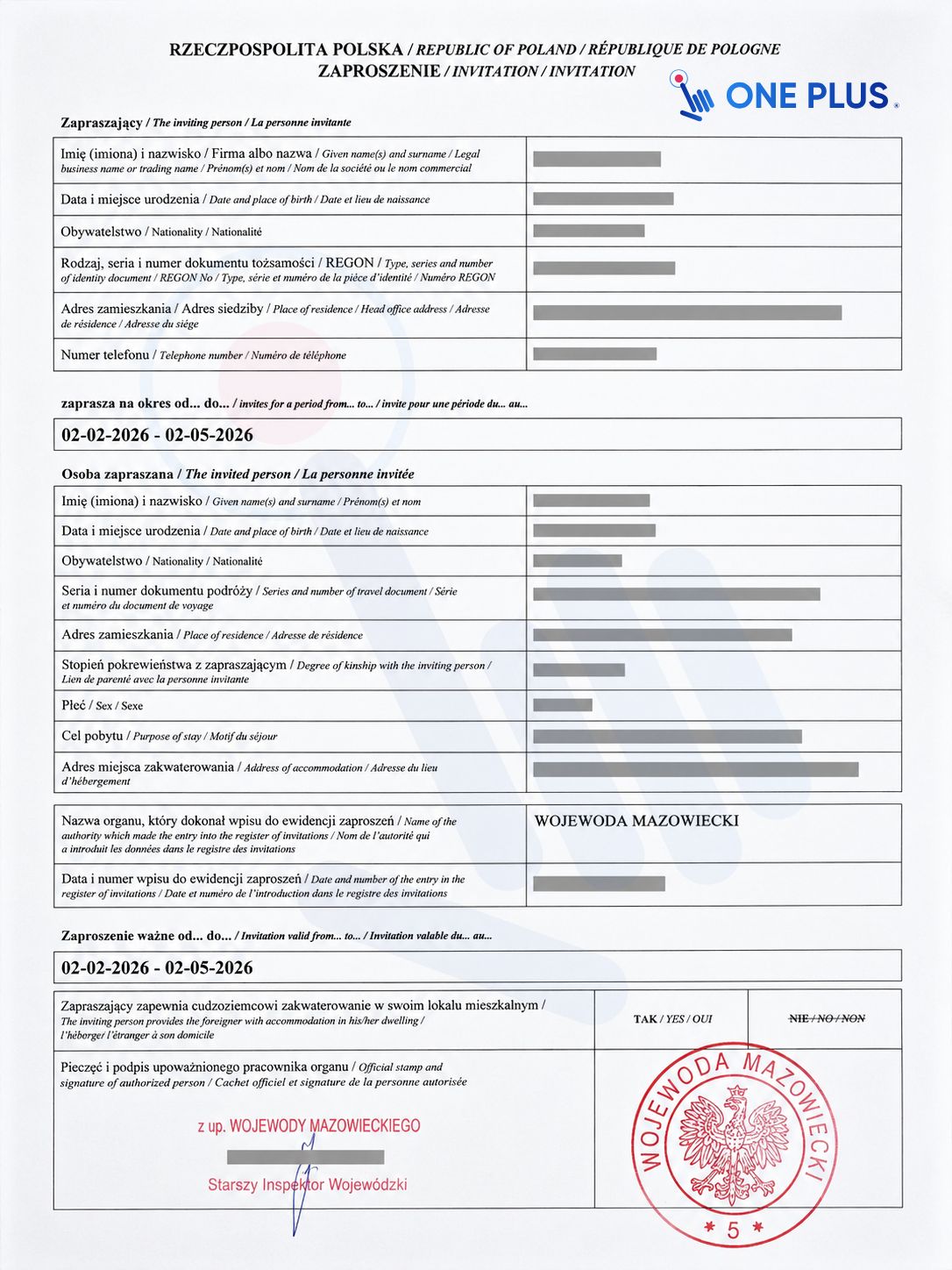
An official invitation registered in Poland is not free-form text. It is a document issued through an administrative procedure and it contains information confirmed by the Voivodeship Office.
The invitation usually includes:
Mistakes in the name, surname, passport number, travel dates or purpose of the trip may later create problems during the visa procedure. This is why all data should be checked carefully before the documents are submitted.
A guest invitation is most often used when applying for a Polish visa. Depending on the purpose and duration of the trip, this may be a national visa or a Schengen visa.
If the foreigner plans a longer private stay in Poland, the invitation may be used as one of the supporting documents for a national visa. If the visit is short and relates to family or a private stay, the invitation may be used for a Schengen visa application.
It is very important to match the real purpose of travel with the visa route. If the invitation says the trip is private, but in reality the foreigner intends to work, study or provide services in Poland, this may lead to serious problems both at the consulate and later at the border.
In practice, one of the most common situations is when a man living in Poland wants to invite his wife, or when a wife in Poland wants to invite her husband. In such cases, the invitation is usually based on a private or family visit.
These cases seem simple, but they still require proper preparation. The office may verify whether the inviting person has the required legal status in Poland, whether there is real accommodation available, whether there are enough financial means and whether the intended duration of the visit is realistic.
The purpose of travel must also be described in a way that makes sense. A family visit, private stay, spending time together, support during a temporary stay or participation in an important family event may all be valid reasons, but the description should match the documents and the visa plan.
If the real intention is not just a short visit but a long-term move, family reunification or future residence in Poland, then an invitation may not always be the best legal route. In such cases, ONE PLUS helps determine whether a visa based on an invitation is appropriate or whether another immigration procedure would be more suitable.
The exact document list depends on the voivodeship, the status of the inviting person, the nationality of the foreigner, the duration of the invitation and the legal basis of stay in Poland. However, in most cases several key document groups must be prepared.
The inviting party must prove identity and the legal right to act as the applicant.
Usually this includes:
If the invitation is being issued by a company, additional documents may be required, including registration documents, extracts from the National Court Register or CEIDG, documents proving representation rights and company financial documents.
Accurate personal data of the foreigner is essential. It is always better to work from a passport scan to avoid mistakes.
Usually the following is needed:
Even one mistake in passport details may later require corrections or even a new filing.
The inviting party must prove where the foreigner will stay in Poland. This is one of the most important elements of the procedure.
Possible evidence may include:
A very common problem is submitting a lease agreement that prohibits accommodation of third parties. In such a case, the office may require the landlord’s written consent or additional evidence. If there are several property owners, the consent of all of them may sometimes be required.
The inviting person must prove that they have sufficient funds to cover the foreigner’s stay in Poland and return journey.
Financial evidence may include:
Official regional authorities state that the application should include documents confirming funds for accommodation, subsistence and return travel of the foreigner.
Financial requirements depend on the number of persons supported by the inviting party, the duration of the foreigner’s intended stay and the country to which the foreigner must return after the trip.
The inviting person must prove that they have enough funds not only for the guest, but also for themselves and for any family members already dependent on them. This is why it is not enough to look at a single figure on a bank statement.
The office usually takes into account:
Return travel costs are often assessed depending on the foreigner’s country of origin or habitual residence. The calculation may therefore differ significantly depending on whether the invited person comes from Ukraine, Belarus, India, Nepal, the United States, Kazakhstan or another country.
The official state fee for entering an invitation into the register is generally 27 PLN per invited foreigner. If the documents are filed through an authorized representative, an additional power of attorney fee of 17 PLN may apply. These amounts are listed on official Voivodeship Office websites.
Separate legal support fees apply if the client asks ONE PLUS to prepare and handle the case.
As a rule, the Voivodeship Office should review the application within 30 days, although in practice the timing may differ depending on the city, office workload, document quality and whether additional documents are requested.
In some voivodeships the invitation may be issued relatively quickly. In others, the case may take several weeks. If the filing is incomplete, the time may increase because the office will issue a request for supplements.
This is why it is worth preparing the file correctly the first time. Mistakes in the application, finances, housing documents or personal details frequently lead to delays.
The application must be submitted to the Voivodeship Office competent for the residence of the inviting person or the registered office of the company if the invitation is issued by a legal entity.
In practice, the process usually involves the following steps:
In some regions a personal appointment may be required. In others, filing by post or through the office registry may be possible. The practice may vary, so it is important to check the rules of the specific office before filing.
Once the invitation is issued, it usually needs to be sent to the foreigner. In many visa procedures, the consulate requires the original document or official confirmation of its registration, depending on the country and consular practice.
The foreigner then submits the visa application to the Polish consulate. The consul reviews the invitation, the foreigner’s personal data, the purpose of the trip, financial circumstances, visa history and the rest of the application file.
If the details in the invitation do not match the passport or visa application form, this may create problems. For that reason, before the document is sent to the guest, the following should be checked again carefully:
At first glance, invitation registration seems simple. In practice, even a small mistake may cause a delay or refusal.
The most common errors include:
ONE PLUS checks these risks before filing so that the client does not lose time on corrections and additional requests.
ONE PLUS helps clients obtain an official invitation to Poland on a full-service basis. We do not simply fill in the form. We analyze the whole case, because the invitation must not only look correct on paper, but also be accepted by the Voivodeship Office without avoidable problems.
We help clients:
The ONE PLUS team works with foreign national matters, Voivodeship Office practice and visa-related documentation. This allows us to spot mistakes in advance, including those that are not obvious to the client but may later cause a refusal or delay.
In most cases, invitations are issued for wives, husbands, parents, children, siblings, relatives, friends or acquaintances who want to come to Poland for a private visit.
In such matters, it is especially important to describe the purpose of the trip properly. This may include visiting family, spending time with relatives, helping family members, attending a family event, a temporary private stay or another genuine private purpose.
If the purpose is described in a way that does not match the timing or the rest of the file, it may lead to questions from the office or later from the consulate.
There are cases where an invitation is not the best legal route. For example, if the real purpose of the foreigner’s trip is work, study, long-term residence, starting a business or family relocation, other documents may be more appropriate.
In such situations, ONE PLUS helps choose the right procedure, which may include:
Choosing the correct route from the beginning saves time and reduces the risk of visa refusal.
If you need an official invitation for your wife or another foreign family member to come to Poland, ONE PLUS will help you prepare the case properly, quickly and in line with the requirements of the competent Voivodeship Office.
We support the case from the first document review to collection of the registered invitation. Our goal is to reduce the risk of refusal, avoid preventable mistakes and help the foreigner prepare for the visa procedure in the safest and most practical way.
Get ConsultationYes. The person you invite does not have to be a family member. A registered invitation can also be issued for a friend, partner, acquaintance or another third-country national, provided you meet the legal requirements and can cover the costs connected with their stay. Because the inviting person takes on financial responsibility, an invitation should only be issued for someone you know and trust.
The amount depends on the length of the visit, the number of people you support and the invited person’s return destination. The standard calculation is at least PLN 515 per month for the inviting person, each dependent family member and each invited foreign national. For certain close relatives, including a spouse, child, parent or sibling, the amount may be reduced to PLN 200 per person per month. You must also show funds for the return journey, unless an appropriate return ticket has already been purchased.
The official stamp duty for entering an invitation in the register is PLN 27 per invited person. If a representative is appointed, a separate PLN 17 power of attorney fee may also apply. ONE PLUS professional fees are charged separately and depend on the scope of the case. Current service prices are available in the ONE PLUS price list.
Yes. ONE PLUS can manage the process from the initial eligibility check through to obtaining the registered invitation. We review the host’s legal status, accommodation and financial documents, prepare the application, verify the invited person’s details and handle the case with the competent Voivodeship Office. We can also advise whether an invitation is the right solution or whether another immigration route would be more suitable.
No. A registered invitation does not guarantee that a Polish visa will be issued. It confirms financial support for the planned stay and return journey, but the consul still assesses the purpose of travel, supporting documents and the applicant’s individual circumstances. The invitation is therefore supporting evidence rather than permission to enter Poland.

Certified Specialist in the Legalization of Stay and Employment of Foreigners in Poland. Tatiana is a graduate of Uniwersytet Ekonomiczny we Wrocławiu and Uniwersytet Wrocławski, where she completed studies in Legal and Business Consulting, followed by the postgraduate program Legalizacja zatrudnienia cudzoziemców at Uniwersytet Wrocławski.
With more than 12 years of professional experience and daily cooperation with Polish government institutions, Tatiana has developed an effective approach to resolving even the most complex immigration matters. She provides clear legal guidance, assists with document preparation, and supports clients throughout every stage of the legalization process.
Her individual approach, in-depth knowledge of Polish immigration law, and practical experience make the legalization process straightforward, secure, and as smooth as possible for every client.
Very helpful service. I invited my dad to Poland, they guided me at every step. I recommend!
I ordered a voivodeship invitation from this company, everything went very quickly. The visa was opened without any problems. I recommend!
I applied for a TRC card through this lawyer and the whole process was very professional. They were responsive, helpful and guided me clearly at every stage. The case went smoothly and quickly. I highly recommend their services to anyone applying for a TRC card in Poland.
Huge thanks to ONE PLUS for their professionalism!!! Everything was clear and specific. Thanks to their help I received a residence permit, as well as financial support for the Polish Card. They sped up the process of applying for my husband's Card, and today we received wonderful news, a positive decision for my child, and in just three months! Tatiana, you are a true professional! If you need help with legalization of stay, ONE PLUS is the answer!
I contacted ONE PLUS in Wroclaw when I decided to apply for a residence permit. The team supported my case and advised me on what to prepare and when. I got the result about 5 months later. I was satisfied with the cooperation.
It is a good company, they invited me and they keep helping me with various matters, consultations and legal assistance.
I contacted ONEPLUS to apply for permanent residence on the basis of a humanitarian visa and I don't regret it. Everything went very quickly, on time, and the service was very nice and helpful throughout the whole process! I recommend them to everyone ;)
I would like to thank the One Plus agency for obtaining the card for everyday life. The coordinator Anastasia helped with everything that was needed, the documents were handled quickly and there were no problems, the agency is great, I recommend it to anyone who intends to apply for the card for everyday life, there will be no problems. Thank you One Plus for the help and cooperation.
I recently asked for help with applying for a residence permit and I was satisfied. It saved me from tedious bureaucracy. Many thanks to the staff, who were always in touch, patiently answered all my questions and helped with handling the documents. In the future I plan to come back here to exchange my driving licence.
I am very happy with the agency's work. They received me after I arrived and took me to my accommodation. The accommodation is excellent and the conditions are very good. Payments are always on time. The coordinator Alexander is always available to help and advise in any situation.
Good day everyone!!!! I want this company to only broaden its horizons!!! You do very high quality and solid work!!! You help with documents! Those girls on the team! Very friendly... They inform about all events!!! They consult online!! SUCCESS in business! Grow your ENTERPRISE!!!! You helped me a lot! And I hope!!! That thanks to the huge work you have done!!!!! Another 10,000 people will change their lives for the better! And people will be able to move forward!! Even faster. P.s. I HIGHLY RECOMMEND YOU TO EVERYONE FROM THE HEART!!!!!!! YOU ARE PEOPLE WHO KEEP THEIR WORD! THANK YOU ONCE AGAIN, IT IS A PLEASURE TO WORK WITH YOU!
I would like to express my gratitude to the ONE PLUS company for excellent service. They helped me get a visa, find a direct employer in Wroclaw and submit an application for permanent residence. Now I am waiting for the card itself. I am very happy with my cooperation with this company.
I received approval for a student card within five months. It was a very urgent matter, literally two days before my visa expired. Thank you to the guys for their help. My involvement was minimal, which was ideal. Minimum stress, maximum benefit.
I used this company's services twice, for a visa and a driving licence. I am very satisfied with their work. Everything was done on time and without any problems. They run like clockwork. I also received thorough answers to my questions. Thank you very much! I will certainly use their services again if the need arises.
Good morning. Great company. I had a month and a half left on my visa, they took me on and without unnecessary questions found me a job. They explain everything in detail based on the documents. They don't take a single penny. They don't charge any fee at all for the passport...
I am satisfied with the work done, I received the decision within about a month.
I contacted this company to get a residence permit for my daughter, and I don't regret it. Tatiana was an excellent specialist, always available and ready to help. Dmitrij and the rest of the staff were great too. Thank you for your help.
Hello. I would especially like to rate the ONE PLUS agency for the high level of professionalism of the people working there. Aleksander, the coordinator, is a responsible person. He received me punctually and helped me throughout the whole process in various situations. Dmitry always responds to every situation and is a competent and capable manager. This agency is simply amazing. They helped me prepare documents for the permanent residence card and obtain it. The pay is always on time. The accommodation is at the highest level. I have been working with this agency for a year and I have never regretted choosing this warehouse and agency. And the girls: Tatiana, Ivanna and Anastazja, you are simply amazing. Thank you for helping me find work and obtain the permanent residence card. I recommend them to everyone!
I have been working in Wroclaw for a few years, but after changing jobs bureaucratic difficulties came up, so I turned to them and I do not regret it!
A very useful consultation about a residence permit. I finally understood my situation and received the necessary documents. Thank you for the professional approach.
Call Mon-Fri 09:00-17:00
 +48 71 880 85 08
Contact us online


We’ll call you back during business hours.
 We will tell you more about servicesInitial client consultationExpress situation audit
During business hours
Your data stays secure
Support with your case

 4,7
4,7