Family Reunification Residence Permit in Poland
ONE PLUS provides end-to-end legal support for family reunification residence permit applications in Wroclaw and across Poland. We help spouses, minor children and other eligible family members obtain a temporary residence permit, commonly referred to as a TRC, and the corresponding residence card known in Polish as a karta pobytu.
We review the status of the family member living in Poland, choose the correct legal basis, prepare the application and manage the case until a decision is issued. We also support electronic submission through MOS 2.0, handle official correspondence, contact the case officer and prepare responses to requests from the Voivodeship Office.
Our services are available in Wroclaw, Warsaw, Katowice, Gdansk and other cities throughout Poland.
What is a family reunification residence permit?
A family reunification residence permit allows a foreign national to live legally in Poland with a close family member who already resides in the country or is applying for their own Polish residence permit.
This procedure is most commonly used by husbands, wives and minor children. Depending on the circumstances, other relatives may need to use a different family-based residence route.
Clients often use the terms Residence Permit, TRC, Residence Card and Karta Pobytu interchangeably. Legally, they describe different stages of the procedure. The voivode first grants a temporary residence permit by issuing an administrative decision. After a positive decision, the foreign national receives the physical residence card, called a karta pobytu.
Family reunification does not mean that the applicant must currently live abroad. A husband, wife or child who is already legally staying in Poland may also apply.
Who can apply for family reunification?
The correct procedure depends on the status of the family member already living in Poland. For clarity, we refer to this person as the sponsoring family member.
A family reunification residence permit may be available when the sponsoring family member is:
- a Polish citizen;
- a permanent residence permit holder;
- an EU long-term resident in Poland;
- an EU Blue Card holder;
- a foreign national with an eligible temporary residence permit;
- a person with refugee status or subsidiary protection;
- a researcher holding a qualifying residence permit;
- a person covered by an eligible intra-company transfer permit;
- a foreign national currently applying for their first residence permit.
Parents, adult children and other relatives do not automatically qualify for the standard family reunification procedure. Their cases require an individual assessment of the relationship, dependency, care needs and the sponsor’s status in Poland.
Can spouses apply at the same time?
Yes. A husband or wife can apply for a residence permit even if the sponsoring spouse is still waiting for their first residence decision.
For example, a husband may apply for a TRC based on employment, business activity or highly qualified work. His wife can submit her own residence application based on their marriage without waiting for him to receive the physical Karta Pobytu.
Both applications may be registered and processed at the same time. However, the Voivodeship Office normally needs to decide the sponsoring spouse’s case before it can complete the second application.
In practice, the husband may receive his decision first. That decision is then added to his wife’s file, allowing the case officer to confirm her residence basis and continue the proceedings. The same process applies when the wife is the sponsoring applicant and the husband applies through family reunification.
The absence of a physical residence card does not prevent the second spouse from applying. The important points are to submit the application during legal stay, prepare both cases consistently and clearly inform the office that the proceedings are connected.
Spouse of a Polish citizen
A foreign national married to a Polish citizen may apply for a residence permit as a family member of a Polish citizen.
The marriage must be legally recognised in Poland and must represent a genuine relationship. A marriage certificate is essential, but it may not be the only evidence required.
The Voivodeship Office may examine whether the spouses live together, share household expenses and maintain a genuine family life. Evidence may include a joint tenancy agreement, shared bills, bank records, documents relating to children, insurance policies, photographs and travel records.
If the marriage was registered outside Poland, the foreign marriage certificate may require an apostille or consular legalisation. A Polish translation prepared by a sworn translator will normally also be required.
Not every marriage that is valid in another country is automatically recognised under Polish law. Religious marriages, proxy marriages and other non-standard forms of marriage should be checked before the application is submitted.
Spouse of a foreign national
A husband or wife may also obtain a residence permit through a foreign spouse who is living legally in Poland.
The standard family reunification procedure applies when the sponsoring spouse holds a status recognised under Polish immigration law. This includes permanent residence, EU long-term resident status, an EU Blue Card, refugee status, subsidiary protection and certain permits granted to researchers or employees transferred within an international company.
A spouse who has lived in Poland under consecutive temporary residence permits may also become eligible to sponsor family reunification when the statutory requirements concerning the type and length of residence are met.
An application can also be submitted when the sponsoring spouse is applying for their first temporary residence permit or has held a temporary permit for a shorter period. In this situation, the application remains possible, but the exact legal basis and the rights granted under the future permit may differ from those available under standard family reunification.
This distinction may affect access to the labour market, the right to register a sole proprietorship and the duration of the residence permit. ONE PLUS therefore checks both the physical residence card and the administrative decision on which it is based.
Residence permit for a child
A minor child may obtain a residence permit to live with a parent who is legally residing in Poland or applying for their own residence permit.
The application is submitted by a parent or legal guardian. The required documents usually include the child’s birth certificate, passport, evidence of the parents’ status in Poland, health insurance and proof of accommodation.
Additional documents may be necessary if the parents are divorced, have different surnames or do not share parental responsibility. The Voivodeship Office may request the consent of the other parent, a custody judgment or another document confirming who is authorised to act for the child.
If the child is at least six years old, their personal attendance may be required to complete the necessary formalities.
A child born in Poland does not automatically receive Polish citizenship if neither parent is a Polish citizen. The child’s stay must be legalised separately, even if both parents already hold valid residence cards.
A child’s residence permit is not renewed automatically. A new application must be submitted before the existing permit expires.
Residence permit for an unmarried partner
A foreign national living with a boyfriend or girlfriend may be able to apply for a residence permit based on family life or other circumstances. This is not the same as the standard family reunification procedure available to married couples.
The applicant must show that the relationship is genuine, stable and comparable to family life. Useful evidence may include a joint tenancy agreement, a shared address, common expenses, bank transfers, photographs, correspondence, travel records and documents relating to shared children.
Simply being in a relationship with a person living in Poland does not guarantee a residence permit. The authorities may examine the length of the relationship, the couple’s living arrangements, their financial situation and their plans for the future.
A residence permit issued to an unmarried partner does not always provide automatic access to the Polish labour market. The right to work must be checked separately.
What does the residence permit provide?
A family reunification residence permit allows the holder to live legally in Poland for the period stated in the residence decision. It gives families greater stability when planning work, housing, education and everyday life.
Together with a valid passport, the Karta Pobytu allows repeated entry into Poland and short visits to other Schengen countries for up to 90 days in any 180-day period. It does not automatically give the holder the right to live or work permanently in another EU country.
The validity period of a TRC may depend on the status and permit held by the sponsoring family member. If the sponsor receives a short residence permit, the spouse’s permit will not normally be granted beyond the sponsor’s legal residence period.
Residence based on family reunification may also form part of a future route to permanent residence or EU long-term resident status. These procedures have separate requirements concerning residence history, income, Polish language skills and periods spent outside Poland.
Can the holder work in Poland?
A residence permit granted under the standard family reunification procedure generally allows the holder to work in Poland without obtaining a separate work permit. The physical Karta Pobytu normally includes the wording “dostęp do rynku pracy”, meaning access to the labour market.
A foreign spouse of a Polish citizen may also work without an additional work permit after obtaining the relevant residence status.
Different rules may apply when the permit is based on a spouse’s first temporary residence permit, an unmarried relationship or other family circumstances. In such cases, access to the labour market must be checked individually.
The right to work depends on the legal basis stated in the residence decision, not only on the existence of a plastic residence card.
Can the holder open a JDG?
Some family reunification residence permits allow the holder to register and operate a sole proprietorship in Poland, known as JDG.
This may apply to the spouse of a Polish citizen and to a person who has received a permit under the standard family reunification rules. A permit issued to an unmarried partner or under other circumstances may not provide the same right.
Before registering a JDG, the residence decision should be checked carefully. The wording “access to the labour market” does not always confirm the right to conduct business activity.
If the business will later be used as a basis for another residence application, it should be genuine and supported by contracts, accounting, tax payments and evidence of actual income.
What does the Voivodeship Office check?
The authorities do not assess only the marriage or birth certificate. They examine the complete family and immigration situation.
Depending on the legal basis, the case officer may check the sponsor’s residence status, the validity of the marriage, joint residence, parental responsibility, accommodation, stable income and health insurance.
The information provided in connected applications must be consistent. If a husband and wife state different addresses, dates or information about their income, the office may request additional documents or explanations.
This is particularly important when spouses apply at approximately the same time. Details concerning the marriage, home address, children and financial situation should match across both cases.
How is a genuine marriage proved?
The Voivodeship Office may investigate whether a marriage was entered into to create a genuine family or only to obtain a Polish residence permit.
Additional questions may arise when the marriage is recent, the spouses live at different addresses or the information in their applications is inconsistent.
Evidence of genuine family life may include a joint tenancy agreement, shared bills, bank transactions, photographs, correspondence, travel records, insurance documents and children’s birth certificates.
The spouses may also be invited to an interview. Questions can concern how they met, their wedding, their home, relatives, daily routine and future plans.
There is no need to memorise identical answers. The important point is to provide truthful information supported by documents that reflect the couple’s real life.
Income, accommodation and health insurance
A family reunification residence permit may require evidence of stable and regular income, accommodation and health insurance. The exact requirements depend on the applicant’s legal basis and the status of the sponsoring family member.
Income may be demonstrated through an employment agreement, an employer’s certificate, payslips, bank statements, tax returns or business records. One working spouse may support the whole family if the income is sufficient and properly documented.
Accommodation may be confirmed with a tenancy agreement, proof of ownership, a free-use agreement or a declaration from the property owner. The address should be consistent with the information included in the application.
Health insurance may be confirmed through ZUS or NFZ coverage or through a suitable private insurance policy.
The same document package should not be used for every case. For example, the requirements for the spouse of a Polish citizen may differ from those for the wife or husband of a foreign national applying for their first TRC.
Documents for family reunification
The final list of documents depends on the family relationship, the sponsor’s status and whether the applicant is currently in Poland.
A typical application may include:
- an electronic application through MOS 2.0;
- scans of all pages of a valid passport;
- a digital biometric photograph;
- proof of payment of the stamp duty;
- a marriage or birth certificate;
- a Polish sworn translation;
- an apostille or consular legalisation, if required;
- the sponsor’s passport, Polish ID, residence card or residence decision;
- evidence of joint residence;
- income documents, where required;
- proof of accommodation and health insurance;
- custody documents or the other parent’s consent;
- evidence of a genuine family relationship;
- confirmation of the sponsor’s pending residence proceedings.
If the sponsoring family member is still waiting for a residence decision, the second application should clearly identify the connected case. Once the sponsor receives a decision, it should be added to the family member’s file without unnecessary delay.
There is no universal checklist suitable for every family. ONE PLUS prepares an individual list based on the applicant’s relationship, current status and place of residence in Poland.
Foreign documents and apostille
Marriage, birth, divorce and name-change certificates issued outside Poland normally require a Polish translation prepared by a sworn translator.
Depending on the country and type of document, an apostille or consular legalisation may also be necessary. In some situations, registering the foreign civil-status record in Poland may be useful or required.
Before ordering a translation, the names, surnames, dates and places of birth should be checked carefully. Differences between national spelling, Latin transliteration and Polish spelling may lead to additional questions from the office.
Where possible, errors should be corrected before the residence application is submitted. Explaining inconsistencies after receiving a formal request usually makes the process longer and more complicated.
Applying through MOS 2.0
Since 27 April 2026, most Polish residence permit applications have been submitted electronically through the government MOS system, commonly referred to as MOS 2.0.
The application must be completed in Polish, signed using an accepted electronic method and submitted with the required digital documents. The applicant should keep the official electronic confirmation of submission.
When spouses apply at a similar time, both applications should clearly explain how the cases are connected. The Voivodeship Office needs to know which family member is the sponsor and which residence decision is required before the second case can be completed.
Electronic submission does not mean that the entire procedure takes place online. The applicant may still need to present original documents, confirm their identity, provide fingerprints, attend an interview or appear at the office with a child.
After submission, official correspondence must be monitored carefully. Missing a request for additional evidence may result in the case being decided without important documents.
Applying from outside Poland
In certain family reunification cases, an application may be submitted while the family member is outside Poland. The spouse or parent living in Poland may be permitted to act on the applicant’s behalf.
The exact procedure depends on the family relationship and the sponsor’s residence status. After a positive decision, the foreign family member may still need to complete formalities connected with entry, identity verification, fingerprints and collection of the Karta Pobytu.
The procedure should be checked before making travel or visa arrangements. Applications submitted from outside Poland do not always follow the same rules as applications filed by people who are already legally staying in the country.
Extending the residence permit
A family reunification residence permit is not extended automatically. A new application must be submitted before the current permit expires.
The Voivodeship Office will check whether the family relationship and residence basis still exist. Updated documents may be required if the family has moved, the sponsor has received a different permit, the income has changed or the spouses have lived separately for an extended period.
Documents relating to accommodation, insurance, income and the sponsor’s status should be current at the time of the new application. Reusing the previous package without reviewing it may lead to additional requests or delays.
If the sponsoring family member has obtained permanent residence, EU long-term resident status or Polish citizenship, a different residence basis may be available for the next application.
Permanent residence after marriage
Marriage to a Polish citizen does not provide permanent residence immediately after the wedding.
A foreign spouse may apply for permanent residence when both statutory conditions are met. The marriage must have existed for at least three years before the application, and immediately before applying the foreign national must have lived continuously in Poland for at least two years under a temporary residence permit granted because of that marriage.
Periods spent outside Poland must also be checked when calculating continuous residence. Longer absences may affect eligibility even if the applicant has held residence cards for the required number of years.
Permanent residence and Polish citizenship are separate procedures. Marriage to a Polish citizen does not grant citizenship automatically.
Why can the case take longer?
When one spouse is applying for their first residence permit, the other spouse’s case may wait for the sponsor’s decision. This is a normal connection between the two proceedings.
A common problem occurs when the sponsoring spouse has already received a positive decision, but that decision has not been added to the second application. The case officer may not know that the sponsor’s status has changed and may therefore be unable to complete the case.
Other causes of delay include an incorrect legal basis, missing translations, inconsistent addresses, insufficient income evidence, lack of insurance or unanswered correspondence from the Voivodeship Office.
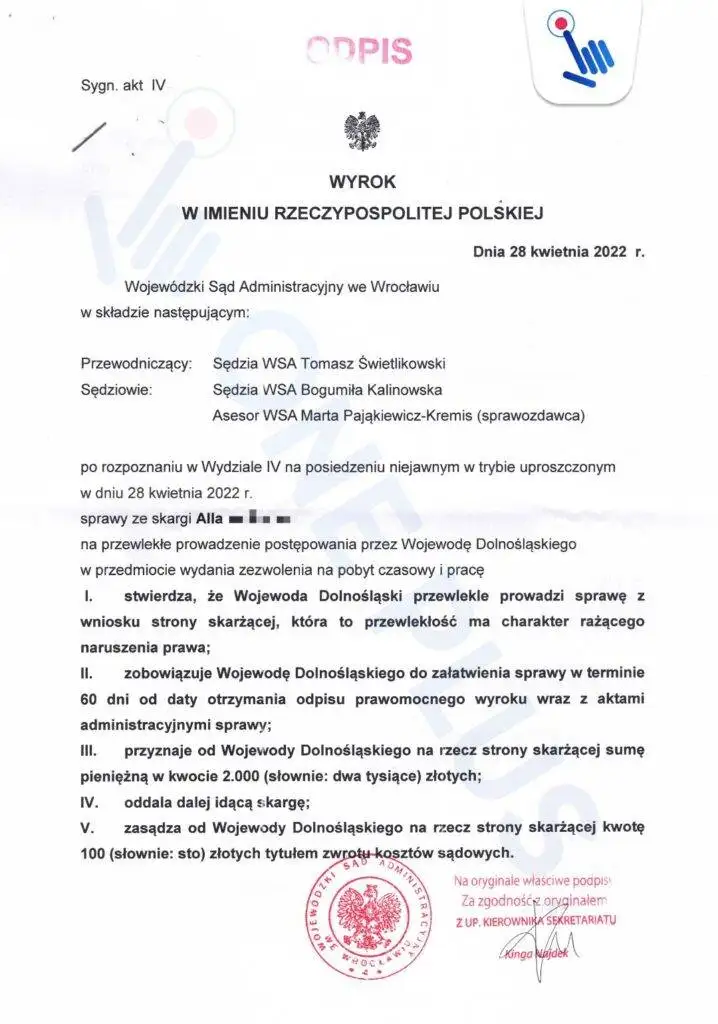
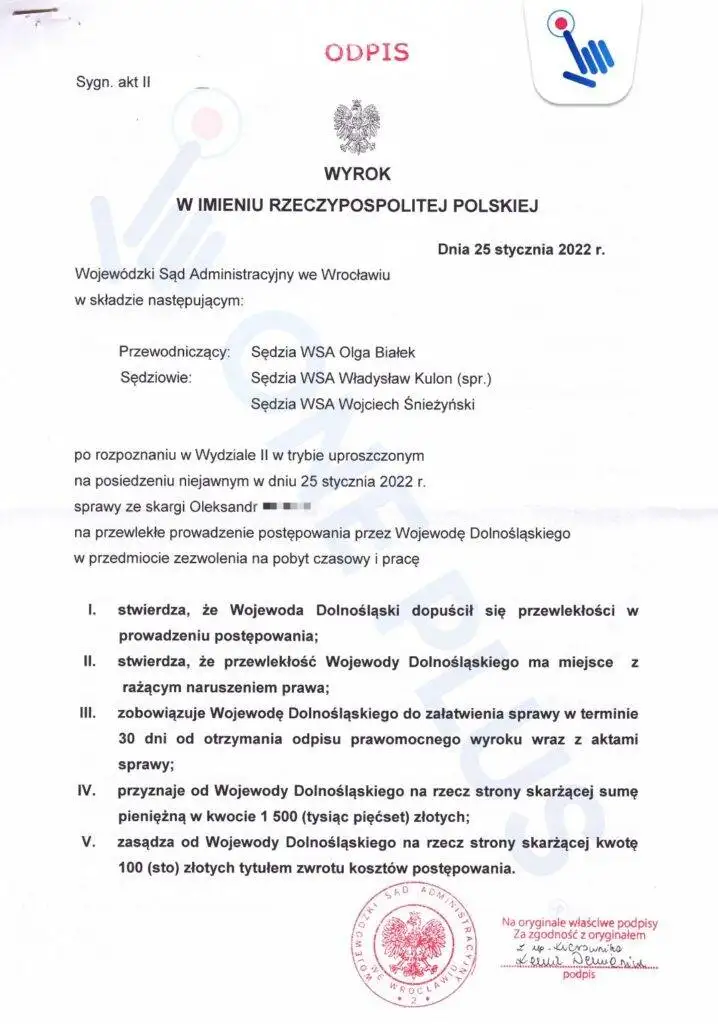
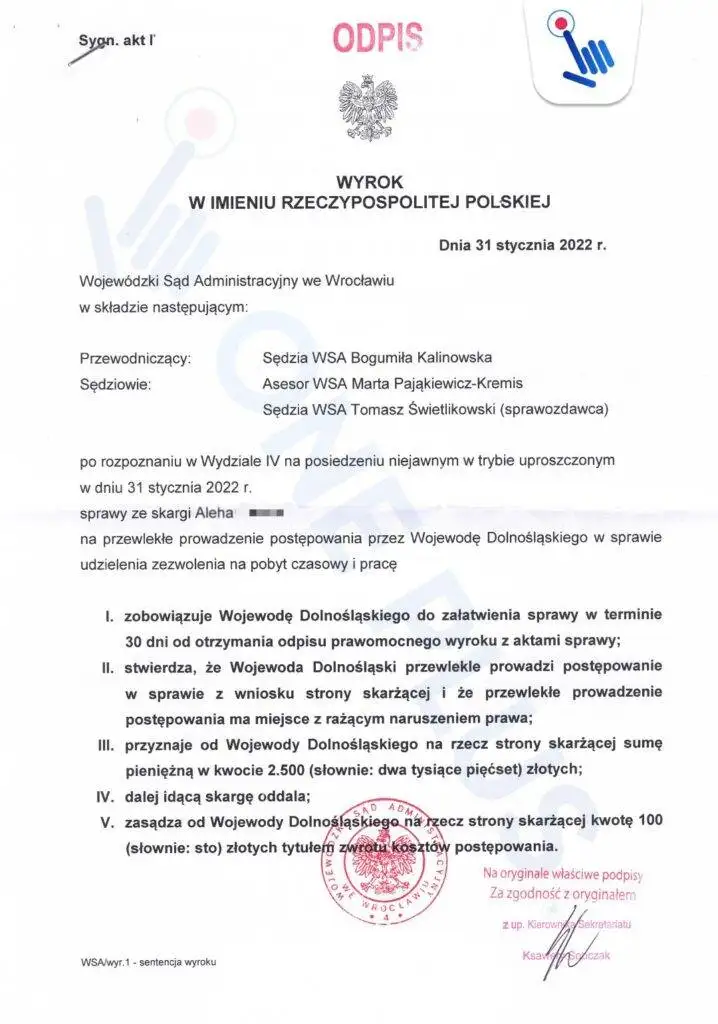
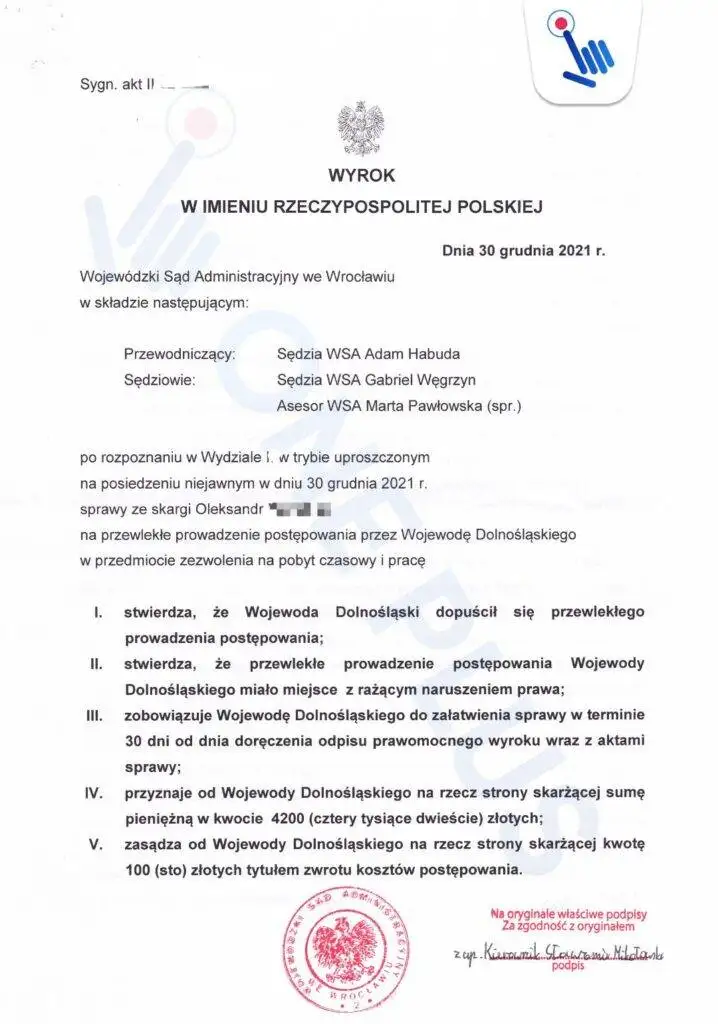
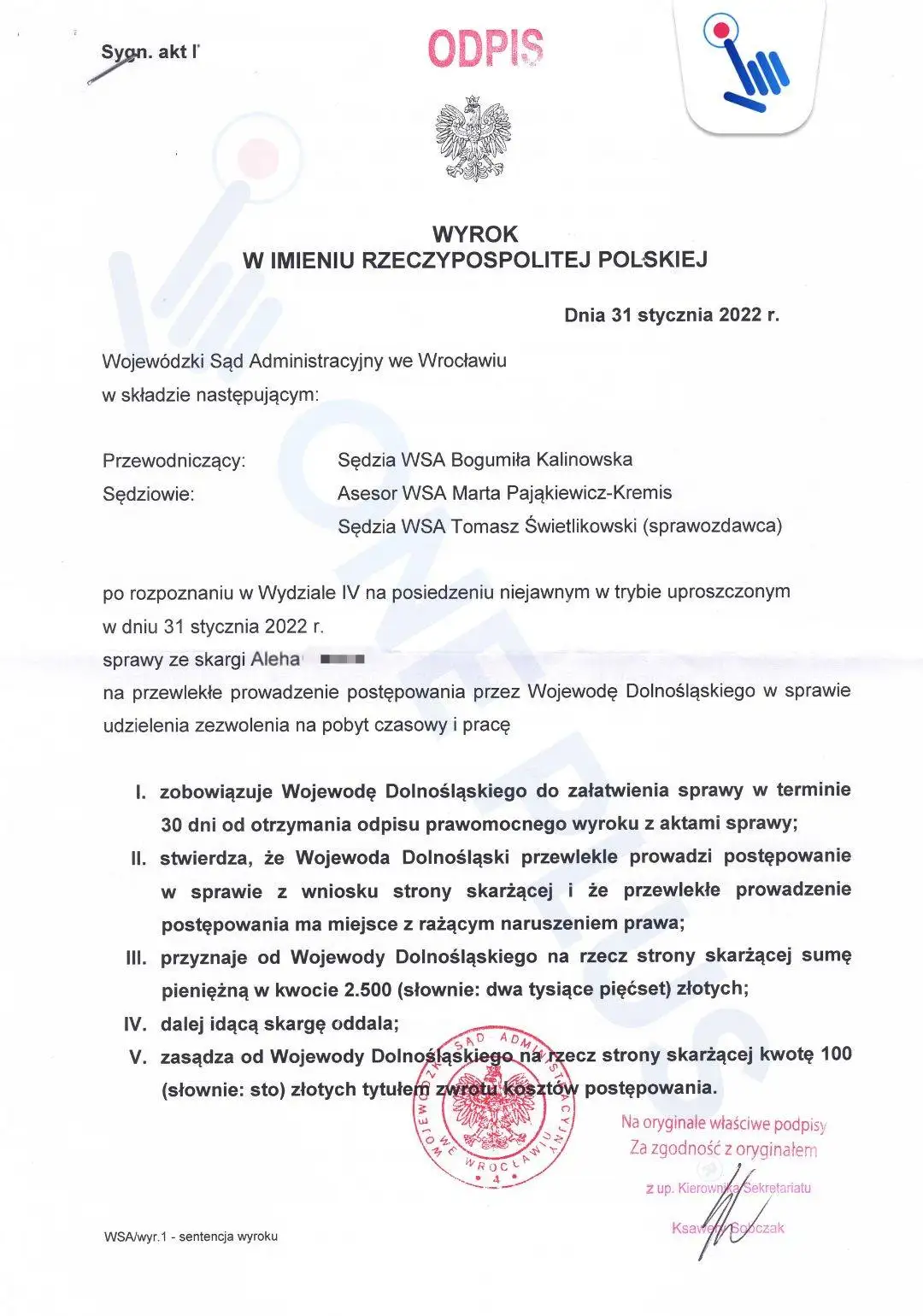
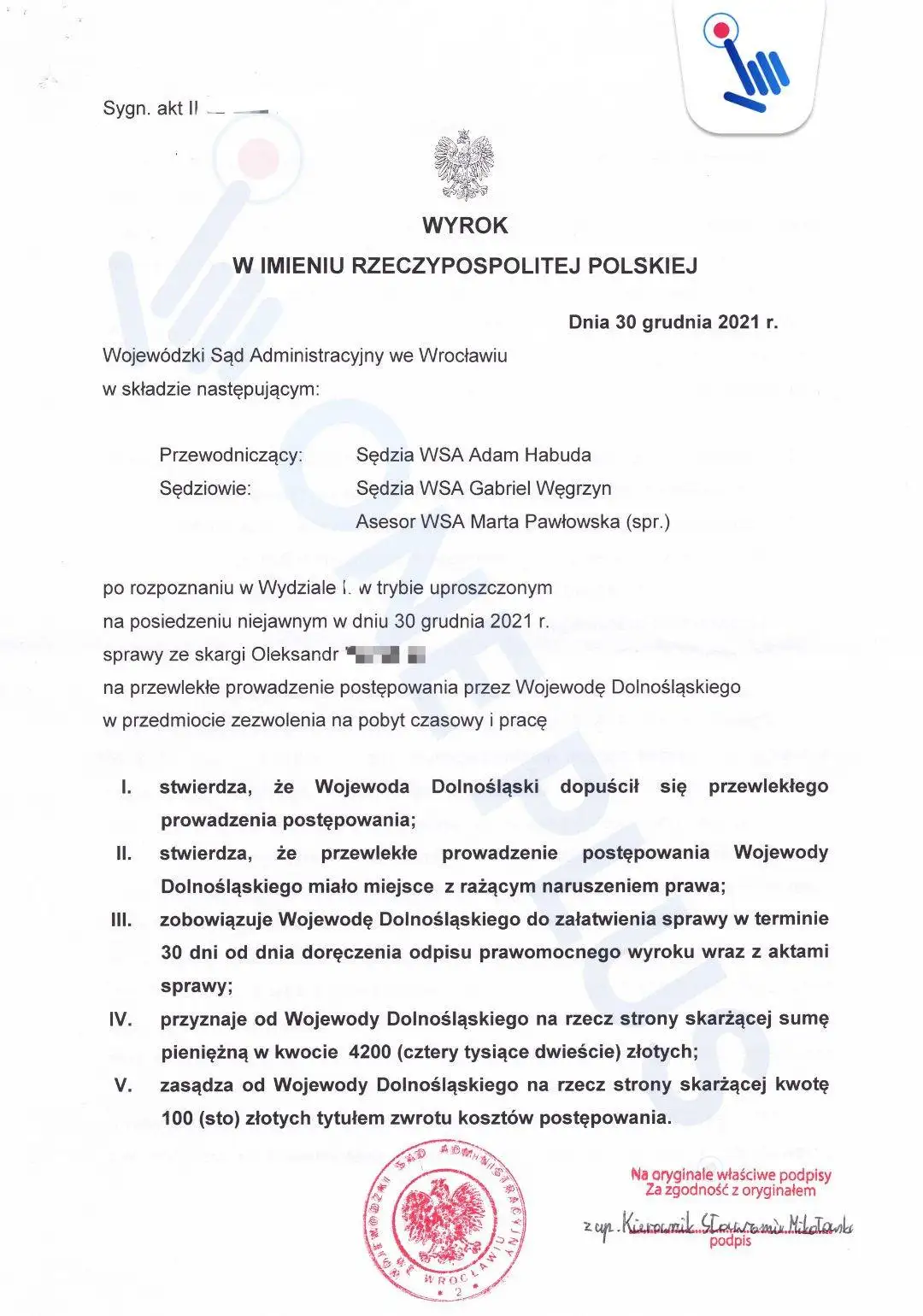
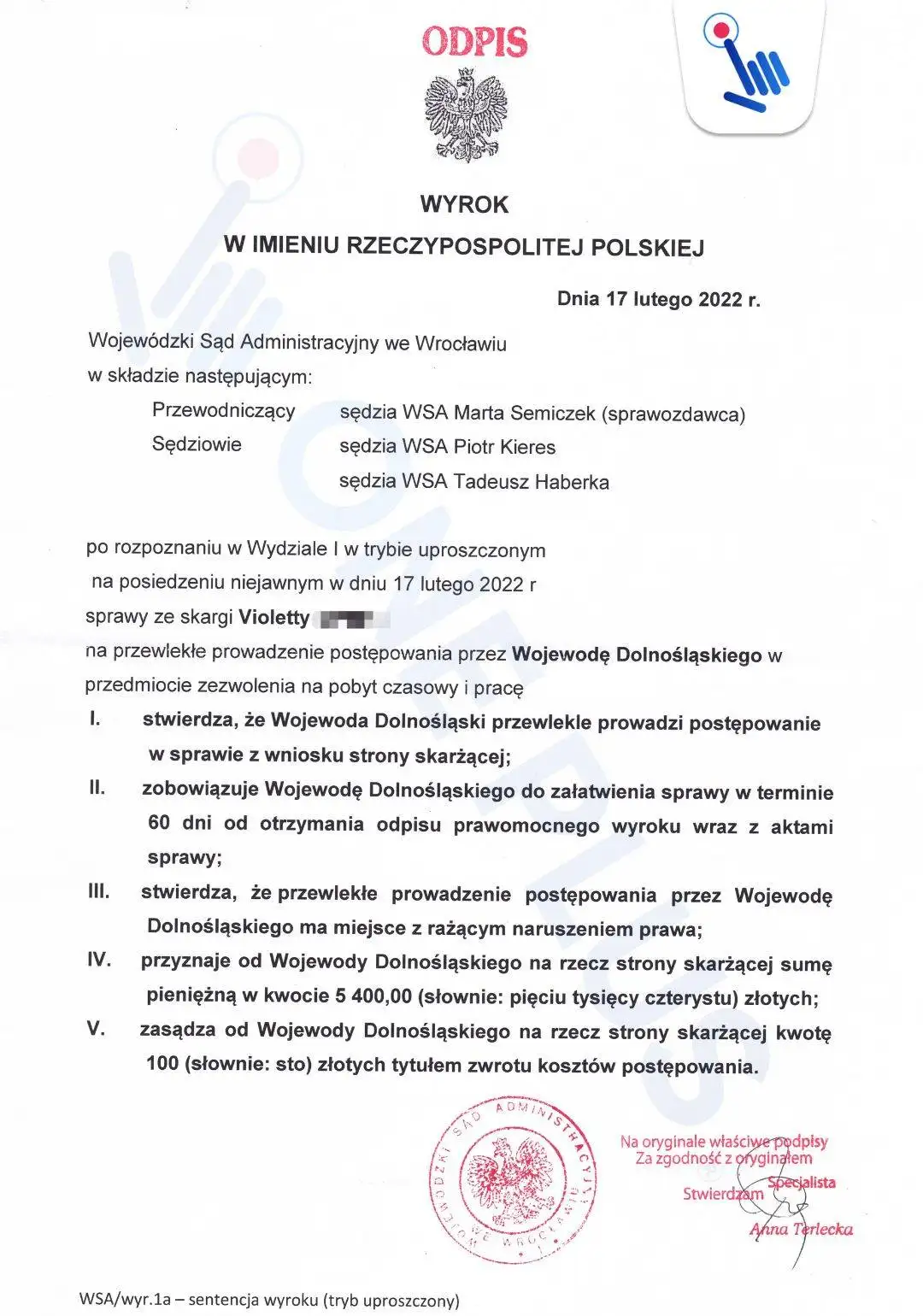
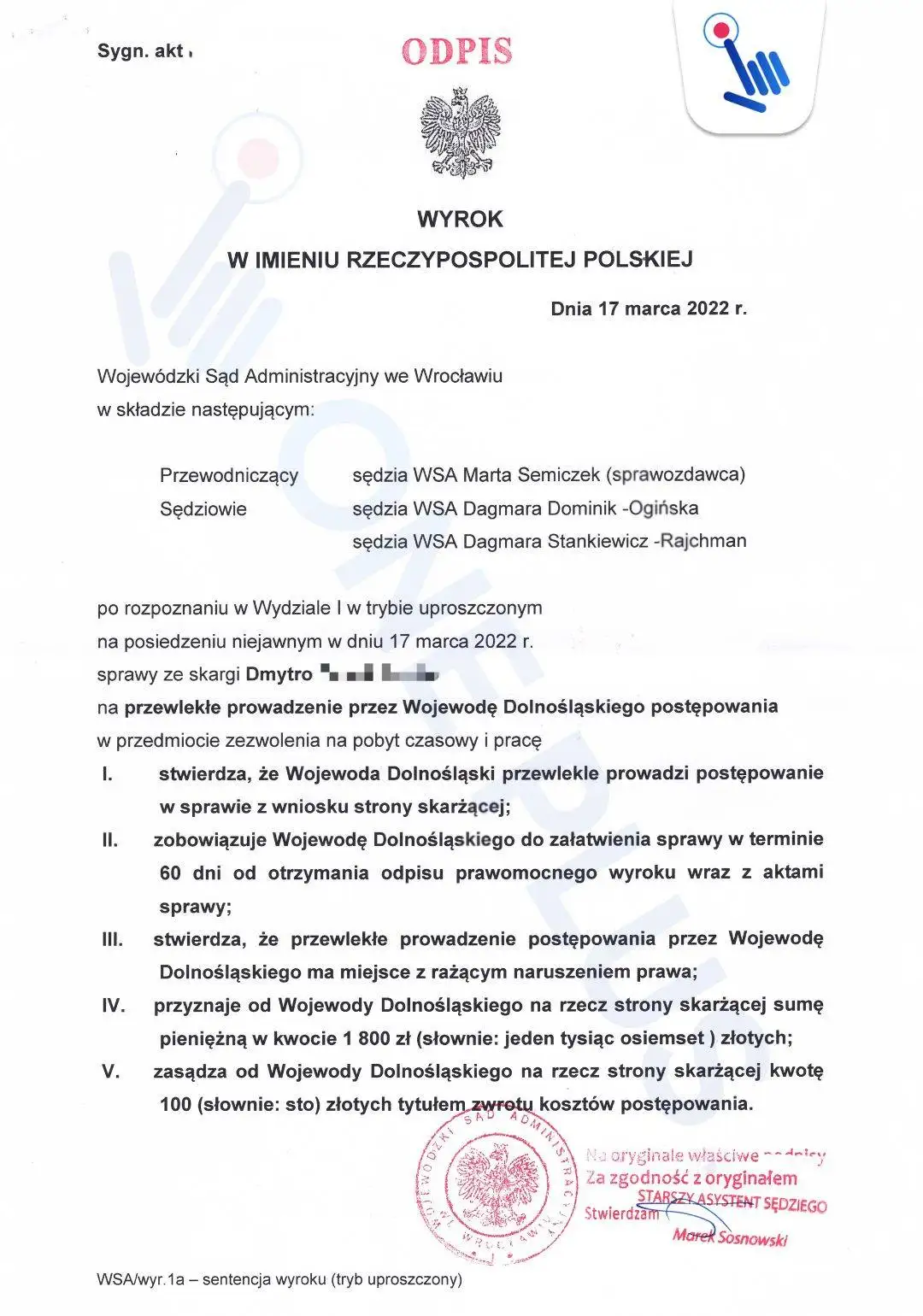
If all required documents have been submitted and the case remains inactive for an unreasonable period, legally available measures such as a formal reminder, known in Polish as a ponaglenie, may be considered.
How ONE PLUS can help
ONE PLUS manages family reunification residence permit cases from the initial legal assessment to the residence decision and collection of the Karta Pobytu.
We determine the correct legal basis, verify the status of the spouse or parent and prepare an individual document list. We also connect applications when family members apply at the same time.
Our team reviews marriage and birth certificates, arranges sworn translations, checks apostille requirements and prepares evidence of income, accommodation and health insurance.
After submission through MOS 2.0, we monitor official correspondence, contact the case officer and prepare responses to requests from the Voivodeship Office. When the sponsor receives a new decision, we add it to the connected family case.
If the proceedings are delayed, we assess whether a ponaglenie or another administrative measure is appropriate. If the application is refused, we review the reasons and prepare an appeal where legal grounds exist.
Why choose ONE PLUS?
ONE PLUS has supported foreign nationals and their families in Poland since 2018. We handle first applications, extensions, connected applications for spouses, residence permits for children and complex cases involving documents issued in different countries.
The company was founded by Tatiana Vyborna, a specialist in administrative and civil law, immigration procedures and the employment of foreign nationals in Poland. She has more than 11 years of practical experience.
Tatiana graduated from the Faculty of Law at the University of Wroclaw and completed postgraduate studies at the Wroclaw University of Economics and Business, specialising in the residence and employment of foreign nationals.
She has represented companies and individual clients during more than 20 inspections involving the Polish Border Guard, National Labour Inspectorate, Tax Office and ZUS. This experience allows ONE PLUS to assess documents not only formally but also from the perspective of how Polish public authorities may examine them.
Tatiana speaks English, Polish, Ukrainian and Russian. She explains immigration procedures in clear language and helps families choose a solution that reflects their actual circumstances.
Our work does not end once the application has been submitted. We build and manage a consistent case in which the family relationship, residence status, address, income and supporting evidence do not contradict one another.
Family reunification with ONE PLUS
If your husband, wife, parent or child already lives in Poland or is applying for their first residence permit, you may be able to start your own family reunification procedure.
You do not always need to wait until the sponsoring family member receives the physical residence card. The important points are to apply during legal stay, prepare the correct documents and clearly connect the applications of the family members.
ONE PLUS can help you obtain a family reunification Residence Permit, TRC or Karta Pobytu in Wroclaw and throughout Poland. We will review your circumstances, prepare the application and manage the case through MOS 2.0 until a decision is issued.
Contact ONE PLUS to receive a clear legal plan for your family’s residence in Poland.






 4,7
4,7