
ONE PLUS handles EU long-term resident permit cases from our office in Wrocław and online across Poland. This is the permit most people mean by permanent residence in Poland. We count your five years date by date, check income, insurance and your B1 Polish document, and prepare your MOS 2.0 application. If the voivodeship office (urząd wojewódzki) sends a request for documents (wezwanie), we write the reply with you.
This page covers one basis. The steps at the office, documents, prices and waiting times for every type of card are on our main page: all types of residence card.
The office does not just look at the card in your wallet. It checks all five years: the basis of each period, gaps between permits, every trip abroad and your income. A few days with no legal basis between two cards are enough for a request or a refusal. So are a forgotten trip or a Polish certificate that is not on the accepted list. If something is missing, we tell you before you file. You sign and submit yourself.
The short version, checked 18 October 2026:
- The permit is indefinite. The residence card is valid for 5 years.
- Stamp duty (opłata skarbowa) is PLN 640, plus normally PLN 100 for the card. For applications filed from 5 March 2026 the PLN 640 is not refunded after a refusal or discontinuation.
- You file online only, in MOS 2.0, since 27 April 2026. Fingerprints follow at the office.
- The legal time is 6 months, but time limits are suspended until 4 March 2027 (art. 100d), so expect longer.
- Our work costs from PLN 1,000 net. Government fees are extra.
Permanent residence in Poland: two permits
Poland has two indefinite permits. The EU long-term resident permit needs five years of legal stay. Permanent residence (pobyt stały) needs Polish ties. This page covers the first.
| Criterion | EU long-term resident permit | Permanent residence (pobyt stały) |
|---|---|---|
| Basis | 5 years of legal residence, no Polish roots | Karta Polaka, Polish ancestry, marriage to or child of a Polish citizen. |
| Income and B1 Polish | both required | generally not required. |
| Residence card | valid 5 years | valid 10 years. |
Karta Polaka holders: see permanent residence based on Karta Polaka. Polish ancestors: see permanent residence based on Polish ancestry.
What the EU long-term permit gives you
The permit is indefinite, and the card is replaced every 5 years without checking income or Polish again. It is not citizenship. You get:
- work without a work permit and without being tied to one employer, and a sole proprietorship (JDG) on the same terms as Polish citizens.
- Schengen travel for up to 90 days in any 180 days.
- a simplified procedure for working or studying in another EU country.
- after 3 years with this status, the right to apply for Polish citizenship recognition by the voivode.
Who can apply
You can apply if you lived in Poland legally and continuously for the five years just before filing and also have:
- stable, regular income for the last 3 years and while the case runs.
- health insurance: ZUS (NFZ) contributions or a private policy that covers treatment in Poland.
- the right to your home: a lease, proof of ownership or another document showing you may live at that address.
- a B1 Polish document from the accepted list (not required under 16).
You need all five at once. Five years will not replace a B1 document, and a good salary today will not cover missing years.
On the filing day you cannot be in Poland on studies, temporary protection (UKR) or international protection. The same applies to an ICT or art. 181 permit and to posted workers. No case is opened then. Students should first switch to a residence permit based on work.
How the five years are counted
The five years run back from the day you file, and the office checks the legal basis of every period, not stamps.
| Counts in full | Counts at half | Does not count |
|---|---|---|
| permits for work, business, family; national visas and visa-free stays unless for studies; waiting for a decision | university studies, doctoral school, vocational training | temporary protection (UKR status). |
| CUKR card, from the day you collect it; international protection over 18 months | international protection under 18 months | school, post-secondary school, language courses, ICT, art. 181 permit, posted workers. |
Okresy pobytu w celu studiów wlicza się do wymaganego pięcioletniego okresu w połowie (art. 212 ustawy o cudzoziemcach).
In short, study counts at half. Two years at university plus three years of work give four qualifying years, not five. A few days with no legal basis between two permits also break continuity.
Visa-free time may count too, and it does not have to be followed immediately by a residence permit. Keep contracts and ZUS records to show you really lived in Poland.
Time outside Poland
Your stay counts as continuous under two conditions. No absence may last more than 6 months, and all absences in five years may add up to no more than 10 months. Longer absences are allowed for work abroad for a Polish employer, an internship during Polish university studies, or illness of up to 6 months.
Typical cases we see
Indian, Pakistani, Nepali and Bangladeshi workers often arrived as students, so study years count at half. Our guide for Indian, Nepali and Bangladeshi citizens covers the earlier permits. Family documents need an apostille and a sworn translation.
UK citizens who moved here before 1 January 2021 fall under Withdrawal Agreement rules: see the guide for UK and Irish citizens. Later arrivals need a temporary permit first.
For Ukrainians, UKR time does not count, and a CUKR card counts from the day you collect it. CUKR alone therefore gives five years no earlier than 2031.
Income requirements
You need stable, regular income for the last 3 years above the social assistance threshold. Officials test whether you and your family can live without social help. Small changes in monthly income do not automatically mean a refusal.
| Income period | Single person | Per family member |
|---|---|---|
| from 1 January 2025 | more than PLN 1,010 net a month | more than PLN 823 net a month. |
| 1 January 2022 to 31 December 2024 | more than PLN 776 net a month | more than PLN 600 net a month. |
Example: a family of three needs more than PLN 2,469 net a month in total (3 × PLN 823). Employment, civil-law contracts, a sole proprietorship (JDG), a board role and pensions count. For a JDG the office uses income from your PIT return, not turnover.
Polish B1: accepted documents
There is no resident exam. Only documents from a closed list count, at B1 or higher:
- a state certificate of proficiency in Polish.
- an ECL or TELC certificate.
- a CEFR statement from an authorised university.
- a school certificate with Polish instruction (not post-secondary).
- a university diploma for studies taught in Polish.
- sworn translator qualifications.
A post-secondary school (szkoła policealna) certificate counts only in cases started before 30 June 2026, if the school was completed before 30 June 2025. Private language school letters are not accepted. See why only a B1 certificate now proves knowledge of Polish.
Documents you need
You need the MOS application, passport, digital photo, proof of the PLN 640 fee, and proof of five years, income, insurance, housing and B1. The list grows with a business or long absences. We give you a personal checklist that says where to get each paper.
| Document | What it proves |
|---|---|
| passport (all pages), old passports, digital photo | identity, trips, earlier stays. |
| proof of paying PLN 640 | stamp duty. |
| all decisions, cards, visas and UPO receipts for 5 years | the basis of each period. |
| list of trips with dates, papers for long absences | the 6 and 10 month limits. |
| PIT returns for 3 years, ZUS certificates, contracts, bank statements | stable income. |
| ZUS (NFZ) contributions or a private policy | health insurance. |
| lease or proof of ownership | the right to your home. |
| certificate, school certificate or diploma | Polish at B1. |
| marriage or birth certificate with apostille and sworn translation | family size for the income test. |
Scans must be complete, with stamps, back pages and blank passport pages. A card or policy number alone is often not enough for insurance: the office may ask for a ZUS confirmation of paid contributions or the full policy. A lease must be current and name the parties, address and term. If the signer is not the owner, the office may ask for proof that this person could let the flat. If a representative files for you, add a power of attorney and the PLN 17 payment. Documents in other languages need a sworn translation.
How we work with you
First we count your five years and check the conditions, then we prepare the application, and after you file we help you answer the office.
- We list your decisions, cards, visas and trips, and work out which periods count in full, at half or not at all.
- We check three years of income against PIT, ZUS, contracts and bank statements.
- We check your Polish document, insurance and proof of address, and give you a document list.
- We prepare the application for MOS 2.0. You log in, sign and file it yourself, and we guide you through each step.
- After you file, we write replies to the office’s letters. The client portal shows the status of your case with us.
- If the decision is positive, we explain how to pay for and collect the card. After a refusal, we go through the reasons and say whether an appeal makes sense. We promise no result: the office decides.
Applying through MOS 2.0
Since 27 April 2026 you apply only through MOS 2.0. You log in via login.gov.pl, sign yourself and keep the UPO receipt (urzędowe poświadczenie odbioru).
Sign with a trusted signature via Profil Zaufany (you need a PESEL number) or a qualified electronic signature. The UPO only confirms that the application was sent, not a decision. Never share your login or signature with anyone, including us. A representative can prepare the form and attachments but cannot sign or submit for you. For how the system works in general, see residence applications via MOS 2.0.
What happens after you apply
- MOS generates a certificate of submission. If you filed during a legal stay, you may remain in Poland until the decision is final. It does not allow Schengen travel.
- The appointment is set at least 7 days after the wezwanie arrives. Bring your original passport and proof of housing, then give fingerprints.
- A wezwanie to add documents gives you at least 14 days. It does not always mean a mistake: sometimes a contract has simply gone out of date.
- The decision comes by post. If positive, you pay for the card and collect it in person.
Cases from Lower Silesia go to the Lower Silesian Voivodeship Office in Wrocław (DUW). Clients from other regions are decided by the office where they actually live, and we work with them too.
Fees and processing time
The stamp duty is PLN 640 and the card is normally PLN 100. By law the decision takes 6 months, but expect longer now.
| Payment | Amount | If refused |
|---|---|---|
| stamp duty | PLN 640 | from 5 March 2026, not refunded after a refusal or discontinuation. |
| residence card | PLN 100, or PLN 50 with relief | a separate payment, the non-refund rule does not apply automatically. |
| power of attorney | PLN 17 | not applicable. |
The PLN 50 relief (art. 237) covers children under 16 on the filing date, study at a Polish post-primary school (szkoła ponadpodstawowa) or university, and hardship. You need a supporting document.
The statutory time is 6 months (art. 222d), but time limits are suspended until 4 March 2027 (art. 100d), so you will wait longer. Treat this as a guide, not a forecast.
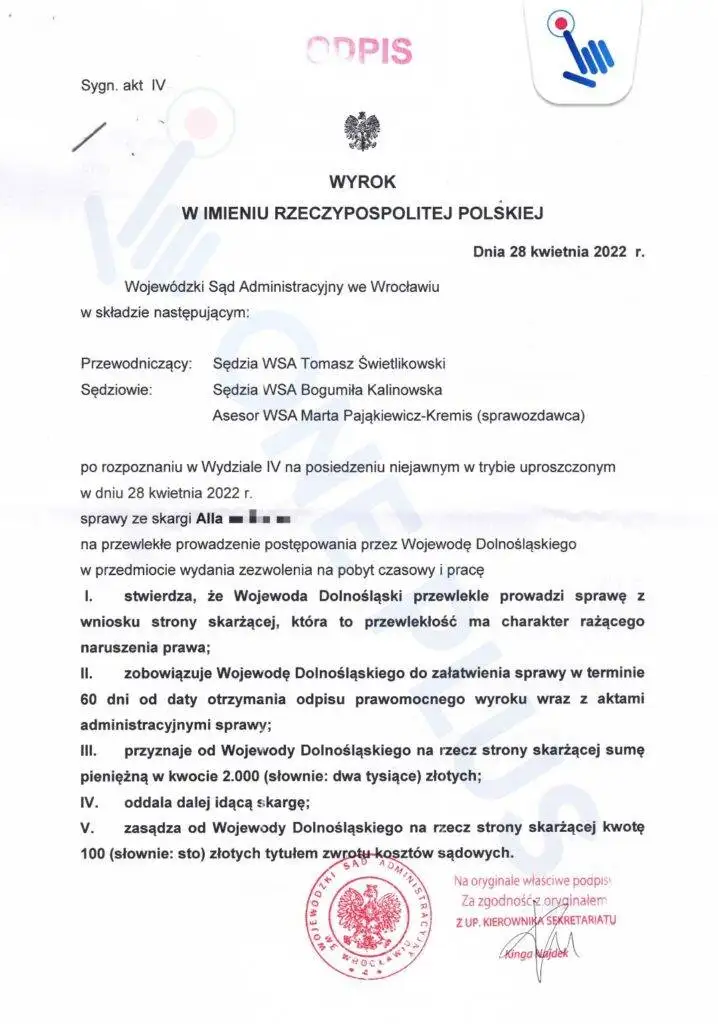
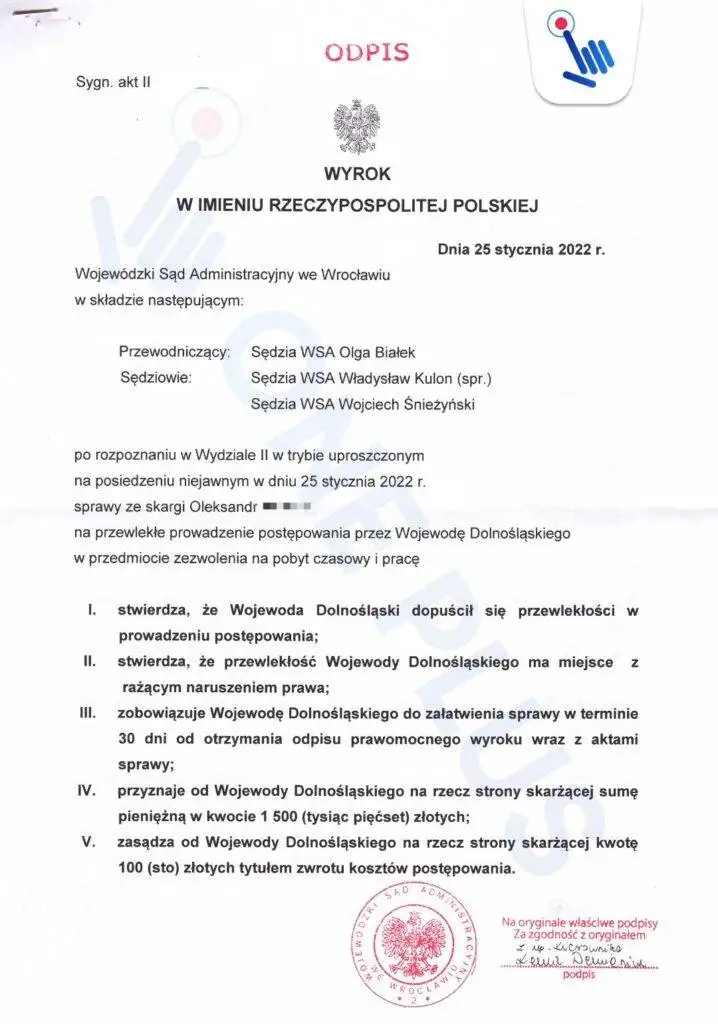
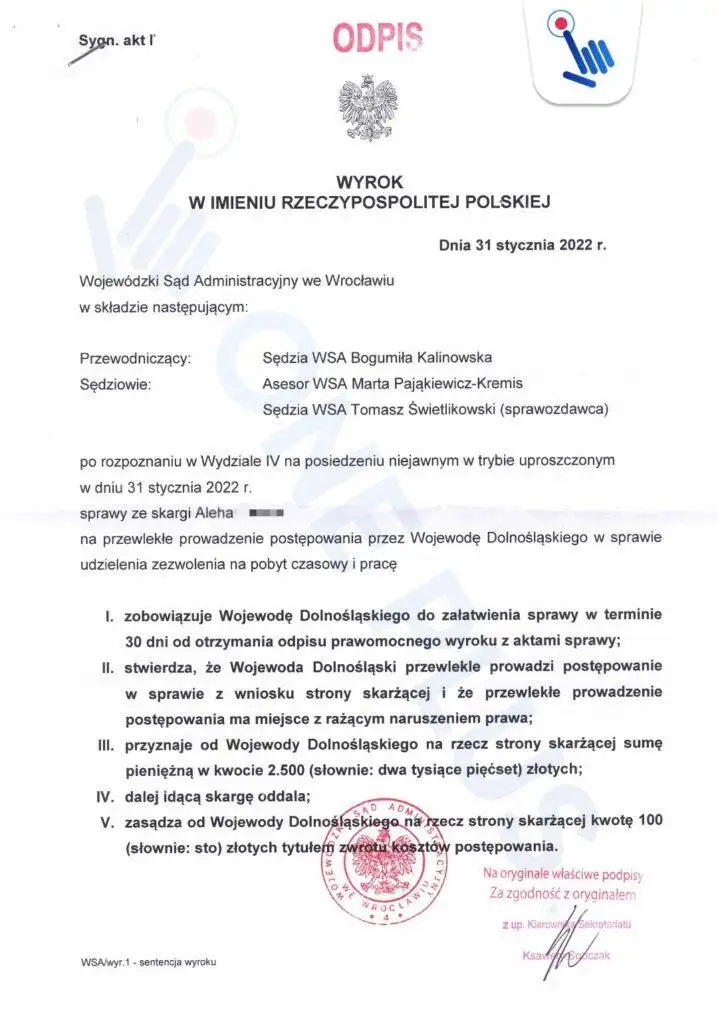
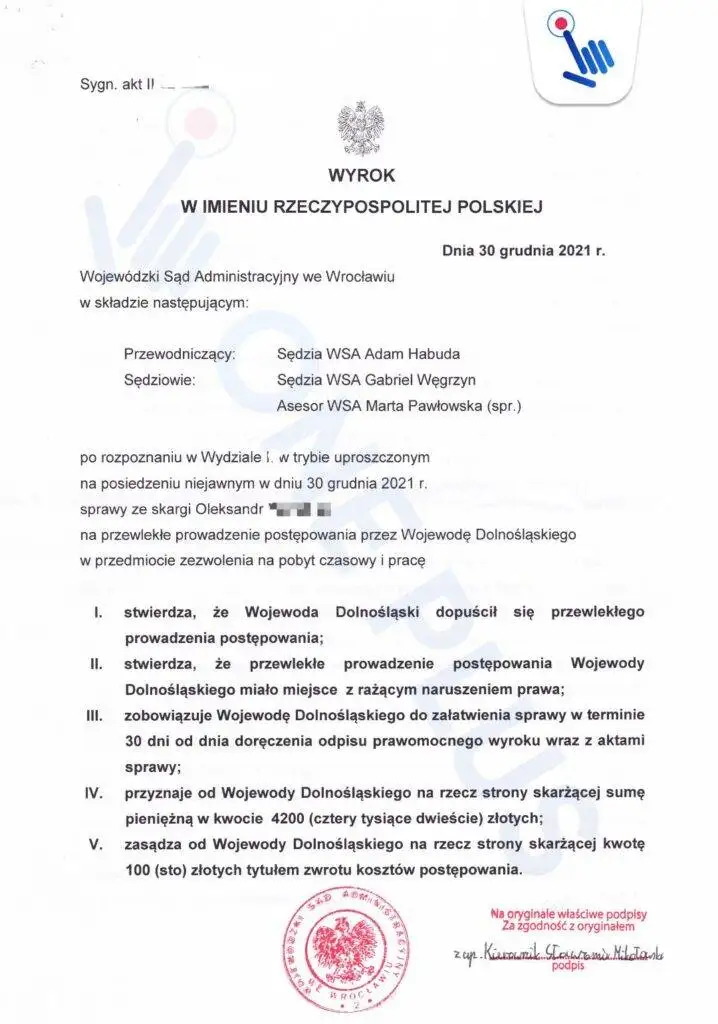
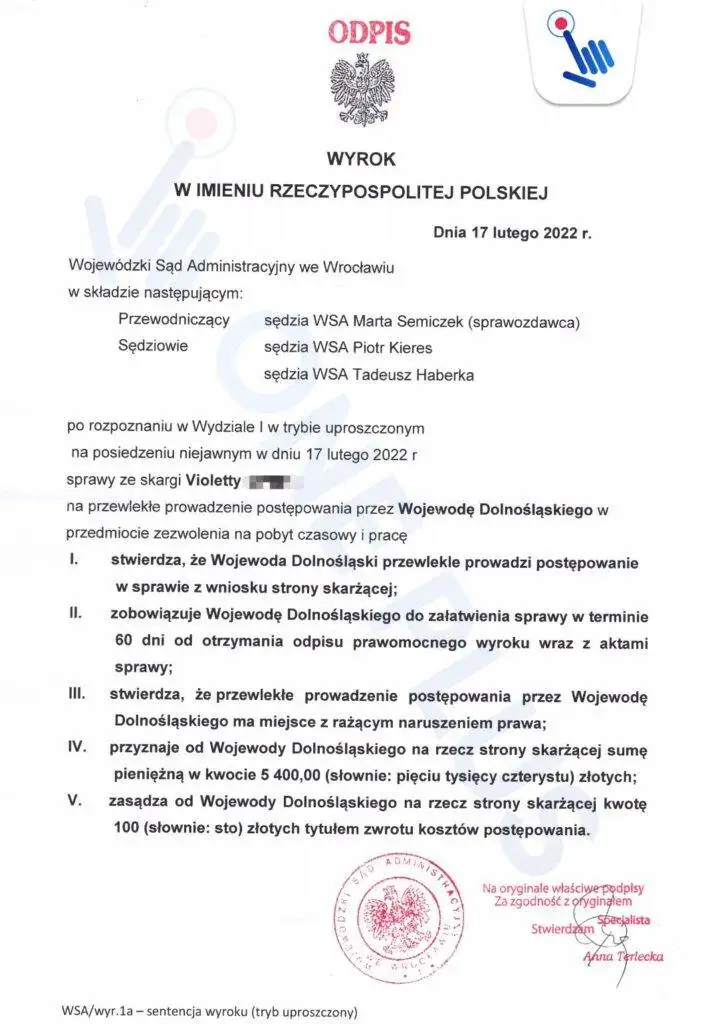
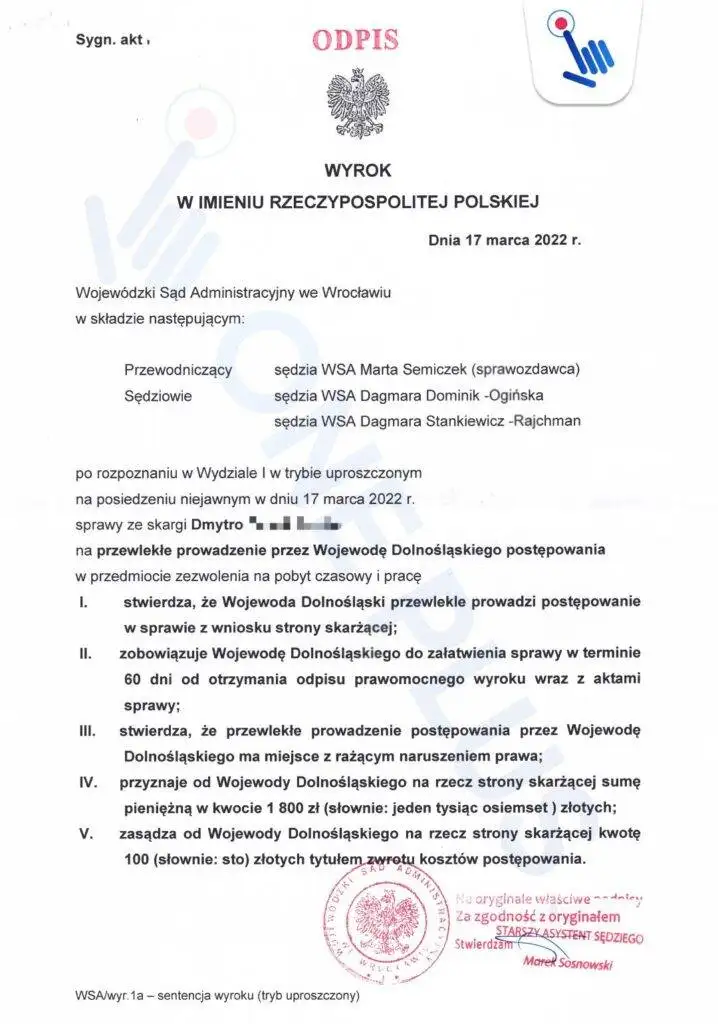
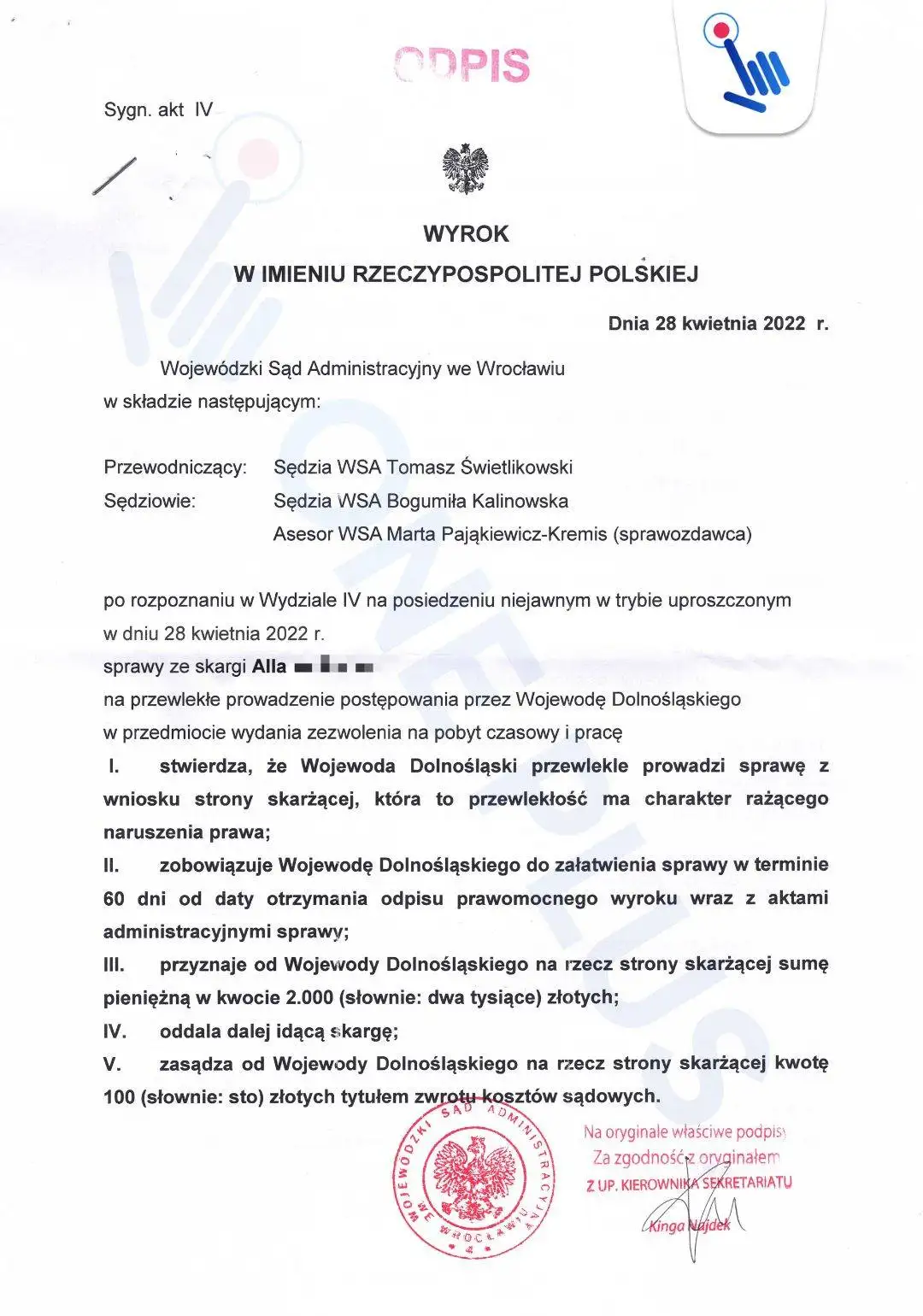
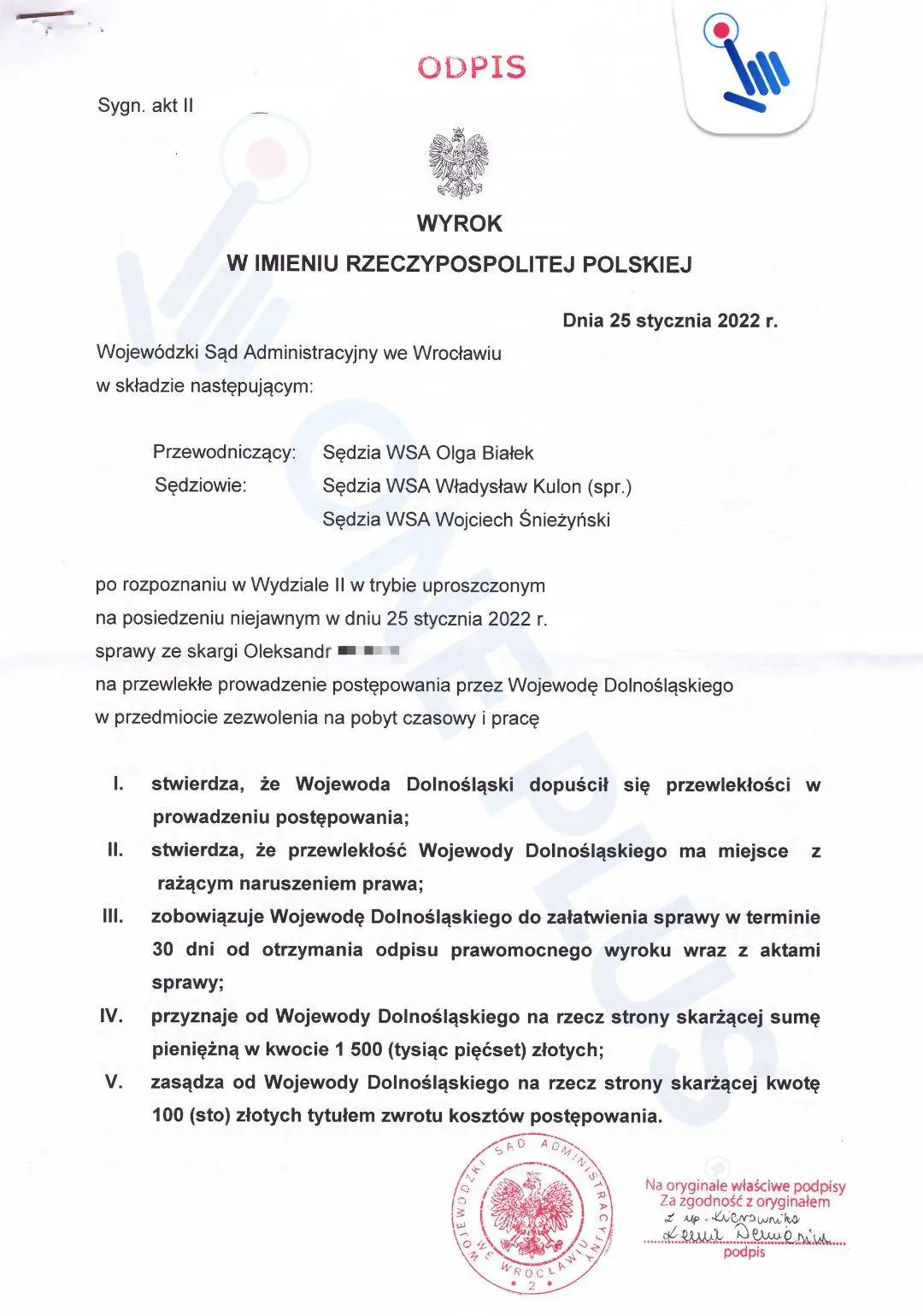
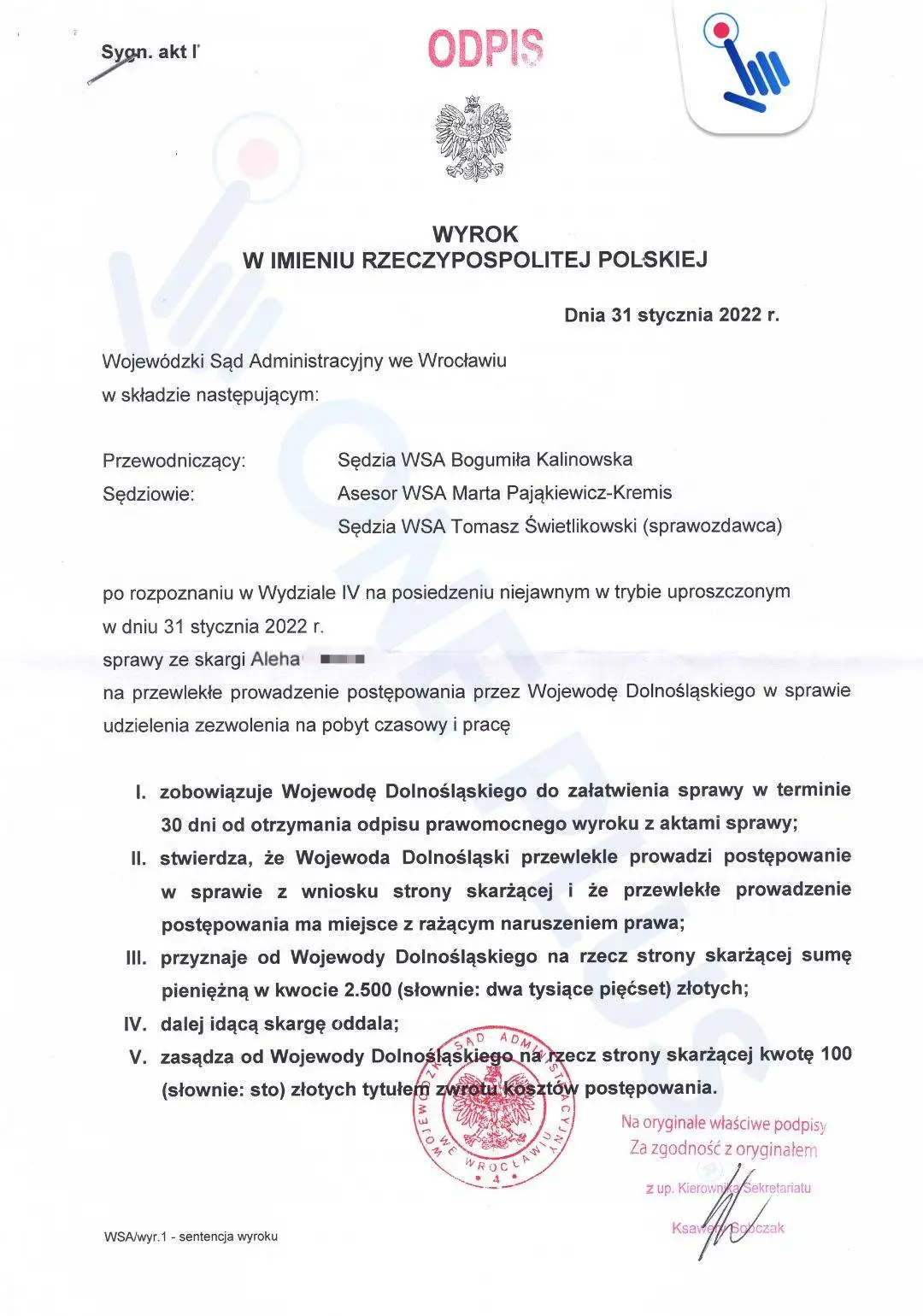
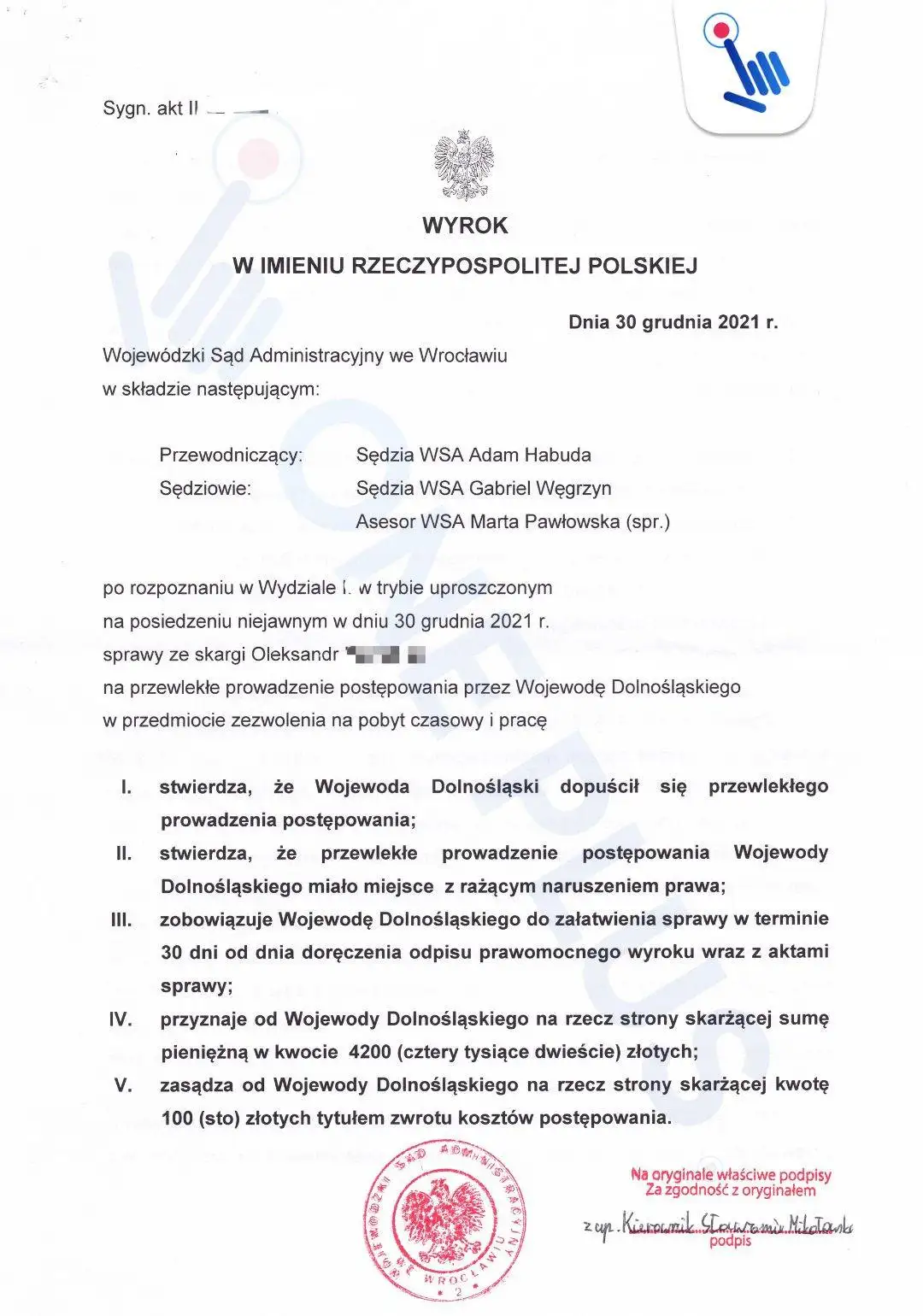
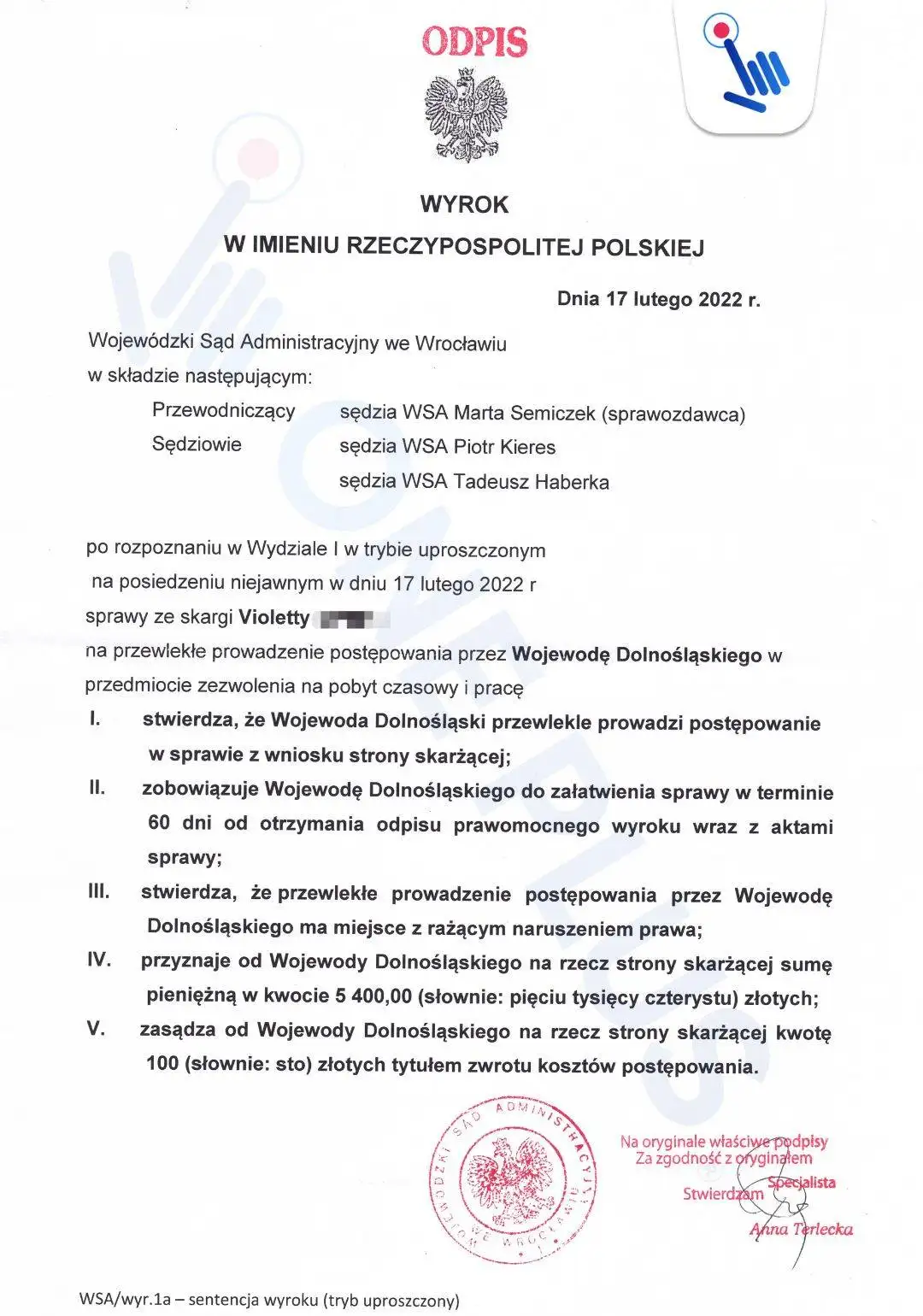
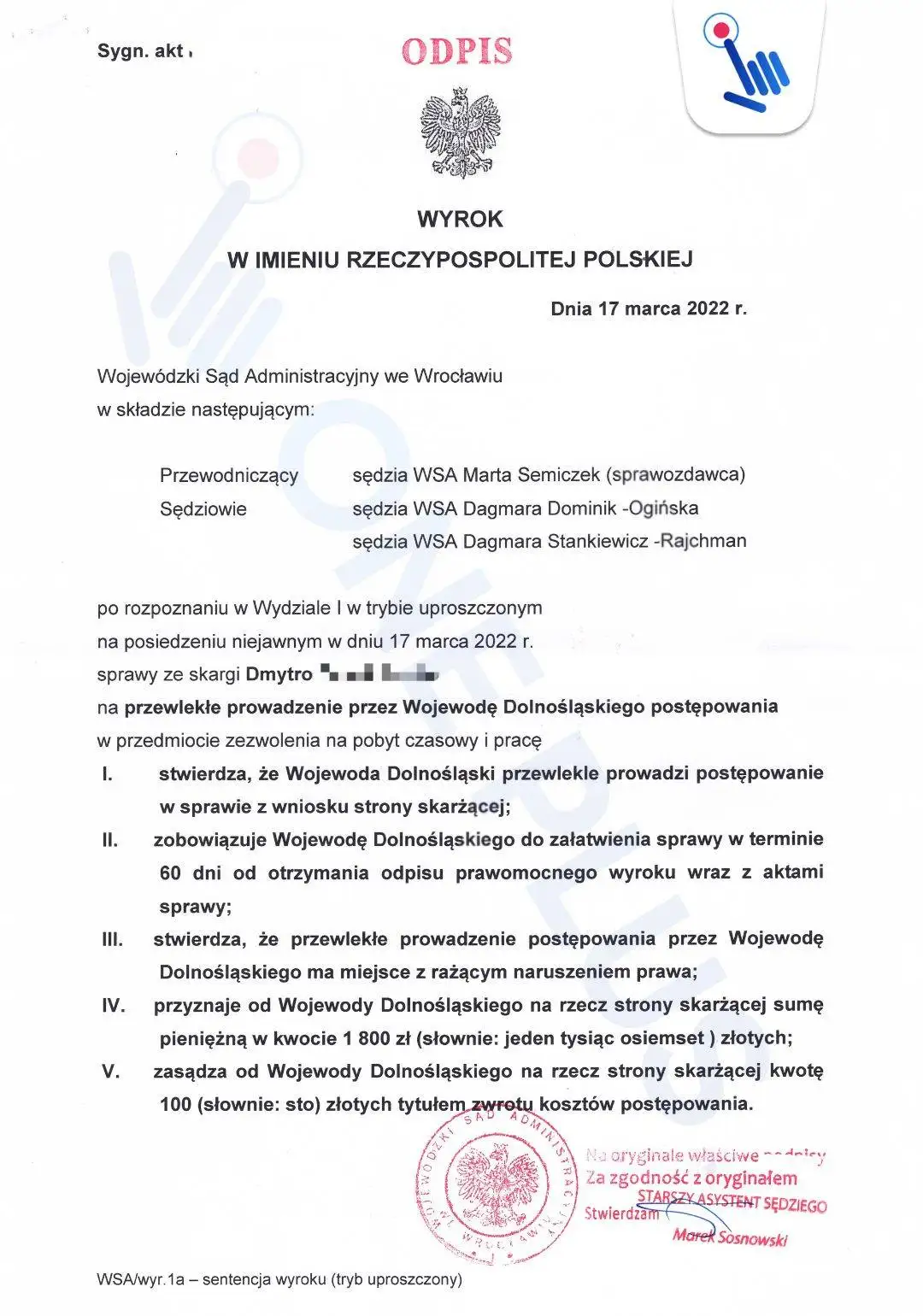
A long-term resident case stands on your five years. The office checks every permit and every visa-free period, and one gap in the dates can bring a wezwanie. If your case has stalled, we recalculate the five years with you and add the missing papers.
If the deadline has passed, we prepare a ponaglenie (a complaint about the delay). Our legal training helps us spot a gap in the dates early. The office decides the timing, and we cannot promise a date or compensation. See delays in EU long-term resident cases.
Why applications are refused
The usual reasons are miscounted years, undocumented income and a Polish certificate that is not on the list.
- study years counted in full, so five years are not there on the filing date.
- a gap with no legal basis between two permits.
- absences over 6 months at a time or 10 in total, with no proof.
- PIT that does not match ZUS.
- filing from a student permit or with UKR status.
If a wezwanie arrives, reply before the date in the letter. After a refusal, the appeal deadline and address are in the decision, so show it to a lawyer at once. Sometimes it is better to wait and file later: the PLN 640 is not refunded after a refusal.
What our work costs
Our work costs from PLN 1,000 net, depending on how much you hand over. Government fees and translations are extra.
| What we do | Price, net |
|---|---|
| consultation, five-year calculation, document check, help with the application, instructions for the appointment | PLN 1,000. |
| the same, plus replies to the office’s letters and a client portal | PLN 2,500. |
| the same, plus power of attorney, ZUS and PIT certificates, coming with you to the appointment, steps if the case stalls, an appeal after a refusal | PLN 2,700. |
Details are in the ONE PLUS price list. Want to file alone? Our guide how to get an EU long-term resident permit in Poland walks you through it.
Expert view
Long-term resident cases are run by a team led by Tatiana Vyborna, President of the Management Board of ONE PLUS. She has more than 12 years of practice in legalising foreigners’ stay and employment and a law degree from the University of Wrocław. She also completed a postgraduate programme at Uniwersytet Ekonomiczny we Wrocławiu. She has represented clients in more than 25 inspections by the Border Guard (Straż Graniczna), the National Labour Inspectorate (PIP), the Social Insurance Institution (ZUS) and the Tax Offices (Urząd Skarbowy).
In Tatiana Vyborna’s experience, people who moved from studies to work often apply too early because they count study years in full. List every permit and visa-free period with dates, and halve the study periods. This table shows whether you are at five years or a year short. Tatiana Vyborna’s profile.
Check your eligibility
Not sure you have five years? Leave a request in the form below or contact us. We will count your periods and tell you what to prepare.
Updated: 20 October 2026. Sources: MOS 2.0, EU long-term resident permit, Office for Foreigners on gov.pl, Lower Silesian Voivodeship Office, Journal of Laws 2026 item 203.
Not sure this basis fits you? Our page on help with karta pobytu has a table of situations with the matching basis, plus a comparison of card types.






 4,7