
ONE PLUS helps foreigners obtain a karta pobytu, the Polish residence permit, in Wrocław and manages such cases across Poland. We check which legal basis fits your situation, prepare the application and documents, file it through MOS 2.0, handle correspondence with the voivodeship office and follow the case until the decision is issued.
We support residence permits based on work, business, studies and family reunification, as well as the EU Blue Card, the CUKR card, permanent residence and EU long-term resident status. Difficult cases are part of the routine: long waits, requests for extra documents, a change of employer, refusals. More than 12 years of practice and over 15,000 clients mean most risks are visible to us before filing. You can choose partial support (review and filing) or full support (case management to the decision), in person in Wrocław or remotely from anywhere in Poland.
In brief, as of 18 October 2026:
- Karta pobytu is the residence card for non-EU nationals. In English it is called a residence permit or TRC. Your rights, such as the right to work, are set out in the voivode’s decision (decyzja), not on the plastic.
- Official fees: PLN 440 for work and the EU Blue Card, PLN 340 for studies, family, business, CUKR and most other temporary grounds, PLN 640 for permanent and EU long-term residence, plus PLN 100 for the card itself.
- Validity: a temporary card for up to 3 years, CUKR 3 years, a permanent residence card 10 years, an EU long-term resident card 5 years.
- Filing: since 27 April 2026 online only, through MOS 2.0 with an electronic signature.
- Main risk: the wrong legal basis, or details that differ between your contract, the employer’s attachment and the form. Since 5 March 2026 the stamp duty is not refunded after a refusal.
- ONE PLUS support: from PLN 700 depending on the basis, CUKR from PLN 500. Official fees are paid separately.
Karta Pobytu, TRC or Residence Permit?
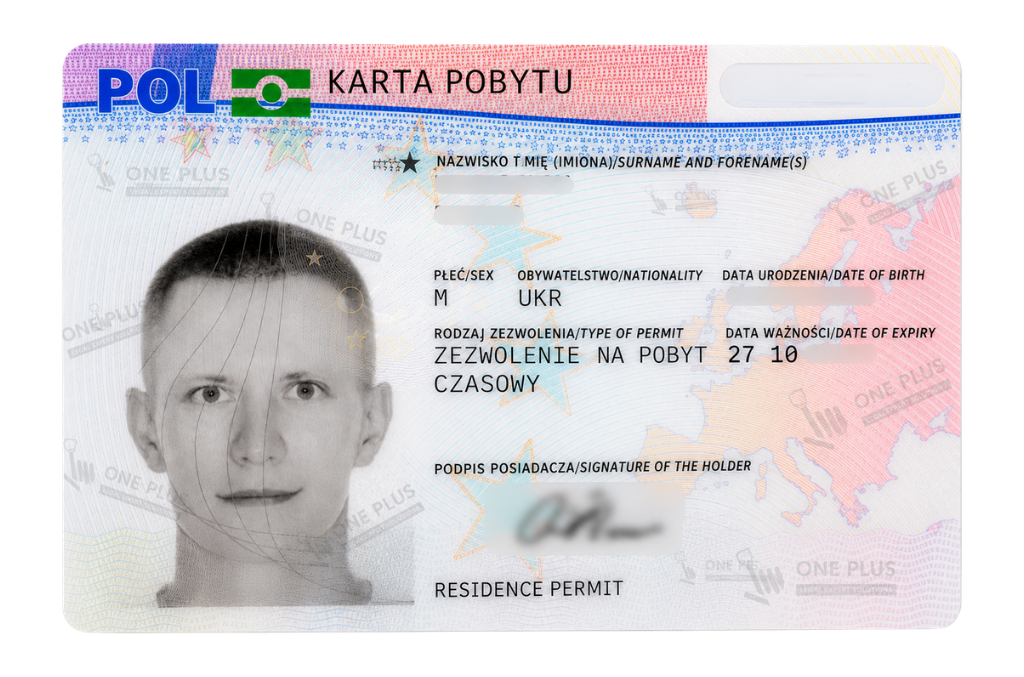
These words are used as synonyms, but legally there are two things. First the voivode, the regional governor acting through the voivodeship office (urząd wojewódzki), issues a decision granting the permit (zezwolenie). The decision states your basis, how long you may stay and the conditions, for example your employer and position. Only then does the office produce the plastic card with your photo and fingerprints. The Act on Foreigners defines the card like this:
Karta pobytu, w okresie swojej ważności, potwierdza tożsamość cudzoziemca podczas jego pobytu na terytorium Rzeczypospolitej Polskiej oraz uprawnia go, wraz z dokumentem podróży, do wielokrotnego przekraczania granicy bez konieczności uzyskania wizy.
In plain English: while valid, the card confirms the foreigner’s identity during the stay in Poland and, together with a travel document, allows multiple border crossings without a visa. In practice this means you can live in Poland for the period stated in the decision, leave and re-enter the country, and travel in the Schengen Area for up to 90 days in any 180 days. The card does not let you live or work in another EU country. Access to the Polish labour market depends on your basis: a work-based permit is tied to the conditions in the decision, while permanent residence, EU long-term residence and CUKR give free access.
EU, EEA and Swiss citizens do not apply for a karta pobytu; they register their stay under separate rules. For everyone else a temporary permit is usually the first step: after 5 years of legal and continuous residence you may apply for EU long-term resident status, and lawful visa-free stay may count towards those 5 years, subject to the continuity rules.
Which Legal Basis Fits You
Your basis must match what you actually do in Poland. The table lists every ground we handle, the official stamp duty and the starting price of our ONE package (preparation and filing). The PLN 100 card fee is added in every case.
| Basis | Who it is for | Stamp duty | ONE PLUS from | Details |
|---|---|---|---|---|
| Work | employees of Polish companies; the employer signs an attachment in MOS | PLN 440 | PLN 800 | work-based residence permit |
| Studies | students at Polish universities | PLN 340 | PLN 700 | student residence permit |
| Business | owners of a sole proprietorship (JDG) and board members of a sp. z o.o. | PLN 340 | PLN 1,000 | business residence permit |
| Family | spouses and children of foreign residents and Polish citizens | PLN 340 | PLN 700 | family reunification permit |
| UKR status | Ukrainian citizens with UKR status for at least 365 days | PLN 340 | PLN 500 | CUKR card for Ukrainians |
| Highly qualified work | specialists with a degree or senior experience and a high salary | PLN 440 | PLN 900 | EU Blue Card in Poland |
| International transport | truck drivers | PLN 440 | PLN 800 | residence permit for truck drivers |
| Religious service | priests, monks and members of religious communities | PLN 340 | PLN 700 | residence permit for clergy |
| Karta Polaka | holders of the Pole’s Card (exempt from the PLN 640 duty) | PLN 0 | PLN 700 | permanent residence with Karta Polaka |
| Polish ancestry | people who can document Polish roots | PLN 640 | PLN 1,000 | permanent residence based on Polish ancestry |
| 5 years in Poland | with stable income and Polish at B1 level | PLN 640 | PLN 1,000 | EU long-term residence |
| Any basis, online | if you only need preparation and filing | per basis | PLN 800 | MOS 2.0 residence permit application |
Can you get a residence card without a job? Yes, if you have another basis: studies, family, your own business, Karta Polaka, Polish ancestry or UKR status. Simply wanting to live in Poland is not a legal basis.
Documents and Legalisation
The core set is almost always the same:
- a valid passport (scan of all pages; you show the original when giving fingerprints);
- a digital photo that meets the MOS requirements;
- proof of the stamp duty and the card fee;
- documents for your purpose: contract and employer attachment, university certificate, company documents, marriage or birth certificates;
- health insurance and proof of income or funds, where your basis requires them;
- sworn translations into Polish of foreign documents.
Documents issued abroad usually need an apostille if your country is a party to the Hague Convention (India, the Philippines and Pakistan are, among others; in India the apostille is issued by the Ministry of External Affairs). Otherwise consular legalisation applies. A Polish sworn translation comes after the apostille, not before. A country-specific checklist is in our guide for Indian, Nepali and Bangladeshi citizens.
For grounds without a job, income is measured against the social assistance threshold: at least PLN 1,010 a month for a single person or PLN 823 per family member after housing costs. For a work-based permit, the salary in the employer’s attachment cannot be lower than the minimum wage: PLN 4,806 gross in 2026 and PLN 4,950 from 1 January 2027.
How to Apply Through MOS 2.0
Since 27 April 2026, applications for temporary residence, permanent residence and EU long-term residence are accepted only online through MOS (Moduł Obsługi Spraw). Paper filing remains only for a few family cases filed from abroad.
- Create a new MOS account; old accounts were not carried over. You log in through login.gov.pl.
- Arrange your signature. A foreigner who files on their own behalf signs with a Trusted Profile (Profil Zaufany, the trusted signature) or a qualified electronic signature. The personal signature on an e-ID card is provided for legal representatives, for example a child’s parents. A Trusted Profile requires a PESEL number, so newcomers should sort out access well before their visa or visa-free days run out.
- Fill in the form and upload a scan of every passport page, a digital photo, proof of payment and the documents for your basis.
- For work, studies or an internship, enter the email address of your employer or university. They sign their own attachment in MOS.
- Sign and submit. The system issues a UPO (Urzędowe Poświadczenie Odbioru), the official receipt confirming that the application arrived.
- Once the office has checked the file, MOS shows a certificate of submission (zaświadczenie). It replaced the old passport stamp.

Your account and signature belong to you alone: never share your login, not even with us. We prepare the form and attachments, and you sign. A photo that passes the system check can be made with our DocPhoto Online tool.
Official Fees and Payments
| Payment | Amount | Paid to |
|---|---|---|
| Stamp duty (opłata skarbowa): temporary residence and work, EU Blue Card | PLN 440 | city account (in Wrocław, Gmina Wrocław) |
| Stamp duty: studies, family, business, CUKR, other temporary grounds | PLN 340 | city account |
| Stamp duty: permanent residence, EU long-term residence | PLN 640 (Karta Polaka holders: PLN 0) | city account |
| Issue of the card | PLN 100 | voivodeship office |
| Reduced card fee (Article 237) | PLN 50 | voivodeship office |
| New card after a loss caused by you | PLN 200, PLN 300 for a repeat loss | voivodeship office |
| Power of attorney for a representative | PLN 17 | city account |
These are two separate transfers, and both confirmations are uploaded in MOS. The card normally costs PLN 100. The reduced fee of PLN 50 applies where the law provides for it and you attach proof: children under 16 on the filing date, people studying at a Polish secondary school (szkoła ponadpodstawowa) or university, and applicants in financial hardship. Some procedures have exceptions: a CUKR card always costs PLN 100, even for a child.
For applications filed on or after 5 March 2026, the stamp duty of PLN 340, 440 or 640 is not refunded if the case ends in a refusal or is discontinued (umorzenie). The PLN 100 card fee is a separate payment and this rule does not apply to it automatically; whether it can be recovered depends on the circumstances of the case. For CUKR the rule is stricter: the PLN 340 is also kept if the application is left unexamined, and if a ready card is not collected within 60 days both payments are lost.
How Long Does It Take?
Filing, registration, fingerprints, decision and card production are separate stages, and mixing them up is why a case often seems to be stuck. The UPO only means the application arrived; the certificate in MOS means the office accepted it; a summons (wezwanie) calls you for fingerprints or extra documents and must be answered by the deadline in the letter; the decision is sent to your address for correspondence; the card is printed only after the decision and the PLN 100 payment, and you collect it in person with your passport.
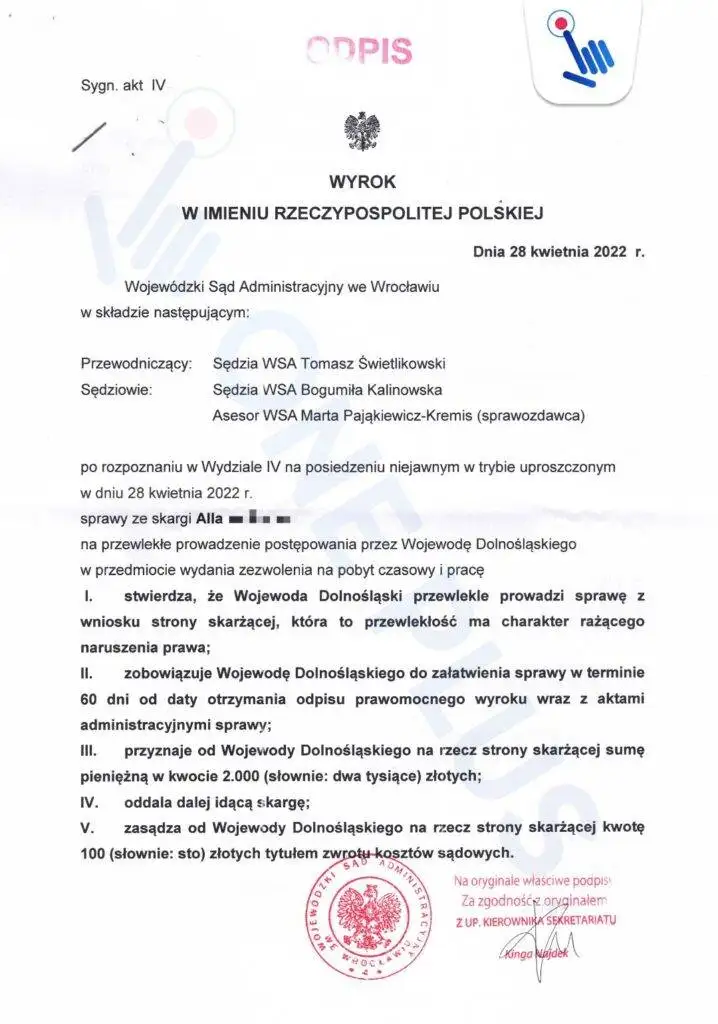
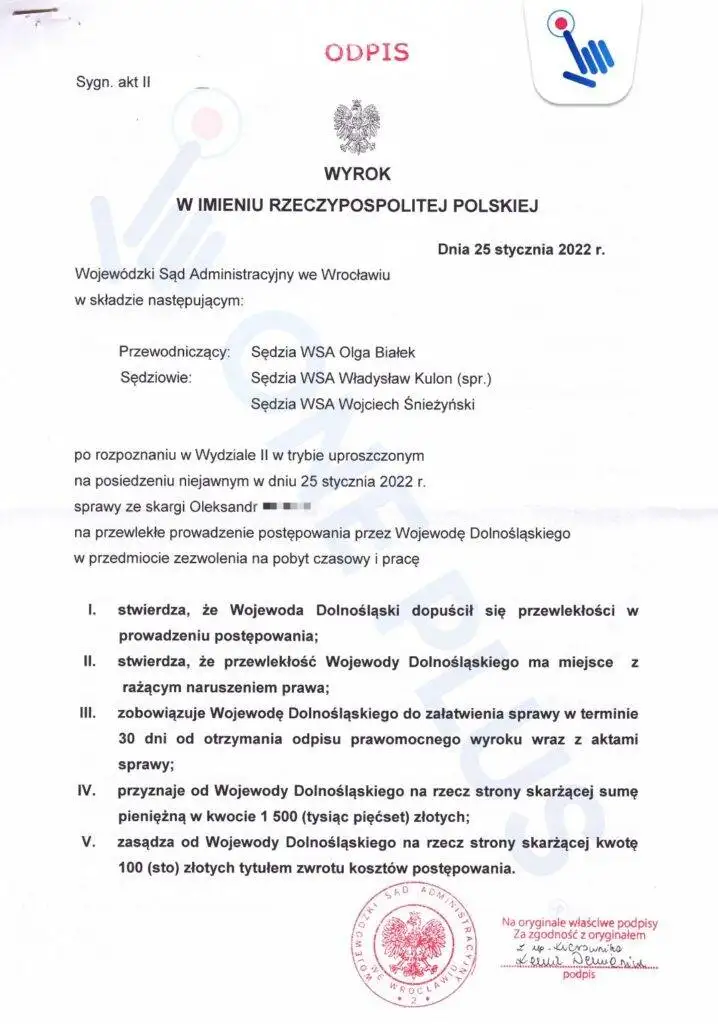
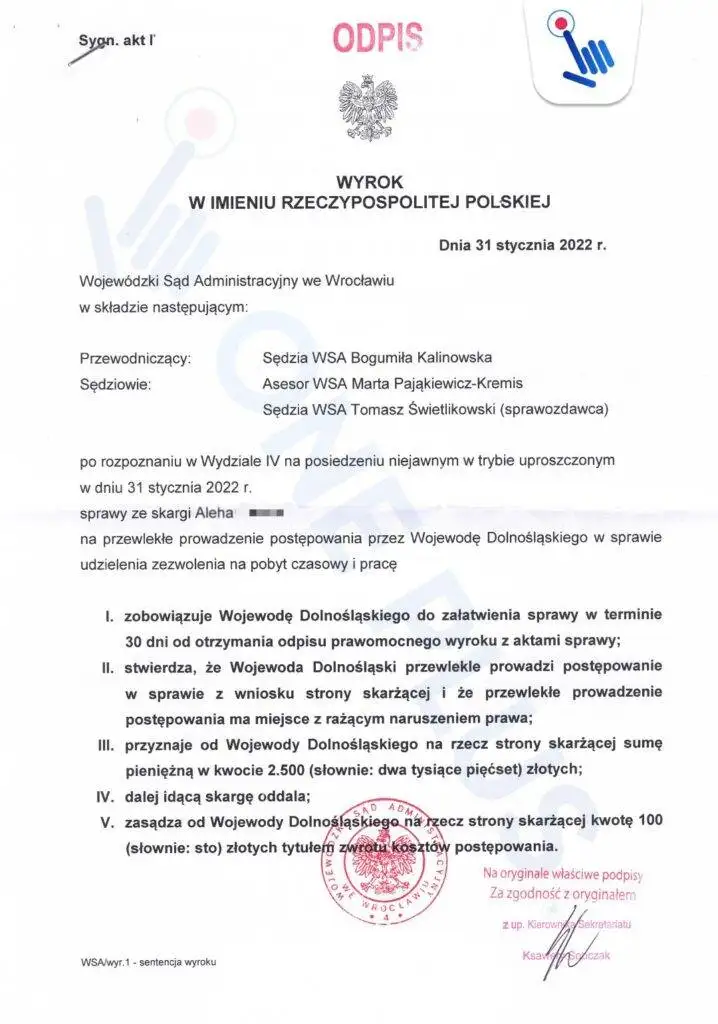
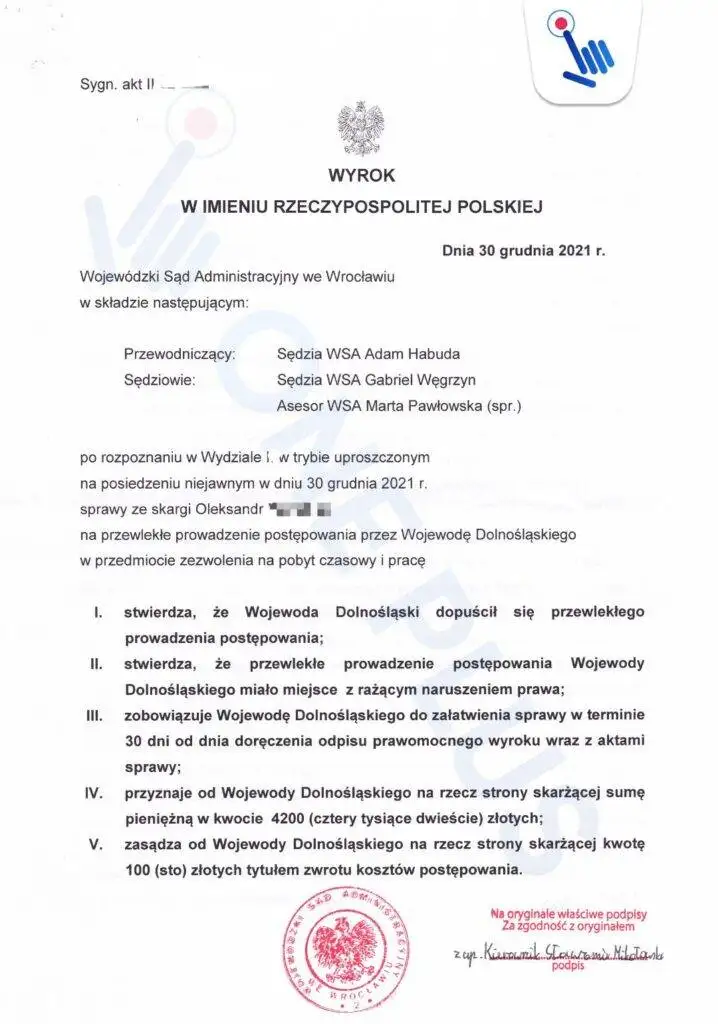
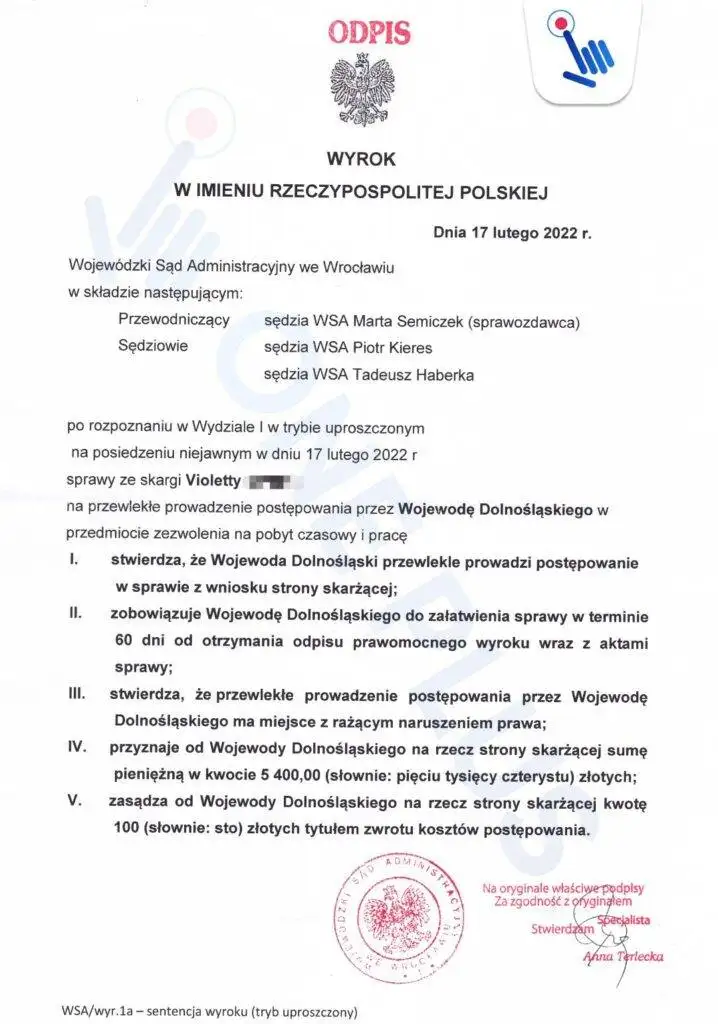
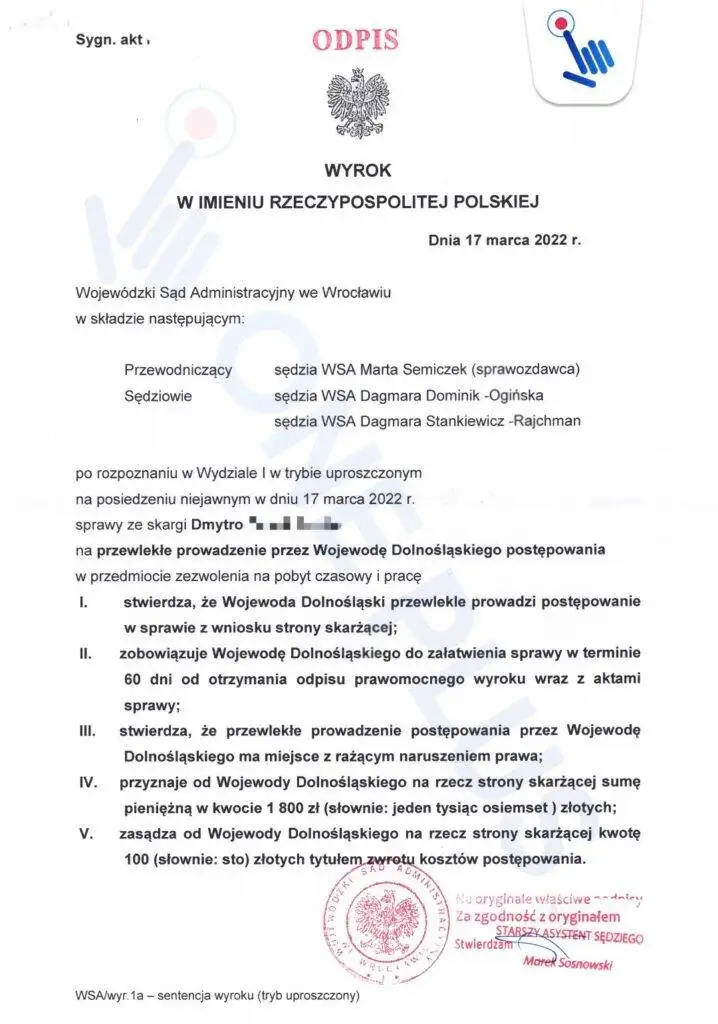
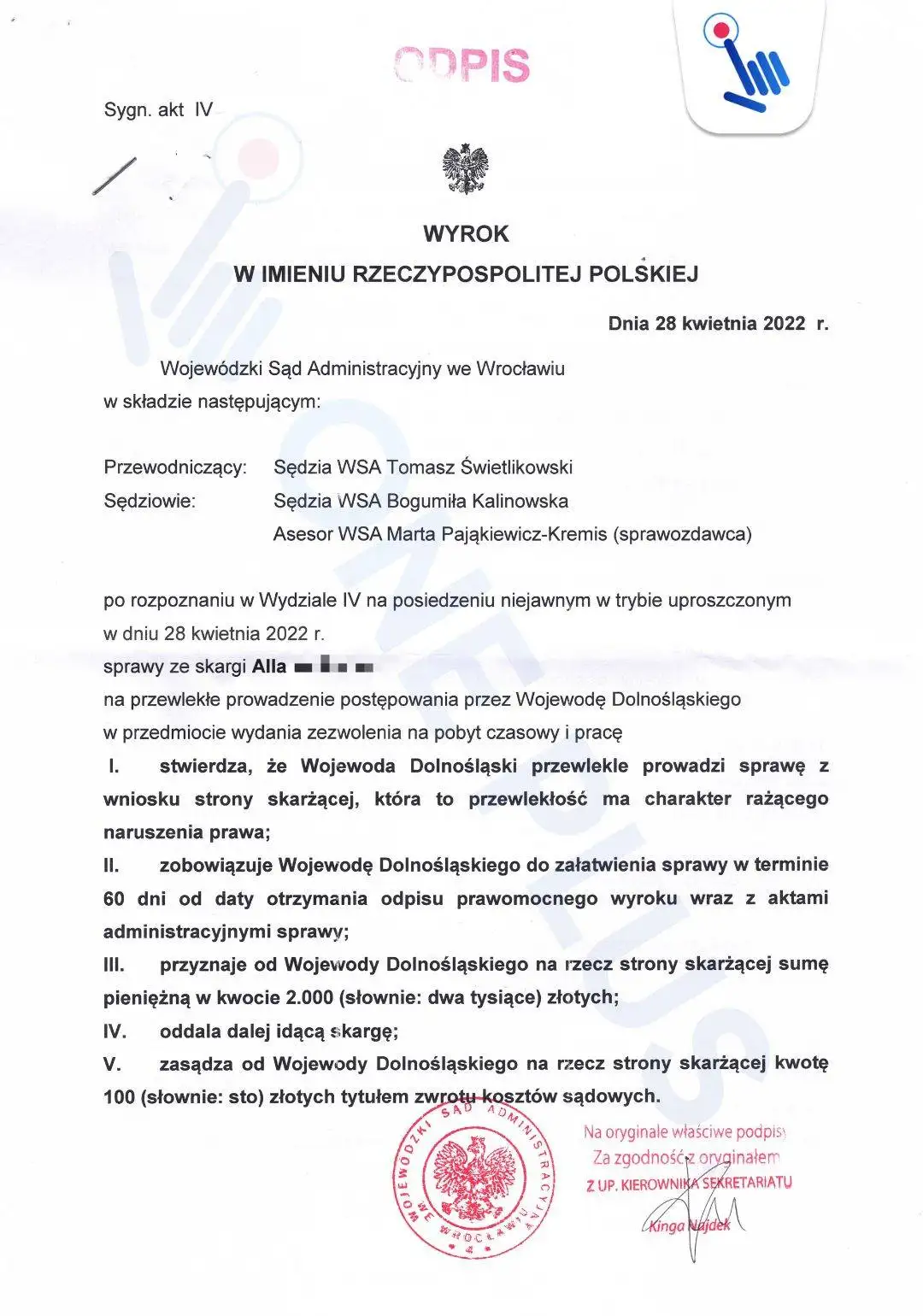
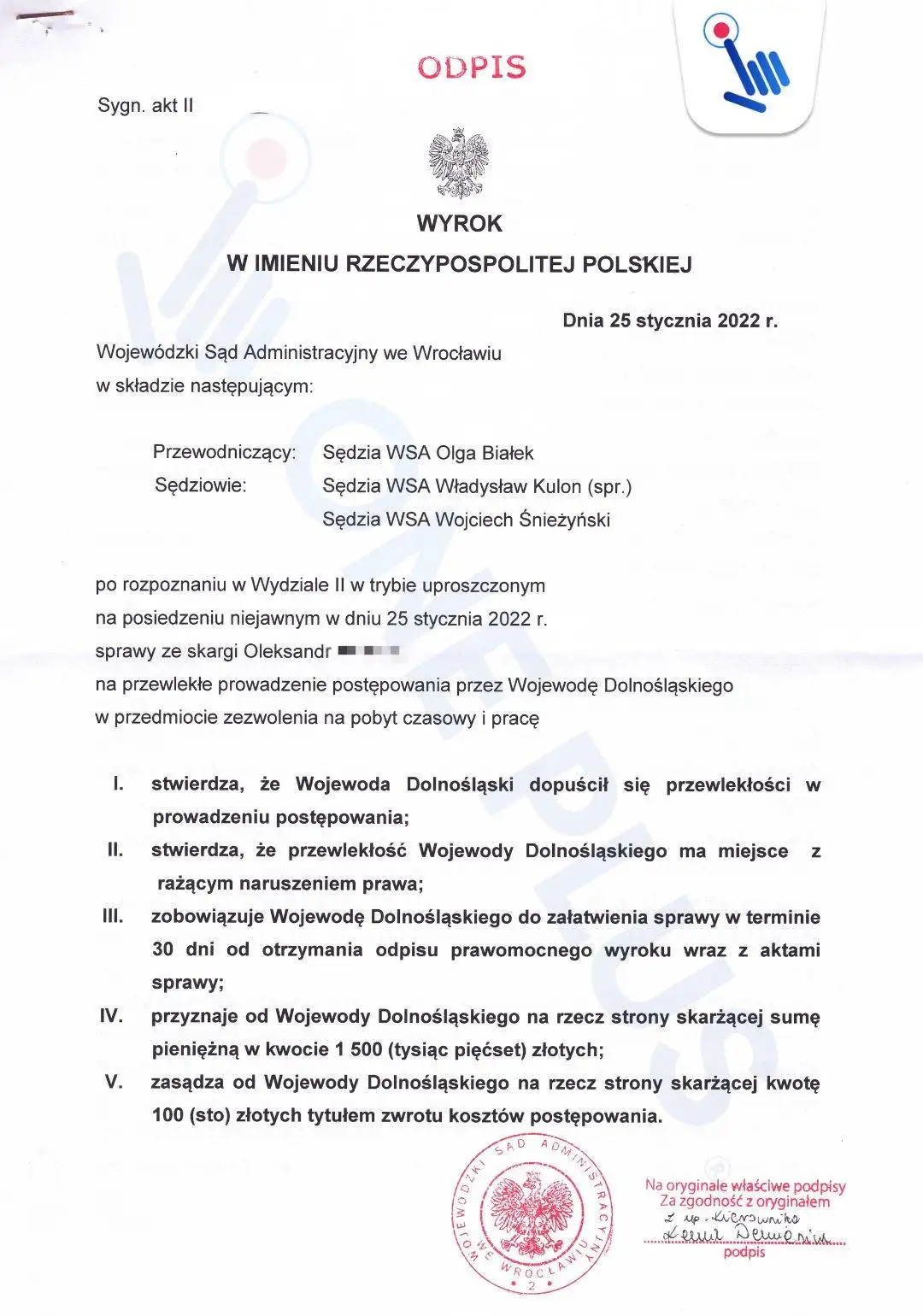
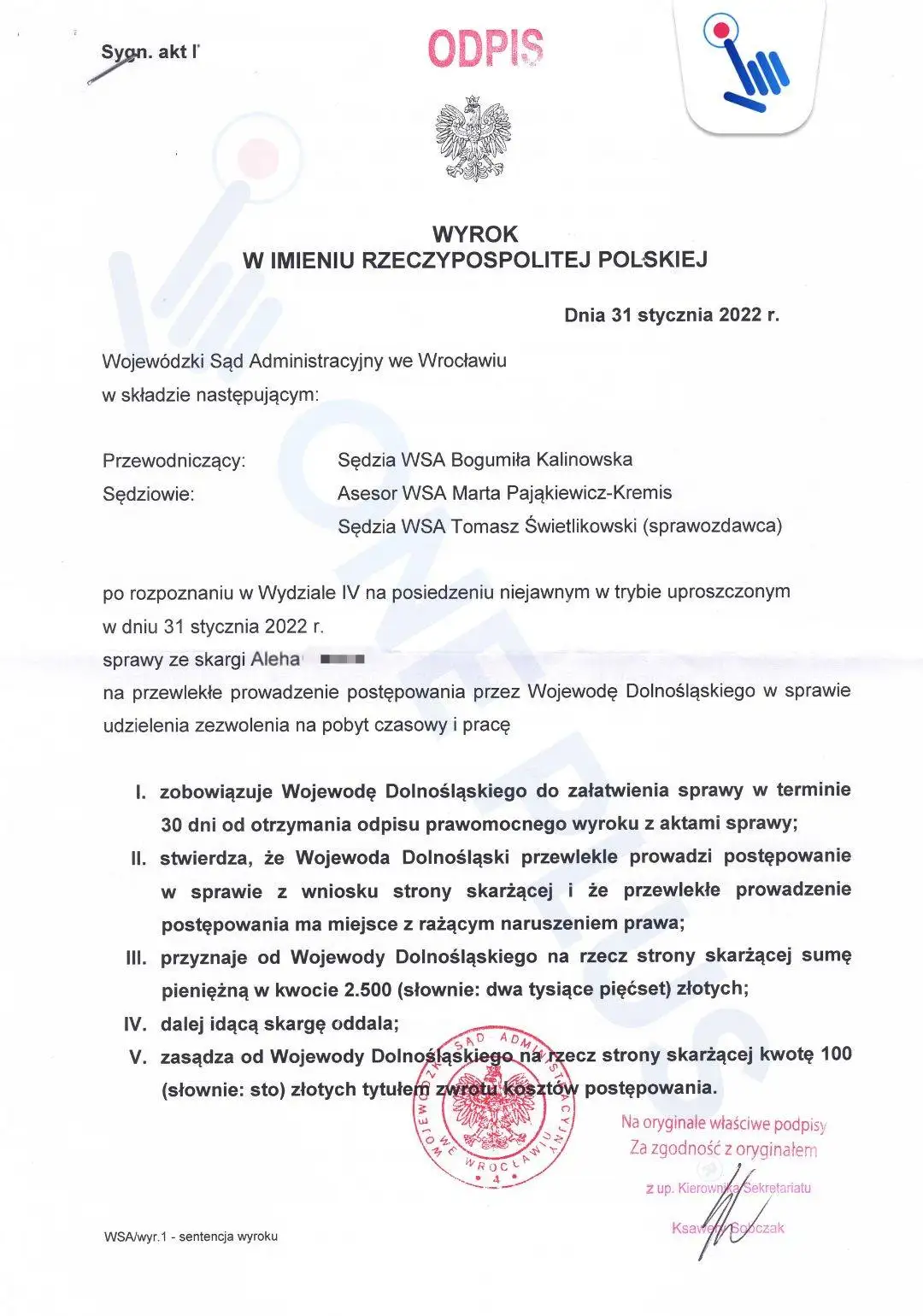
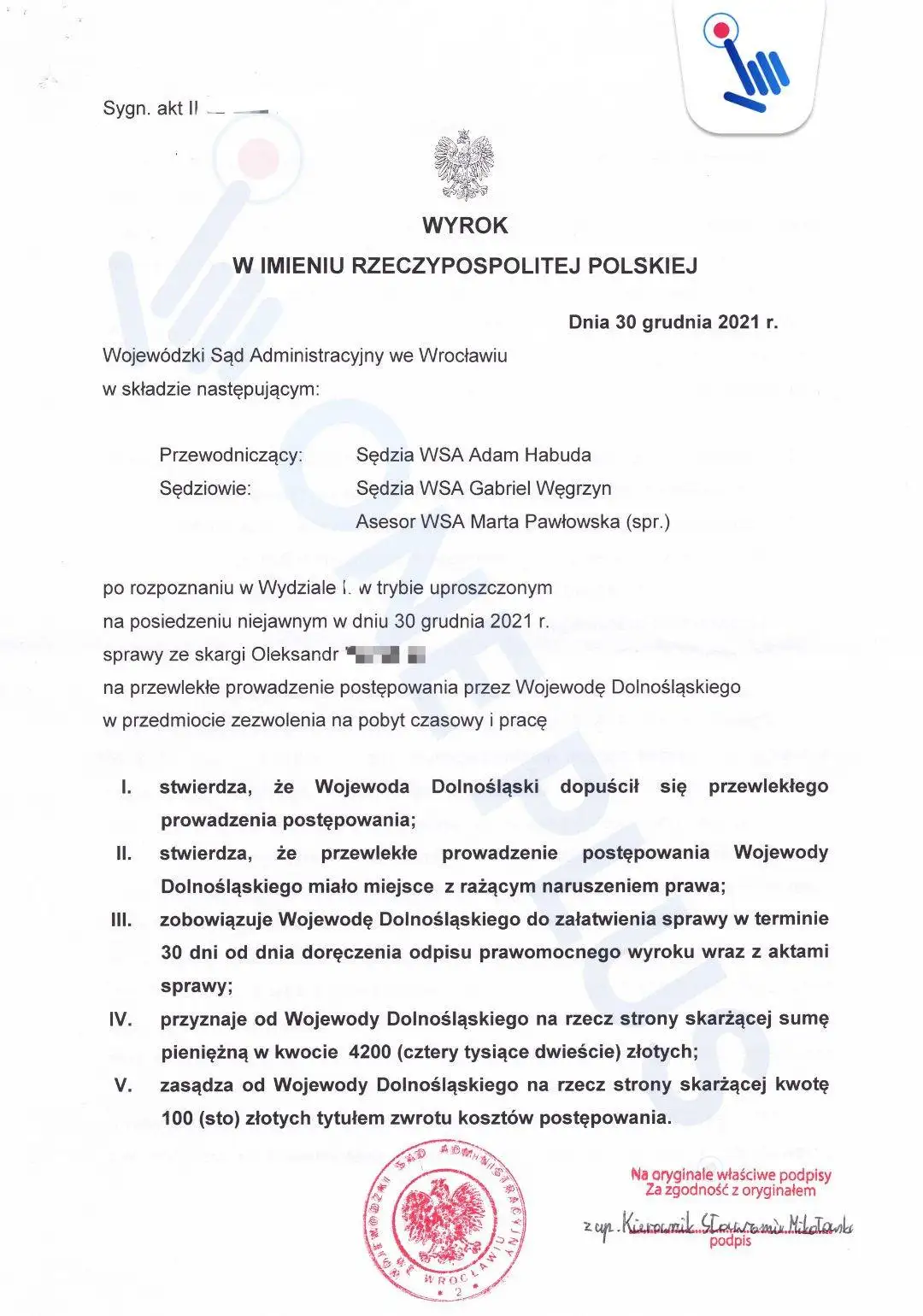
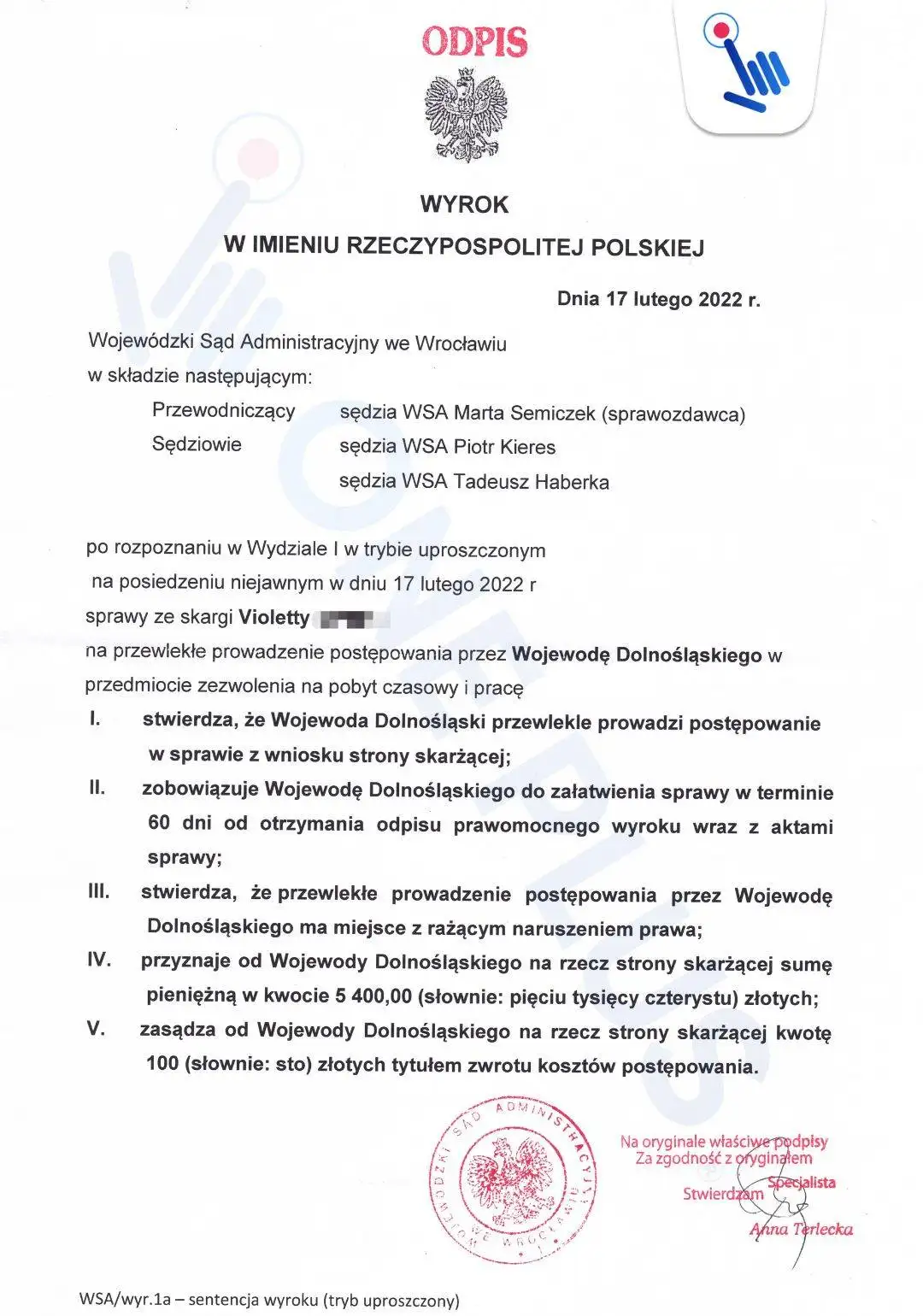
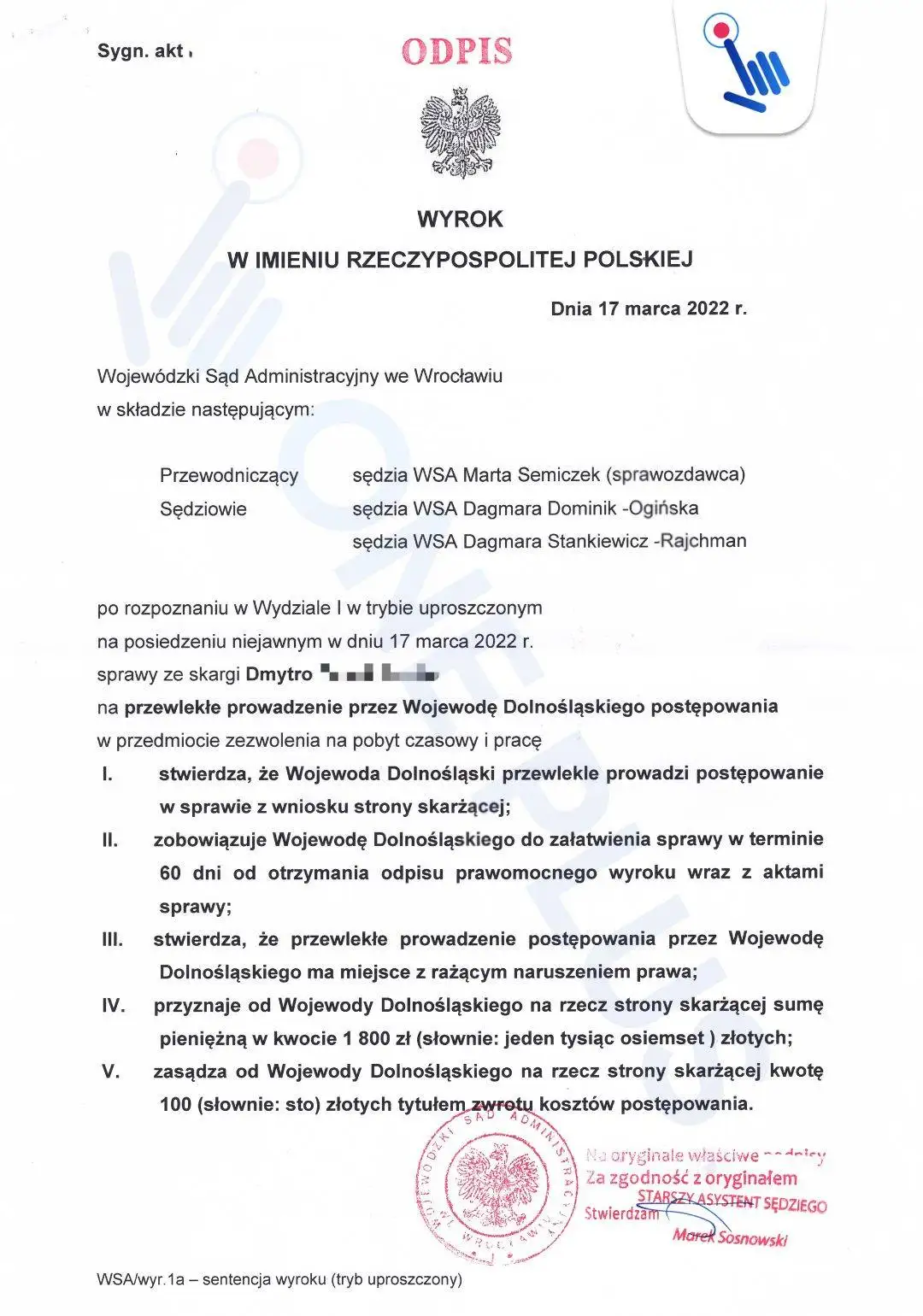
The statutory time limits are 60 days for temporary residence and 6 months for permanent residence and EU long-term residence, counted from a complete application. However, in 2026 a special suspension of time limits applies to a range of migration proceedings until 4 March 2027 (Article 100d of the Act on Assistance to Citizens of Ukraine), and it covers all foreigners, not only Ukrainians. The actual wait may be longer than the statutory limits, and whether inaction can be challenged is assessed case by case in the light of current court practice. Our price list assumes 2 to 6 months for a temporary permit and about 8 months for permanent and EU long-term residence. This is an estimate, not a promise: the office decides.
What genuinely saves time is an employer who signs within days, identical details in every document and a fast reply to any summons. If your case has stalled, we analyse the reasons for the delay, help prepare a formal reminder (ponaglenie) and assess whether a complaint is possible, taking Article 100d and court practice into account. Neither the timing nor any compensation can be guaranteed.
Working and Travelling While You Wait
If you applied during a period of legal stay and the application has no formal defects, you remain in Poland legally until the case ends. The UPO only proves that the application arrived; the certificate of submission confirms legal stay during the procedure. Neither gives you the right to work for any employer, and neither is a travel document.
You may keep working if your previous status and the terms of your application allow it; check before changing employer, position or salary. You can leave Poland, but you need a valid visa or unused visa-free days to come back.
UK, US and Canadian Citizens
Citizens of the United Kingdom, the United States, Canada and Australia can stay in the Schengen Area visa-free for 90 days in any 180 days. Living or working in Poland beyond that requires a karta pobytu on a real basis, usually work, business, studies or marriage. After Brexit this applies to British citizens who moved to Poland after 31 December 2020; those covered by the Withdrawal Agreement hold a separate residence document.
Apply while you are still within your visa-free days, arrange a PESEL number and Trusted Profile early, and keep a record of every entry and exit.
ONE PLUS practice: order the apostille and the sworn translation before you open MOS, and compare your job title, salary and working hours line by line across the contract, the employer’s attachment and the form. Most summonses are born from differences that were visible before filing.
Refusal, Lost Card and Replacement
- Refusal: you may appeal to the Head of the Office for Foreigners within 14 days of receiving the decision. Common reasons: wrong basis, insufficient income or no insurance, inconsistent documents, no reply to a summons, an SIS entry. For applications filed since 5 March 2026 the stamp duty is not refunded.
- Lost card: report it within 3 days to the voivode who issued it. You receive a free certificate valid until the new card is issued, for no more than 2 months. Then apply for a new card.
- Next card: apply well before the last day of your legal stay. Your employer or university needs time to sign in MOS.
- Losing your job on a work-based permit: you notify the voivode in writing within 15 working days, and the employer named in the permit notifies separately within 15 calendar days (Article 121). A new MOS application or an email does not count as this notification.
Karta Pobytu in Wrocław
Cases of residents of Lower Silesia are handled by the Lower Silesian Voivodeship Office (DUW). You apply online in MOS and visit the office only when summoned. Case progress is shown in your MOS account and on the DUW Przybysz portal, if your case is registered there; you need the case number from the office’s letter. DUW sends an SMS or a portal notice when the card is ready. To have your address printed on the card, submit proof of address registration within 14 days of receiving the decision.
All our services for the city are listed on residence permit for foreigners in Wrocław. Cases in other voivodeships are handled remotely.
Partial or Full Support
Partial (ONE package): consultation, review of your basis and refusal risks, document audit, completing the form, help filing in MOS 2.0 and written case instructions.
Full (PLUS and PRO): everything in ONE plus case management to the decision, follow-up on the employer’s attachment, replies to summonses, correspondence with the office under a power of attorney and a client portal with your case status, documents and letters (our service, not an official system). PRO adds attendance at filing and collection, an appeal if refused and a court complaint.
Work-based example: ONE PLN 800, PLUS PLN 1,800, PRO PLN 2,000. Prices for other grounds are in the table above and in the price list further down this page. All prices are net; official fees are paid separately.
Expert Advice
Tatiana Vyborna, President of the Management Board of ONE PLUS, has more than 12 years of experience in residence and employment legalisation for foreigners. She graduated in law from the University of Wrocław and completed a postgraduate programme at the Wrocław University of Economics (Uniwersytet Ekonomiczny we Wrocławiu), and has represented clients in more than 20 inspections by the Border Guard (Straż Graniczna), the Labour Inspectorate (PIP), ZUS and the tax authorities.
In Tatiana Vyborna’s experience, international applicants lose the most time on documents from home: a certificate apostilled after it was translated, or a degree that is hard to match to the job in the employer’s attachment. Since 5 March 2026 such a mistake also costs a non-refundable stamp duty, so we check the file before payment in every case. More about our expert: Tatiana Vyborna.
Not sure which basis is right for you? Describe your situation in the form below or on our contact page, and we will tell you which documents you need and what support will cost. Our Google rating is 4.7 from about 445 reviews.
Updated: 18.10.2026. Sources: Office for Foreigners on MOS, Office for Foreigners on CUKR, DUW: issue and replacement of the card, Act on Foreigners.







 4,7
4,7