

Since 2018
For over 8 years, we've helped clients navigate Polish law, combining our solid legal knowledge with practical immigration experience.

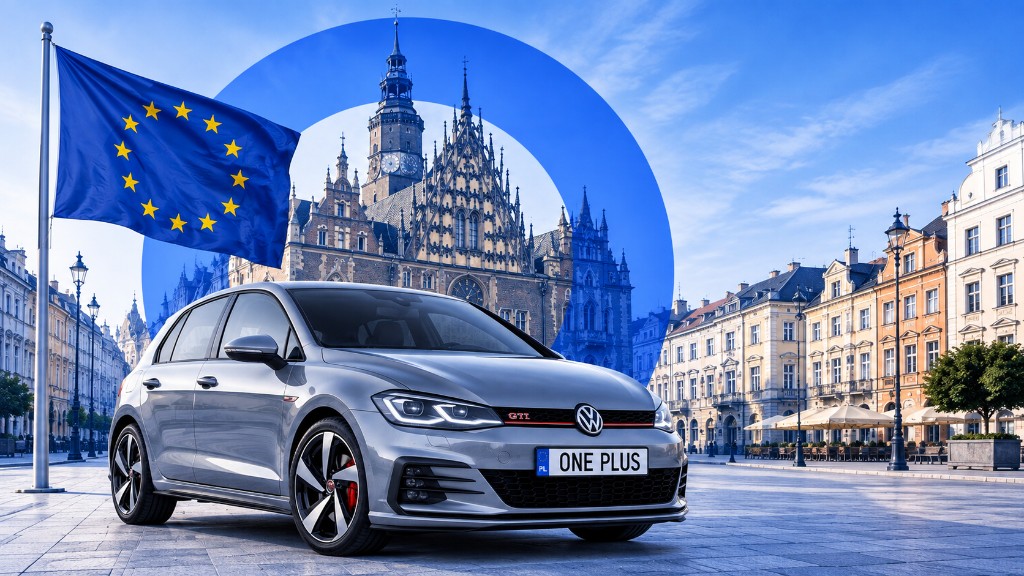
ONE PLUS helps drivers in Wroclaw clear the Polish formalities and re-register a car bought in Germany, the Netherlands, Belgium, France or another European country. We check the paperwork before purchase, calculate Polish excise duty, prepare AKC-US, arrange sworn translations and handle the case through to Polish plates and the registration certificate.
People often call this “EU car customs clearance”, but a vehicle already in free circulation within the EU is not normally subject to import customs duty when moved to Poland. In practice, the service is a Polish tax clearance and re-registration: confirming the VAT position, settling excise duty, obtaining PZAS, checking the technical evidence, arranging insurance and submitting an acceptable file to the registration authority.
Our job is to make those separate formalities work as one process. You receive a clear checklist, an estimate based on the actual car and one point of contact. If the owner must attend a particular appointment, we tell you before the file is submitted.
You can ask us to manage the full case or step in at one specific point. Our service may include:
Government charges, tax, insurance, inspection fees and third-party costs are shown separately. We do not bundle them into a vague headline figure or promise the same total for every vehicle.
The safest time to find a paperwork problem is before money changes hands. A missing section of a German registration certificate, an invoice issued to the wrong buyer or an unclear VAT clause can delay Polish registration even when the car itself is perfectly sound.
Before completing the purchase, check that:
ONE PLUS can review scans before you travel or transfer funds. This is a document and registration check, not a mechanical inspection or a full vehicle history report, but it can prevent an expensive purchase that cannot be registered as expected.
Germany is popular with buyers in Lower Silesia because of its large used-car market and convenient distance from Wroclaw. A proper German file usually requires more than the purchase agreement. The complete registration record and any relevant export paperwork matter just as much as the invoice.
The Netherlands uses a different registration and export process. The buyer should leave with documents that establish the previous registration, lawful transfer of ownership and export status. Belgium, France, Denmark, Austria and other EU states each use their own forms and terminology.
We do not assume that a document set is complete merely because the seller says it is. We assess whether the Polish tax portal, sworn translator, inspection station and registration office can all work with the same evidence.
Excise duty is usually the main Polish tax due on a passenger car brought in from another EU state. The standard rate is generally 3.1% for a car with an engine up to 2,000 cc and 18.6% for an engine above 2,000 cc.
Reduced rates can apply to certain hybrids. Qualifying electric and hydrogen vehicles may be exempt. The correct result depends on the vehicle’s legal classification, powertrain, engine capacity, tax base and the rules in force when the liability arose.
The figure on the sales document is important, but a price well below the normal market level may be queried. If the car was cheap because it was damaged, incomplete or needed major repairs, retain the advert, photographs, payment evidence and repair estimates. They may be needed to explain the genuine transaction value.
The current passenger-car excise declaration is called AKC-US. It is filed through Poland’s official PUESC service.
As a general rule, the declaration must be filed within 14 days of the excise liability arising and the duty must be paid within 30 days. The relevant date is not always simply the date printed on the contract. It can depend on when the car entered Poland and when the buyer acquired the right to dispose of it as owner.
Once the filing and payment match, the system issues a PZAS confirmation. The registration authority relies on this evidence. Where a payment is not matched, a vehicle detail is wrong or PZAS is not generated, we identify the cause and prepare the necessary correction.
A used car bought elsewhere in the EU does not automatically attract an additional 23% Polish VAT charge. The answer depends on whether the seller is a private person or a business, who the buyer is and whether the invoice uses standard VAT, a margin scheme or another valid arrangement.
For VAT purposes, a vehicle is treated as new if it was supplied within six months of first registration or has travelled no more than 6,000 km. A new means of transport is usually taxed in the country where it will be registered, so the invoice must be checked carefully to avoid paying VAT twice.
The European Union explains the distinction on its official page about VAT when buying or selling a car abroad. We apply those general rules to the invoice and parties in your transaction rather than making assumptions from the car’s age alone.
There is no single list that fits every country and every vehicle, but a registration file will commonly include:
An EU registration certificate does not always need to be translated in full. Harmonised EU fields may be accepted without translation, while national notes, contracts, invoices and supporting certificates often require a Polish sworn translation. We identify the relevant pages first, so you do not pay to translate material the office does not need.
Polish registration requires valid roadworthiness information. A test completed in another EU state may be recognised when its result and validity are clear. If the evidence is incomplete, has expired or does not contain the necessary technical data, a Polish badanie techniczne will be required.
A Certificate of Conformity can make the technical stage easier, particularly for a new vehicle, but it is not a blanket requirement for every used EU car. The correct evidence depends on the vehicle’s registration history, category and the information already recorded by the previous authority.
Extra care is needed where a car is currently registered in the EU but was originally manufactured for the US, Canadian or another non-European market. Lighting, emissions data or type-approval evidence may need further work before the registration office can accept the vehicle.
If you have already completed part of the process, we can take over from there. We can review a rejected file, correct AKC-US, arrange translations only or prepare the final registration stage.
Foreign nationals can own and register a car in Poland. The authority will need evidence of identity, ownership and a permanent or temporary place of residence that establishes which office is responsible for the application.
A PESEL number or residence card may form part of the evidence, but it may not by itself prove the address required for a particular case. We check the owner’s immigration and residence documents before the appointment and advise whether a power of attorney can be used.
The Polish government’s current overview is available on the vehicle registration page. For an English-language introduction, see our guide to registering a car in Poland as a foreigner.
Our ONE PLUS office in Wroclaw is at ul. Piłsudskiego 43, close to Urząd Miejski. You can send scans for review before bringing the originals to the office.
Once AKC-US has been filed, excise duty and VAT have been dealt with, PZAS is available, the translations and technical evidence are ready and OC insurance is in place, the final registration appointment and issue of Polish plates can often be organised in about one hour. We prepare the application and check the original documents beforehand, so the client arrives with a registration-ready file.
The one-hour service refers to the final appointment with a complete file. It does not include waiting for PZAS, obtaining missing foreign papers, carrying out an additional inspection or producing sworn translations. We confirm after the initial review whether the fast registration route is realistic for the vehicle.
The paperwork should reflect who is actually buying the car. A private sale contract, a dealer invoice and a purchase by a Polish company can lead to different VAT, accounting and representation questions. Changing the intended owner after the contract has been signed may create inconsistencies between AKC-US, PZAS, insurance and the registration application.
For a company purchase, we check the invoice details, the person authorised to act for the business and the documents needed to identify the entity at registration. For a private buyer, we focus on the owner’s identity, address and immigration evidence. If two people will co-own the car, both ownership shares and representation should be clear from the start.
International buyers should also be careful with name formats. Polish authorities compare the buyer details across the passport, invoice, excise filing, insurance and registration form. A missing middle name is not automatically fatal, but inconsistent spellings should be resolved before submission rather than explained at several different offices.
Vehicle registration is often one item on a much longer relocation list. ONE PLUS can also help you:
These are separate procedures with separate legal tests. They can be coordinated, but success in one does not automatically decide another. We set out the documents and scope for each service clearly.
The total depends on the vehicle and the work required. The budget may include excise duty, possible VAT, registration charges, translations, inspection, OC insurance and our professional fee. A plug-in hybrid, fully electric car, new vehicle or car above 2,000 cc can produce a very different calculation from a standard used petrol car.
For an initial estimate, send the make, model, VIN, year, engine size, fuel or powertrain type, price, purchase date, previous country of registration and clear photographs of the documents. You can reach our Wroclaw office through ONE PLUS contact details.
ONE PLUS helps you complete purchase in the EU → excise → translations → vehicle registration. For non-EU cars see customs clearance outside the EU. Need representation? vehicle power of attorney. All automobile services · contact.
ONE PLUS handles vehicle matters end to end: registration, deregistration, EU/non-EU import, licence exchange, powers of attorney and sworn translations. Our office is about 5 minutes from the Main City Office in Wrocław — useful when you need quick document fixes and a follow-up filing the same day if queues allow.
Related steps often include address registration, a car power of attorney and a sworn translation. Map: automobile services, registration, deregistration, EU import, non-EU customs, licence exchange. Contact.
Normally not, provided the car is already in free circulation in the EU and is moved from another member state to Poland. Polish excise duty, VAT in specific cases, registration charges, translations, insurance and inspection costs may still apply.
The standard rate is generally 3.1% for an engine up to 2,000 cc and 18.6% above that threshold. Certain hybrids benefit from reduced rates, while qualifying electric or hydrogen vehicles may be exempt. The final figure depends on the car’s tax base and legal classification.
The general deadline is 14 days from the date the excise liability arises. Payment is generally due within 30 days. The correct trigger date depends on the purchase and movement of the vehicle, so it should be checked rather than guessed.
No. The VAT position for a used car depends on the seller, buyer and invoice scheme. Different rules apply to a new means of transport, meaning a car supplied within six months of first registration or with no more than 6,000 km on the clock.
Harmonised EU fields may be accepted without translation. Contracts, invoices, national remarks and separate certificates often need a sworn Polish translation. The exact requirement depends on the contents of the documents and the registration office.
Not in every case. A valid roadworthiness test from another EU country may be recognised if the required information is clear. A Polish inspection will usually be needed if the test has expired or the technical evidence is incomplete.
Possibly. The key questions are whether you can prove your identity, lawful position and permanent or temporary residence in Poland. The right document set depends on your nationality and status, so it should be checked before filing.
Many tax and registration steps can be handled by an authorised representative. The owner must still provide original documents, accurate information and any required signatures. We confirm in advance whether personal attendance is needed.
Yes. You can instruct us for document review, excise filing, translations or registration as a standalone service. If you want full support, we combine the stages into one practical plan.
If the vehicle has not been released into free circulation in the EU, or it is being imported directly from a third country, a different customs procedure may apply. See our information on car customs clearance in Poland for non-EU imports or ask us to check the vehicle’s customs status.
Yes. The invoice, company details, representation and tax treatment must be prepared for the business buyer from the outset. We check the company documents and make sure the buyer shown in the excise, insurance and registration records is consistent.
Yes, provided the file is complete. The AKC-US declaration must already have been submitted, any excise due must be paid, the PZAS confirmation must be available, and the required translations, inspection and insurance arrangements must be in place. In that situation, the final registration appointment and issue of Polish plates usually take about an hour. Document preparation, translations, tax clearance and correcting missing paperwork are separate stages.

Certified Specialist in the Legalization of Stay and Employment of Foreigners in Poland. Tatiana is a graduate of Uniwersytet Ekonomiczny we Wrocławiu and Uniwersytet Wrocławski, where she completed studies in Legal and Business Consulting, followed by the postgraduate program Legalizacja zatrudnienia cudzoziemców at Uniwersytet Wrocławski.
With more than 12 years of professional experience and daily cooperation with Polish government institutions, Tatiana has developed an effective approach to resolving even the most complex immigration matters. She provides clear legal guidance, assists with document preparation, and supports clients throughout every stage of the legalization process.
Her individual approach, in-depth knowledge of Polish immigration law, and practical experience make the legalization process straightforward, secure, and as smooth as possible for every client.
I am Korean. You handled a wide range of tasks for me, from vehicle export taxes, through transfers, to translations. You responded well and I am very satisfied with the speed of completion.
Everything was great!! And most importantly, fast!! I recommend to everyone!!
Good day to everyone! I'll keep it short. The service is at the highest level. All questions are answered clearly and competently. These people are true professionals in their field. And most importantly, the entire range of services provided is carried out only within the framework of the applicable regulations. I received the residence card relatively quickly, even considering the current problems with application processing times. I recommend.
Thank you very much! Everything was quick and efficient, and most importantly, professional. I received my residence permit within a few months. I highly recommend!
I have been working with this company since 2018 and I have not had a single complaint. The service is always at the highest level, the staff are friendly and competent, and they solve every problem professionally. They have enormous knowledge of their work and the law, which is especially important in the legalization industry. All problems are solved quickly, efficiently and without unnecessary fuss. I am grateful for our many years of cooperation and with a clear conscience I can recommend their services!
I want to thank you for a good job! They helped quickly with documents, even though there was no hope left! They provide good accommodation, the work is not hard) And most importantly, the working conditions are good!!!! I recommend!!!
Very good approach to the client. They not only accepted the documents, but also explained all the issues in detail and pointed out important details.
A good experience working together. What I liked especially was that they not only answered questions but also explained why it has to be done that way. That was very important to me.
A well-coordinated team, professional work and normal communication. For me that is the most important thing when it comes to documents and legalization.
Huge thanks to ONE PLUS for their help with the formalities of re-registering my car! Everything was handled efficiently, quickly and without any problems. It is a pleasure to work with such professionals!
I would like to thank One Plus for help with deregistering my car. And especially huge thanks go to the agent Inna. All the formalities were handled correctly and quickly. And at a reasonable price. Which is very...
We asked for help adding our driving licence to the MVS service centre database. The remote process took about 10 minutes (maybe even less if you have a faster computer). The convenience was that we did not have to travel to Wroclaw.
The ONE PLUS company helped me quickly and efficiently exchange my driving licence for a Polish one. I am grateful to the company's staff for their professionalism and care.
They quickly and efficiently helped me re-register my driving licence to a Polish one. Thank you.
Thank you very much for registering my drivers! Your work is precise and high quality! I sincerely wish you further growth and improvement! I wish you success and good luck! Sorry for sometimes being slow!))) Honestly, I am slow.
I would like to sincerely thank the ONE PLUS company and Tatiana personally for help in renewing my driving licence. The whole process, from collecting the documents to collecting the finished driving licence, went quickly, smoothly and without problems. Tatiana explained every step in detail, answered my questions and guided me through the whole process, which was extremely helpful in navigating unfamiliar procedures. Their professional approach and attention to detail are a huge asset. I recommend the ONE PLUS company to anyone looking for reliable help with legalization in Poland!
I contacted this company to add my driving licence to the database of the Ministry of Internal Affairs of Ukraine. The result was positive within two days. Their approach was transparent and professional. I highly recommend them. Thank you, ONE PLUS.
Thank you to the specialist Tatyana for her quick help in renewing my driving licence. All documents were quickly translated into Polish and submitted within one day. I received my Polish driving licence within a week.
I received quick and clear advice about my driving licence.
I had to exchange my driving licence for a Polish one. They helped me handle all the formalities and explained exactly what I had to do.
Call Mon-Fri 09:00-17:00
 +48 71 880 85 08
Contact us online


We’ll call you back during business hours.
 We will tell you more about servicesInitial client consultationExpress situation audit
During business hours
Your data stays secure
Support with your case

 4,7
4,7