
Short answer
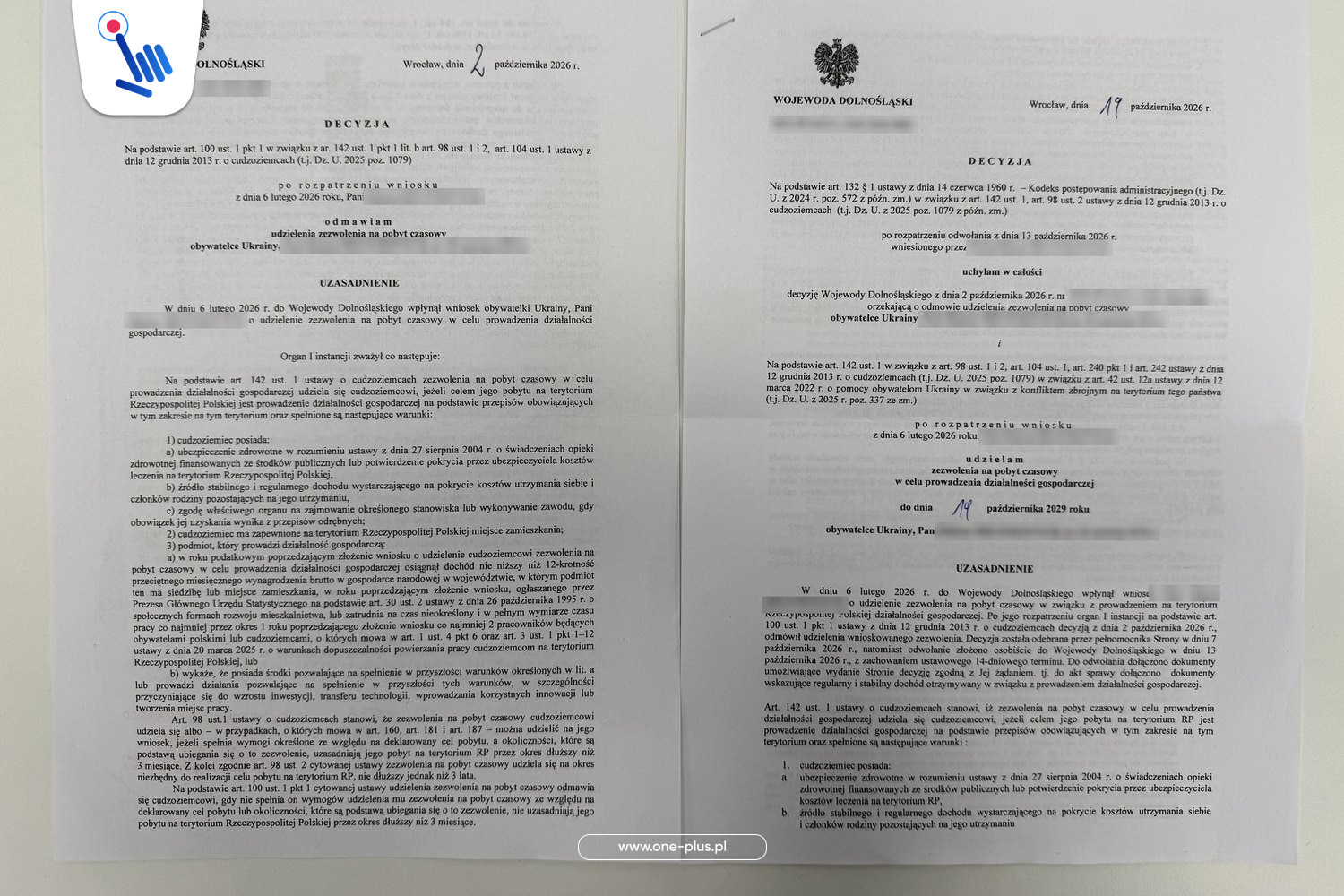
Our client runs a sole proprietorship (JDG) and pays her taxes and contributions, but the voivodeship office refused: the file supposedly held no proof that the business was operating. We had filed those documents twice. We appealed with the filing proofs and fresh documents, and the next day the voivode granted a permit for 3 years.
Our client runs her own business in Poland as a sole trader (JDG), pays her taxes and contributions and has no debts. The voivodeship office still refused her a residence permit, claiming there was no proof that the business was operating. Yet we had filed those documents twice. We filed an appeal (odwołanie), and the next day the voivode overturned his own refusal and granted a permit for 3 years. Below we explain how it happened and what we did as the client’s representative (pełnomocnik).
This case matters for entrepreneurs. A temporary residence permit for business activity is considered one of the hardest to get: the office examines not only the person but also the business. And even when everything is in order, documents can get “lost” inside the file. What then decides the case is whether you can prove what you filed and when.
Twelve days passed between the refusal and the positive decision, and one day between the appeal and that decision. Here is how it looked.
A temporary residence permit for business activity is granted to a foreigner whose purpose of stay is to run a business in Poland under Polish rules.1 For this you have to show insurance, accommodation and, above all, a stable and regular income and a business that is really operating.
The client registered her sole proprietorship in the CEIDG register and runs it herself, with no employees. The business operates, issues invoices and pays taxes and ZUS contributions. It has no arrears with the tax office or ZUS. In the eyes of the law, this is an ordinary active business.
On 6 February 2026 we filed the application for temporary residence. The client had signed a power of attorney (pełnomocnictwo), so we handled the correspondence with the voivodeship office. An initial set of documents about the business went in with the application.
The case ran for several months, and business data goes out of date quickly. So in June 2026 we added fresh documents: the revenue and expense ledger (ewidencja przychodów i kosztów), the history of ZUS payments and certificates of no arrears from ZUS and the tax office (zaświadczenie o niezaleganiu). On fingerprint day we filed the updated set once more.
On 2 October 2026 the voivode refused. He relied on the provision under which a permit is refused if the foreigner does not meet the conditions for granting it, and on the requirement of a stable and regular income.2 The statement of reasons said that the file contained no proof that the business was operating.
In business cases the case officer looks at three things. Whether the foreigner has a source of stable and regular income. Whether there is health insurance and accommodation. And whether the business meets one of the statutory conditions: sufficient income in the previous tax year, two employees hired on indefinite full-time contracts at least a year earlier, or real funds and actions that will allow those conditions to be met in the future.3
The documents that were “missing” were in the file. We had filed them in June and again on fingerprint day. For some reason the case officer did not take them into account. This is not a dispute about whether the business operates. It is a decision issued without assessing the evidence the party had submitted.4
Business cases are bulky, and documents reach the voivodeship office by different routes and at different times: through MOS, by post, in person at an appointment. If a paper lands in the wrong folder or is not attached to the file, the case officer simply does not see it. That is why we always keep proof of every filing.
The decision reached us as the representative on 7 October. The time limit for an appeal started running that day: 14 days.5 We needed six.
The first thing we did was pull from our archive the proof that the documents had been filed: copies bearing the office’s receipt stamp, confirmations of dispatch and the list of attachments. We keep every such paper for every case. Thanks to that, we could show dates and a list of documents instead of merely asserting that “everything was filed”.
Then we gathered documents as of today: the current revenue and expense ledger, the history of ZUS payments and fresh certificates of no arrears from ZUS and the tax office (Urząd Skarbowy). Filing the same old papers a second time would have been weaker. We needed to show that the business was still operating now, on the day the appeal was considered.
In the appeal we went point by point. Which documents were filed and when. What they confirm. Which statutory condition is met. And why a refusal issued without regard to those documents cannot stand. We asked the voivode to overturn the decision himself, without sending the case to Warsaw. This is what a sound appeal against a refusal looks like: short, to the point and with a document behind every argument.
On 13 October we filed the appeal in person at the voivodeship office, so as not to lose days in the post. The same day we contacted the case officer, said that the appeal with the full set was already in the file and asked for it to be considered by way of self-review. Staying in regular contact with the case officer is a normal part of our work.
“In business cases, filing the documents is not enough. You have to be able to prove that you filed them, and when. We keep proof of every filing, so when a refusal says ‘no documents’, we have a simple answer: here they are, here is the date, here is the office’s stamp.”
Tetiana Vyborna, ONE PLUS
On 14 October 2026, the day after the appeal was filed, the voivode overturned his refusal in full and granted a temporary residence permit for business activity. The law allows this: the authority that issued a decision may itself revoke or amend it if it considers the appeal fully justified.6
The permit is valid until October 2029. Three years is the maximum period for a permit of this kind.7 For an entrepreneur this is especially valuable: a first business permit is often granted for one or two years. The case did not go to the second instance, where an answer takes months.
Next, the voivodeship office will produce the card, and the client will collect it in person. It is important for the business to keep paying its taxes and contributions on time: at the next application the office will again check how it is operating. We will remind her of the deadlines in advance.
The refusal could be overturned quickly for three reasons.
We keep everything we file, together with proof of receipt. Without it, the dispute would have come down to the client’s word against the case officer’s. With it, the dispute was over in a day.
We did not stop at the old set but showed the state of the business on the day of the appeal. The case officer was left with no question about whether the business is operating now.
An appeal filed in person enters the file the same day. And a case officer who knows about it does not put it aside for later. For the client acting alone, getting that kind of attention would have been much harder.
These are the documents most often needed for a residence permit based on a sole proprietorship. They should be updated at every stage of the case, not only at filing.
Not every case ends this quickly, and we prepare an appeal so that it will hold up at the next stages. If the voivode does not change the decision himself, he forwards the appeal together with the case file to the Head of the Office for Foreigners in Warsaw (Szef Urzędu do Spraw Cudzoziemców).8 If the refusal is upheld there too, what remains is a complaint to the Voivodeship Administrative Court within 30 days.9 We handle such cases as well: see our page on filing complaints with the court.
The client was connected to the ONE PLUS online CRM system. In her personal account she could see which documents had been filed and when, what had arrived from the voivodeship office and what stage the case was at. An SMS arrived about every step: documents added, decision received, appeal filed, new decision received.
For an entrepreneur this saves time: no trips to the voivodeship office and no working through official letters. The same account gives access to discounts on further ONE PLUS services, for example renewing the permit.
The account also holds the confirmation of every filing. It was this archive that made it possible to prove quickly that the documents about the business were already in the file.
This approach works beyond sole trader cases.
Entrepreneurs most often lose cases over small organisational things.
Have a look at other cases from our practice in Wrocław.
We handle cases like this from start to finish: from applying for a residence permit in Wrocław to appealing a refusal and representation in court.
Yes, if the purpose of your stay is to run a business in Poland and the statutory conditions are met: a stable income, insurance, accommodation and one of the conditions for the business. The right to set up a sole proprietorship is regulated differently for different categories of foreigners, so check this in advance.
One option is income in the previous tax year of at least 12 times the average monthly wage in the voivodeship. The others are two employees hired on indefinite full-time contracts at least a year earlier, or funds and actions that will allow those conditions to be met in the future.
File an appeal and attach proof that the documents were filed, together with their current version. If you have no proof left, file the documents again and explain when and how you filed them before.
14 days from the day you or your representative received the decision. You can file it in person at the voivodeship office or by post.
Every time the case moves to a new stage: a few months after filing, before fingerprints and whenever the case officer asks. Certificates from ZUS and the tax office go out of date quickly.
For 3 years at most. The period depends on the situation of the business and on the documents. In this case the permit was granted for three years straight away.
No. It is possible when the appeal removes every reason for the refusal. Otherwise the case is passed to the second instance, the Head of the Office for Foreigners.
Call Mon-Fri 09:00-17:00
 +48 71 880 85 08
Contact us online


We’ll call you back during business hours.
 We will tell you more about servicesInitial client consultationExpress situation audit
During business hours
Your data stays secure
Support with your case