
Short answer
The father obtained an EU long-term resident permit, but the voivodeship office refused his wife and their child with a disability over “insufficient income” across three years. We filed an appeal with an income calculation and proof of insurance. The Head of the Office for Foreigners overturned the refusal and granted the permit to both directly.
The father obtained his EU long-term resident permit with our help. We then filed applications for his wife and child, and the voivodeship office refused them, claiming the family’s income was too low. We were sure of our figures, filed an appeal (odwołanie), and the second instance in Warsaw granted the permit itself. Below we explain how the case went, what we did as the family’s representative (pełnomocnik) and which legal provisions we relied on.
This case is useful for families who apply for EU long-term resident status together or one after another. In these cases the office calculates income per family member over three years, and a mistake in that calculation turns straight into a refusal. The good news is that the calculation can be checked and challenged.
This case took longer than those where the voivodeship office overturned its own refusal. It went all the way to the second instance, and the timeline shows how long that really takes.
An EU long-term resident permit (zezwolenie na pobyt rezydenta długoterminowego UE) is granted for an indefinite period. To obtain it, you must have lived in Poland legally and continuously for at least 5 years and meet three conditions: a stable and regular income, health insurance and confirmed knowledge of Polish.1
The head of the family applied first. We handled his case from preparing the documents through to the decision, and he received his EU long-term resident permit. At that point the office checked his income and found it sufficient. This detail matters: the same income later became the reason for refusing his wife and child.
Next we prepared the applications for the wife and child. Both are supported by the father: the child has a disability and the mother cares for the child. Every member of the family is insured with ZUS. A parent files the application on behalf of a minor, and a child under 16 does not have to prove knowledge of the language.
Before filing, we analysed the father’s income month by month over three years and compared it with the threshold the law sets for each family member. The income was regular, with no gaps, and comfortably covered all three. So we filed the applications confident of a positive decision.
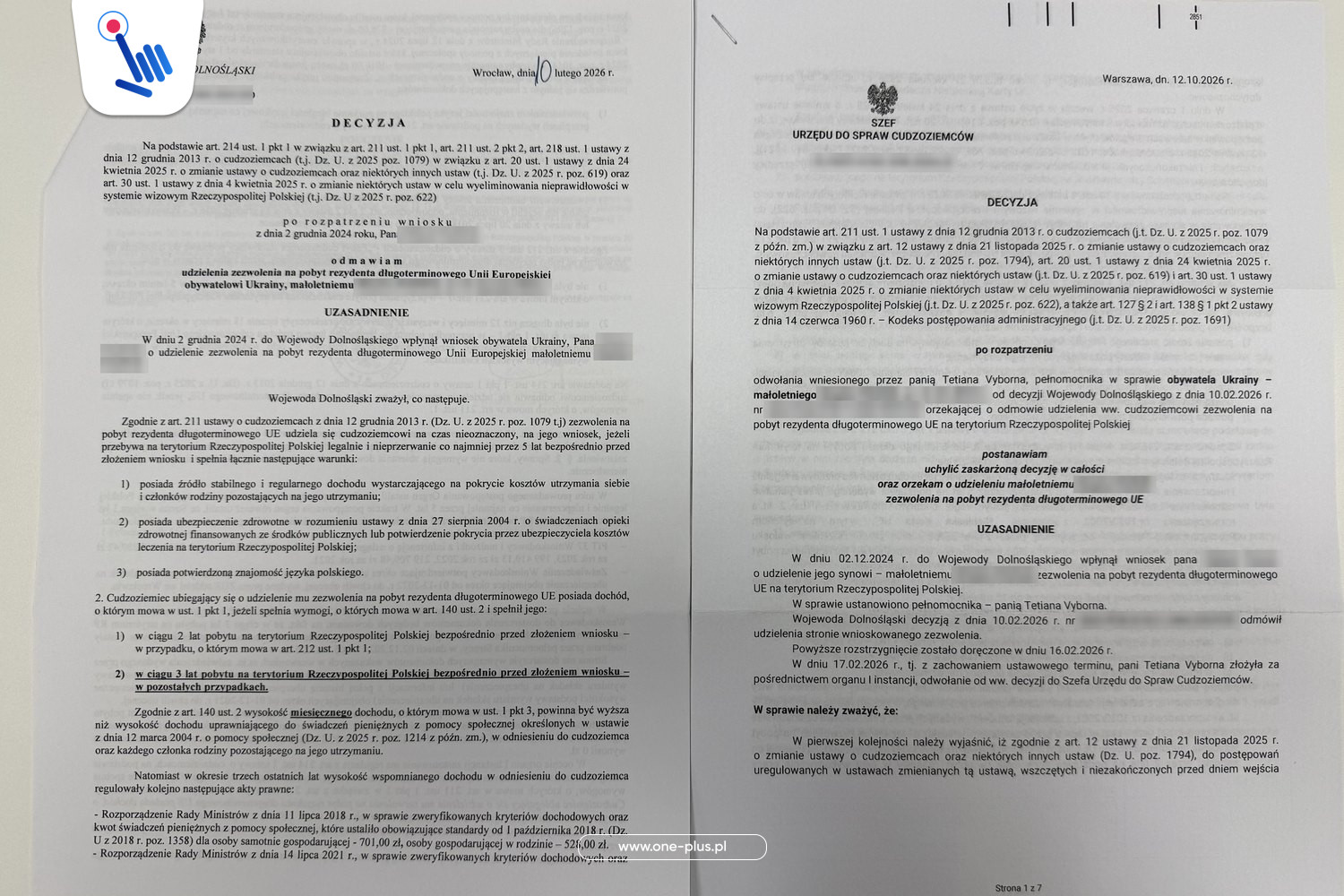
On 10 February 2026 the voivode refused. In the statement of reasons he relied on the provision under which a permit is refused if the foreigner does not meet the conditions for granting it.2 In the case officer’s view, the father’s income had been insufficient over the three years before the application, and there was no confirmation of ZUS insurance.
The law requires the income to be stable and regular throughout the 3 years of stay in Poland immediately before the application is filed.3 What is checked is not a single annual total but how the income is spread over time. If the case officer sees a “dip” in even part of the period, the condition is treated as not met.
Monthly income must be higher than the threshold that gives entitlement to social assistance, counted for the foreigner and for each family member he or she supports.4 The threshold has changed: different amounts applied in recent years, and each period has to be assessed with its own. In 2022–2024 it was PLN 776 for a single person and PLN 600 per person in a family, and since 2025 it has been PLN 1,010 and PLN 823. It is easy to go wrong here: applying the wrong threshold, or applying it to the wrong number of people, is enough.
We compared the case officer’s calculation with the documents and saw that it did not match the facts. The father’s income was continuous and sufficient, and every member of the family was insured with ZUS. On top of that, an authority must gather and assess all the material in a case, not part of it.5 That is what we built the appeal on.
The family had signed a power of attorney (pełnomocnictwo), so all correspondence with the voivodeship office went through us. The decision was served on us, and we started work the same day.
First we wrote out every argument in the refusal and set next to it the document that disproves it. The statement of reasons (uzasadnienie) must explain which facts the authority found proven and why.6 If it has gaps, or the calculation does not agree with the case file, that is a direct argument for the second instance.
We calculated the income again, month by month, for the whole three-year period and set it out in a table: the amount, the number of family members and the threshold in force. We attached PIT tax returns, income certificates and proof of payments to the calculation. That way the second instance could check every figure without asking for anything further.
We answered the point about missing ZUS cover with documents: confirmation of the father’s insurance and confirmation that the wife and child were registered for health insurance as family members. Separately, we attached the child’s disability certificate (orzeczenie o niepełnosprawności). It explains why the mother does not work and why the family lives on the father’s income.
The law allows 14 days for an appeal.7 The decision was served on us on 16 February, and by 17 February the appeal had been filed. It is addressed to the Head of the Office for Foreigners (Szef Urzędu do Spraw Cudzoziemców) and filed through the voivode who issued the refusal. That is how any appeal against a refusal works in residence cases.
The voivode could have corrected his own decision, but chose not to and sent the case to Warsaw.8 We were ready for that. While the case was at the second instance, we monitored the correspondence, answered requests and kept the family’s documents up to date, so that on the day of the decision the file held fresh confirmation of income and insurance.
“In EU long-term resident cases, everything comes down to the calculation. We work out the income month by month before filing, so we know whether the condition is met or not. When the voivodeship office writes that there was not enough money, we do not argue with words. We put its table next to ours, with a document behind every figure.”
Tetiana Vyborna, ONE PLUS
On 12 October 2026 the Head of the Office for Foreigners overturned the voivode’s decision in full and ruled on the merits himself: he granted the EU long-term resident permit.9 This is the best possible outcome. The case was not sent back to the voivodeship office for reconsideration, and the family did not have to wait through another round.
Both the wife and the child received positive decisions. The whole family now has indefinite status: no need to renew the permit or prove the basis of their stay all over again. Only the card itself is replaced, every five years.
EU long-term resident cards will now be produced for the wife and the child. They have to be collected in person. We will let the family know when the cards are ready and remind them in good time when the cards are due to be replaced.
It is not every day that the second instance overturns a refusal and grants the permit itself. In this case three things came together.
We do not file an EU long-term resident application until we have checked the income for three years. Because of that, we did not have to stretch anything in the appeal: we simply showed the calculation we had made before filing.
For every statement the case officer made, we had a document: on income, on insurance, on the make-up of the family. The second instance reviews a case on paper, and only paper can convince it.
The appeal went out the day after we received the decision. In eight months at the second instance we did not miss a single letter and did not let the documents go out of date.
In EU long-term resident cases for a family, the same documents are checked most often. Here is what is worth preparing in advance.
We prepared for that as well. A decision of the second instance can be challenged before the Voivodeship Administrative Court in Warsaw within 30 days.10 We prepare such complaints and conduct cases in court: see our page on filing complaints with the court. This case never got that far.
All our clients are connected to the ONE PLUS online CRM system. In their personal account the family could see both cases, the wife’s and the child’s: the documents filed, the decision, the appeal and the letters from Warsaw. An SMS arrived at every stage, so there was no need to phone and ask whether there was any news.
The same account gives clients discounts on further ONE PLUS services. For a family arranging documents for several people at once, that is a noticeable saving.
Both cases, the wife’s and the child’s, were kept in one account. The parents did not have to follow two sets of letters: everything arrived in one place, clearly labelled.
The lessons of this case are not only for families with the same story.
Income refusals usually come not from having too little money but from how it was presented.
Have a look at other cases from our practice in Wrocław.
We handle cases like this from start to finish: from applying for a residence permit in Wrocław to EU long-term resident status for the whole family and appeals against refusals.
The income must be stable and regular for the three years before filing and exceed the set threshold for each family member. In 2022–2024 the threshold was PLN 600 per person in a family, and since 2025 it has been PLN 823. For earlier periods, the amounts in force at the time apply.
Yes. The law speaks of income sufficient for the foreigner and the family members he or she supports. What matters is showing that one person’s income covers everyone and that this was so for all three years.
A child under 16 does not have to prove knowledge of Polish. Adults need a document confirming knowledge of the language at level B1 or higher.
14 days from the day you or your representative received the decision. The appeal is filed through the voivode who issued the refusal.
In this case it took about eight months. Timing depends on the workload of the Office for Foreigners and on how complex the case is.
The second instance can send a case back to the voivodeship office or decide it itself. Here it overturned the refusal and granted the permit straight away, so the family did not have to wait for a fresh examination.
You can, but first it is worth understanding exactly what the voivodeship office objected to. If the reason is the income calculation, appealing the refusal usually makes more sense than starting a new case from scratch.
Call Mon-Fri 09:00-17:00
 +48 71 880 85 08
Contact us online


We’ll call you back during business hours.
 We will tell you more about servicesInitial client consultationExpress situation audit
During business hours
Your data stays secure
Support with your case