
Since 2018
For over 8 years, we've helped clients navigate Polish law, combining our solid legal knowledge with practical immigration experience.

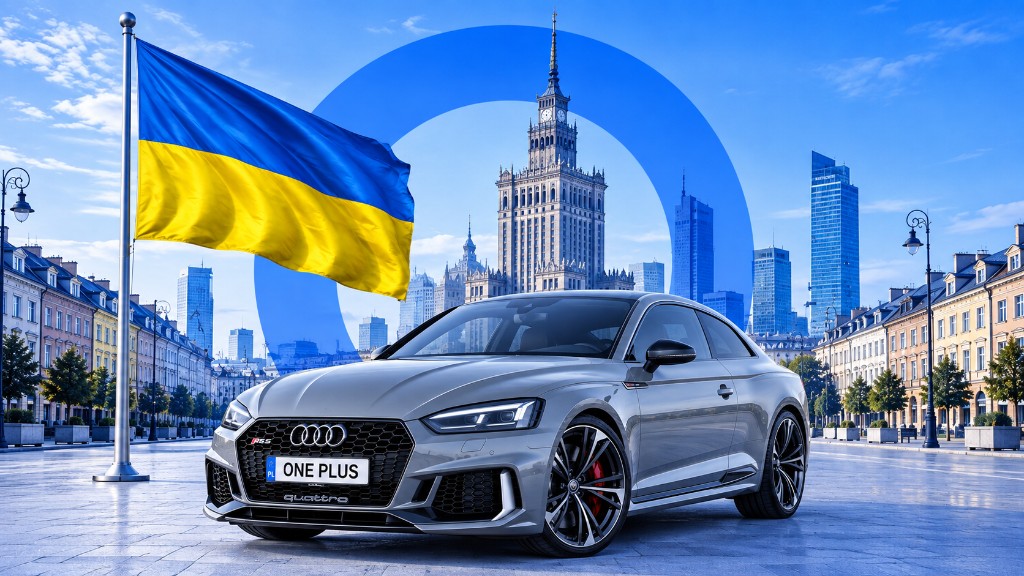
Bringing your own car to Poland from Ukraine, Belarus or any other non-EU country is not simply a matter of paying at the border. The vehicle needs a clear customs status, the correct VAT and excise documents, suitable technical evidence and a registration file that a Polish authority can accept.
ONE PLUS checks whether the plan works before the forms are submitted. We look at where the owner lived, when the car was acquired, how long it was used abroad, where it was made and how it entered or will enter the EU. That tells us whether to prepare a standard import or an application for transfer of residence relief, known in Poland as mienie przesiedlenia.
We then bring the separate stages together: supporting evidence, customs statements, sworn translations, liaison with a customs representative, excise formalities, technical approval and registration. Clients have one coordinator and a clear list of what is included, what they must provide and which official costs remain payable. This support forms part of our wider services for foreign nationals in Poland. The team is led by Tatiana Vyborna, who has more than 12 years of legal and administrative experience. ONE PLUS has worked with international clients since 2018.
The phrase “car from a CIS country” is still used in searches, but it has no separate meaning in EU customs law. The relevant point is that the vehicle is entering from outside the customs territory of the European Union. Similar import principles may therefore apply to cars arriving from Ukraine, Belarus, Kazakhstan, Moldova, Georgia and other non-EU countries.
The country on the registration certificate is only one part of the assessment. Manufacturing origin, tariff classification, ownership history and sanctions can all change the route or cost. A check based only on the number plate may miss a serious problem.
A standard import normally leads to customs duty, Polish import VAT and vehicle excise duty. It is the usual route where the owner bought the car shortly before moving, did not use it for the required period, or is not genuinely transferring their normal residence to Poland.
Transfer of residence relief, known in Poland as mienie przesiedlenia, applies to personal belongings brought by someone who genuinely moves their normal residence from outside the EU. A privately used car can qualify, but relief is not granted simply because the owner is a foreign national or holds a residence permit.
The standard customs duty rate for many passenger cars is 10 per cent. The actual rate can depend on tariff classification, origin and any preferential treatment, so the registration country alone does not provide a reliable answer.
Polish import VAT is generally 23 per cent. Its taxable amount is not necessarily the figure written in the purchase agreement. Customs value, duty, excise and certain transport or incidental costs may all form part of the calculation.
For most passenger cars, the standard excise rate is 3.1 per cent where engine capacity does not exceed 2,000 cc and 18.6 per cent above 2,000 cc. Reduced rates may apply to qualifying hybrids, while certain electric or hydrogen vehicles may be exempt. Declarations and certificates are handled through the official PUESC vehicle excise service.
We provide an estimate before filing, but the final amount is determined under customs and tax rules once the value and classification have been accepted.
The purchase agreement or invoice is the starting point, not always the final answer. Customs may ask for a bank transfer, original advert, transport invoice, insurance, photographs, damage report or independent valuation. This is particularly common where the declared price is well below the market level.
A genuine accident-damaged or incomplete vehicle can have a lower value, but the reason must be evidenced. Deliberately reducing the contract price without supporting material can lead to reassessment, tax arrears and a longer procedure.
The tax estimate is only part of the budget. Transport, transit security, customs representation, sworn translations, valuation, vehicle modifications, inspection and registration may all add to the final cost. A large engine, missing technical records or a car built for a non-European market can make an apparently attractive import much less economical.
We assess these points before transport whenever possible. The aim is to give the owner enough information to compare the likely cost of legalising the car with its value in Poland, rather than discovering an expensive obstacle after arrival.
As a general rule, the applicant must show at least 12 continuous months of normal residence outside the EU before moving and at least six months of actual possession and use of the vehicle at the former home. The car must be intended for the same private use after the move.
A car bought on the way to Poland or shortly before departure will not usually fit the purpose of the relief. Registration in the applicant’s name is strong evidence, but the authority can also examine insurance, servicing, road use and the wider circumstances.
Personal property is normally imported within 12 months of establishing normal residence in Poland, and it may be brought in more than one consignment. The Polish Ministry of Finance explains the conditions on its official transfer of residence customs relief page.
A Polish residence card, employment contract, tenancy agreement, registered address or PESEL can support the application, but no single document proves a transfer of normal residence. The authority looks at where the person’s centre of life was located and when it genuinely moved to Poland.
The strongest files tell one consistent story. Dates on immigration documents, employment records, tenancy agreements, insurance and vehicle papers should support rather than contradict each other.
A customs duty exemption should not be treated as a universal tax clearance. Import VAT and excise duty are governed by separate provisions and may require separate applications or certificates. The registration authority will normally expect evidence that excise has been paid, exempted or was not due.
ONE PLUS checks each liability individually. This gives the client a realistic picture of which reliefs can be supported and which official or third-party costs remain payable.
For a standard import, the file will usually include identity and immigration documents, proof of ownership, the foreign registration certificate, purchase and payment evidence, transport documents, and papers issued at the border or under a transit procedure.
A transfer of residence case also needs evidence of the former non-EU residence, at least six months of vehicle use and the move to Poland. Employment and tenancy agreements, utility bills, tax records, insurance, service invoices, address registration and Polish residence documents can all be relevant. Customs also requires an itemised and valued list of the personal property covered by the application.
There is no sensible one-size-fits-all checklist. We build the file around the actual timeline and identify gaps before the authority asks about them.
The car may be cleared at the point of entry or placed under external transit and delivered to an agreed customs location in Poland. A transit movement comes with a route, a deadline and security requirements. The vehicle cannot simply cross the border and remain indefinitely without its customs status being resolved.
Where the car is already in Poland, we review the border and transit paperwork first. This determines what can still be done and whether any deadline or condition has been missed.
Sanctions must be checked before transport or purchase. Restrictions can affect entry, import, transfer and commercial use. Certain privately owned vehicles registered in Belarus may fall within an exception, but this depends on the owner, the purpose of use and the precise facts.
The Polish customs administration publishes guidance for Belarus-registered passenger cars, while the European Commission maintains consolidated Russia and Belarus sanctions FAQs. Permission to enter for private travel does not necessarily amount to permission to import the car permanently.
A car released as transfer of residence property must not normally be sold, hired out, lent or otherwise transferred during the first 12 months without notifying customs. The period runs from the date of release for free circulation, not automatically from the date on the Polish registration certificate.
An early transfer may cause duty and taxes to become payable. Anyone whose circumstances change should obtain advice before signing a sale or rental agreement.
Customs clearance does not confirm that the car meets Polish technical rules. A non-EU vehicle will need a positive roadworthiness inspection and evidence of the appropriate type approval or individual approval before registration.
A European Certificate of Conformity can make the process easier, but it is not the only possible route. A vehicle built for another market may need individual approval and modifications to lighting, indicators, the rear fog lamp, speedometer or other components. There is no general customs environmental levy imposed simply because a car is below Euro 6.
Foreign-language documents are generally submitted with a Polish sworn translation. This can include the sale contract, invoice, registration certificate and foreign authority documents, subject to any specific exception. Names, VINs, dates and technical details should be checked before translation so that discrepancies are not repeated throughout the Polish file.
Once customs and excise formalities are complete, the owner arranges roadworthiness, compulsory third-party insurance and registration. A car from outside the EU requires proof of customs clearance. The official Register a vehicle service lists the main documents and current registration charges.
We review the owner, vehicle, import route, residence history, likely customs value and technical documentation. We also check whether relief or sanctions may affect the plan. This is best done before the car is moved.
The client receives a tailored document list, a preliminary calculation and a clear sequence of steps. We prepare statements, the property inventory and supporting explanations, and arrange translations where needed.
We coordinate the customs stage, excise documentation, technical formalities and registration. If the owner cannot attend every appointment, ONE PLUS can prepare an appropriate power of attorney and explain which actions still require the owner’s signature or original documents.
Our fee depends on the chosen route and the scope of support. Customs duty, VAT, excise, transit security, customs representation, valuation, translations, inspection and registration charges are separate where applicable. We confirm the scope and price after the initial review.
There is no honest universal completion time. A straightforward standard import can move quickly, while a relief application, value query, sanctions review or individual technical approval will take longer. Send the available documents through the ONE PLUS contact page to receive a case-specific plan.
After customs, you usually need vehicle registration in Poland. ONE PLUS connects duties, documents, translations and filing with the traffic department. Compare with the EU import route. Hub: automobile services. Contact.
ONE PLUS handles vehicle matters end to end: registration, deregistration, EU/non-EU import, licence exchange, powers of attorney and sworn translations. Our office is about 5 minutes from the Main City Office in Wrocław — useful when you need quick document fixes and a follow-up filing the same day if queues allow.
Related steps often include address registration, a car power of attorney and a sworn translation. Map: automobile services, registration, deregistration, EU import, non-EU customs, licence exchange. Contact.
No. Temporary protection and a PESEL UKR number do not automatically provide customs duty, VAT or excise relief. They may support the residence history, but the owner must still meet and document the separate conditions for the car and the move to Poland.
Not necessarily. Customs is concerned with the genuine transfer of normal residence, not just the title printed on a Polish immigration document. A residence card can be useful evidence, but employment, housing, family circumstances and the end of the former residence may also be relevant.
The foreign registration certificate is important, but it may not be enough on its own. Insurance, service and repair invoices, inspection records, road charges and dated payments can help show real use at the former residence. The dates should support one consistent account.
Clearance may take place at the point of entry, or the car may travel under external transit to an agreed customs location in Poland. Transit requires the correct declaration, security and arrival deadline. The route should be arranged before the vehicle sets off.
That depends on the customs procedure, the owner’s normal residence and the conditions under which the car entered the EU. Foreign number plates do not create an unlimited right to use the vehicle in Poland. Border, transit or temporary admission documents should be checked before the car is driven.
Registration may still be possible, but the vehicle might need individual or single-vehicle approval, technical evidence and modifications before inspection. The correct route depends on the model, its original market and the documents available.
The restriction normally lasts for 12 months from release for free circulation. Selling, hiring out, lending or transferring the car earlier requires prior contact with customs and may make duties and taxes payable.
Many administrative steps can be handled by an authorised representative if the power of attorney covers them. The owner must still provide originals, sign certain declarations and give accurate evidence about residence, ownership and vehicle use. We identify any stage requiring personal attendance at the outset.

Certified Specialist in the Legalization of Stay and Employment of Foreigners in Poland. Tatiana is a graduate of Uniwersytet Ekonomiczny we Wrocławiu and Uniwersytet Wrocławski, where she completed studies in Legal and Business Consulting, followed by the postgraduate program Legalizacja zatrudnienia cudzoziemców at Uniwersytet Wrocławski.
With more than 12 years of professional experience and daily cooperation with Polish government institutions, Tatiana has developed an effective approach to resolving even the most complex immigration matters. She provides clear legal guidance, assists with document preparation, and supports clients throughout every stage of the legalization process.
Her individual approach, in-depth knowledge of Polish immigration law, and practical experience make the legalization process straightforward, secure, and as smooth as possible for every client.
Excellent company, responsive customer service. I have been working here for six months and I am happy with everything. Special thanks to the coordinator, Alexander, who is always available and ready to help with any questions!
Thanks to the ONE PLUS team I received a credit card extremely quickly! The professional approach, efficiency and customer service exceeded my expectations. I am very grateful for the help and support at every stage. I recommend their company to anyone who values quality of service and effectiveness!
I decided to contact this company on a friend's recommendation. To be honest, I don't regret it! They helped me with the formalities of registering my company, which operates in a foreign country and can be difficult to handle on your own. They handled everything within the agreed deadline and without unnecessary problems. They always respond and help solve even the most difficult problems. Thank you very much for your cooperation.
Good day to everyone! I'll keep it short. The service is at the highest level. All questions are answered clearly and competently. These people are true professionals in their field. And most importantly, the entire range of services provided is carried out only within the framework of the applicable regulations. I received the residence card relatively quickly, even considering the current problems with application processing times. I recommend.
I recommend to everyone, great customer service!!! Everything was done on time, there were no problems, so I warmly recommend!!!!!!…
Thank you very much for the quick work. You carry out the tasks in front of you precisely and diligently. Very fast customer service together with careful and reliable work on the request. One day and your documents are already ready.
I have been working with this company since 2018 and I have not had a single complaint. The service is always at the highest level, the staff are friendly and competent, and they solve every problem professionally. They have enormous knowledge of their work and the law, which is especially important in the legalization industry. All problems are solved quickly, efficiently and without unnecessary fuss. I am grateful for our many years of cooperation and with a clear conscience I can recommend their services!
I am very grateful to ONE PLUS for their help in the process of legalizing my stay. Special thanks go to Tatiana, I could always count on clear explanations, quick answers and support at every stage.
I highly recommend! I urgently needed to submit a residence permit application in Ukraine without having to leave the country, and in the current pandemic I didn't know what to start with and where to start. But thanks to One Plus's help I managed to successfully…
Everything great, they work fast, are always in contact, you can order the documents you need for various countries, there were no problems, I recommend them, I will use them myself...
In 2020 I started my so-called path of legal work in Poland and I don't regret it. I also worked for 1.5 years and even if I wanted some document today, I would receive it without a doubt. I also had a residence card and help in getting it from this company. Everything OK, I recommend!!!!!
A good experience working together. What I liked especially was that they not only answered questions but also explained why it has to be done that way. That was very important to me.
I want to thank you for a good job! They helped quickly with documents, even though there was no hope left! They provide good accommodation, the work is not hard) And most importantly, the working conditions are good!!!! I recommend!!!
Very good approach to the client. They not only accepted the documents, but also explained all the issues in detail and pointed out important details.
Everything was great!! And most importantly, fast!! I recommend to everyone!!
A well-coordinated team, professional work and normal communication. For me that is the most important thing when it comes to documents and legalization.
Thank you very much! Everything was quick and efficient, and most importantly, professional. I received my residence permit within a few months. I highly recommend!
I am very grateful for the consultation. Before I got in touch, I had many doubts about my stay in Poland, but after the conversation the situation became clear to me.
I submitted a residence permit application. Everything was explained to me in detail, without unnecessary bureaucratic language. I especially liked the consultation about legalization, after which it became much clearer what to submit and where.
I contacted ONE PLUS about a Polish residence permit. I needed to sort out my documents and understand how to go through all the stages of the application correctly. I received legal advice, help with preparing the necessary documents and explanations about the next steps. Everything became much clearer; I didn't have to search through various sources myself. Thank you for the help and support.
Call Mon-Fri 09:00-17:00
 +48 71 880 85 08
Contact us online


We’ll call you back during business hours.
 We will tell you more about servicesInitial client consultationExpress situation audit
During business hours
Your data stays secure
Support with your case

 4,7
4,7