
What the SIS Database Is and How People End Up in It
SIS stands for the Schengen Information System. Every Schengen country uses it to share data about people who are considered inadmissible to the European Union. The legal framework is set by Regulation (EU) 2018/1861. It defines what kind of data can be entered, how long it stays in the system, and who has the right to access it [1].
In plain terms, SIS is a shared watchlist. If your name appears in it, you will be turned away at the border of any Schengen country. It does not matter where you are flying. Poland, Germany, France, or anywhere else. The system works the same across the entire zone.
Reasons Someone Gets Flagged in SIS
A SIS alert does not appear out of nowhere. There is always a documented reason behind it. A government authority made a decision, and that decision got recorded. Most often, it happens for one of the following reasons:
- a deportation from a Schengen country, whether forced or voluntary;
- overstaying a visa or the visa-free period;
- working without a proper permit, once the violation is officially recorded;
- a criminal conviction or an ongoing criminal case;
- a determination that the person poses a threat to public order or national security.
However, each country enters alerts according to its own national legislation. As a result, the same set of facts might lead to a ban in one country and no consequences in another. It all depends on the domestic rules of the state that made the decision.
The Difference Between a National Entry Ban and a SIS Alert
It is important to keep two things separate: a national entry ban and a SIS alert. A national ban is a decision issued by one specific country. For example, Poland might prohibit you from entering its territory for three years. By itself, that decision applies only to Poland. But if Polish authorities then upload that information into the SIS, the ban becomes Schengen-wide. From that moment on, you will be refused entry to every country in the zone [1][3].
That is why, when we talk about removing someone from SIS, we are almost always dealing with two tasks at once. First, we need to get the alert out of the system. Second, we need to deal with the national decision that caused the alert in the first place.
How to Find Out If You Are in the SIS Database
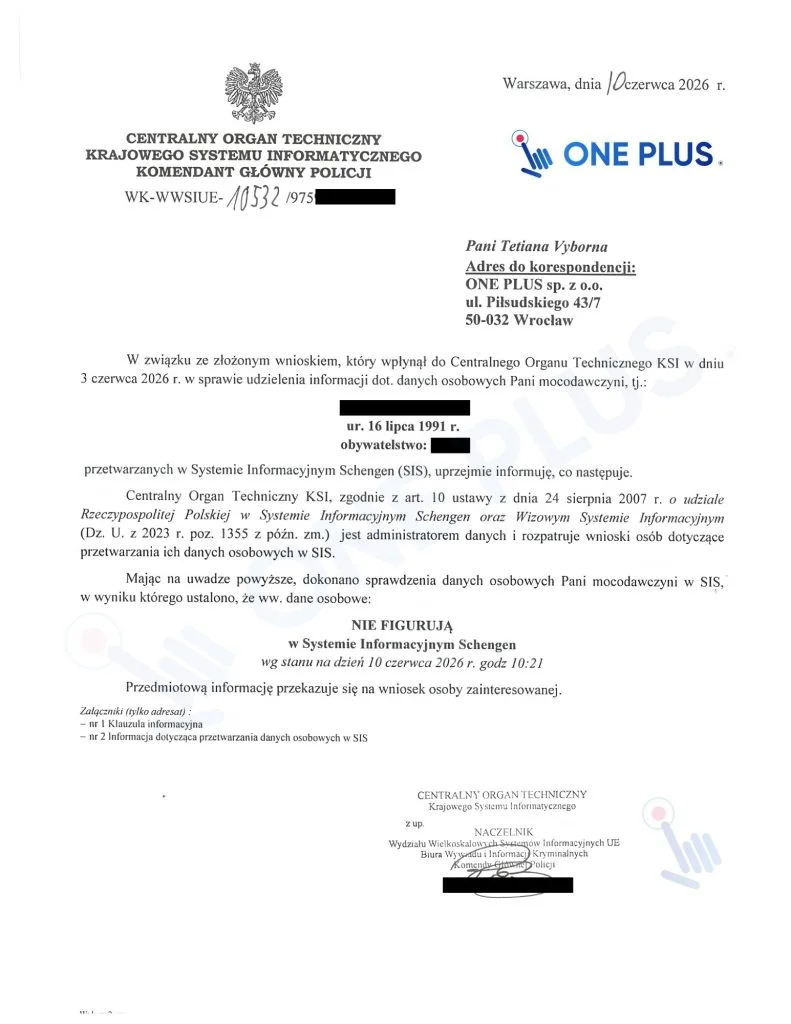
You can check whether you have an active SIS record by filing an official request. The right to access your own data is guaranteed by European data protection law, including the GDPR [4]. In practice, however, the procedure is set up in a way that makes it hard to handle on your own.
Where to Send the Request
The request goes to the competent authority of the country that most likely entered the alert. In Poland, that authority is the Office for Foreigners. If you do not know which country flagged you, you can also go through the SIRENE network. SIRENE is a system of national contact points that allows Schengen countries to exchange information about SIS cases.
Why Doing It Yourself Often Fails
The biggest hurdle is geography. To file a request with the Polish Office for Foreigners, you need a representative physically present in Poland. That person must have a Polish mailing address and a notarized power of attorney signed by you. Without those two things, your request will not even be accepted.
On top of that, there is the language barrier. The reply comes back in Polish, and it is an official document full of legal terms. Without training, it is easy to misunderstand the key points. You might miss whether there is an active alert, which authority entered it, how long it lasts, or whether there are grounds to have it removed.
How to Get a Clear Answer You Can Actually Use
At ONE PLUS, this step is routine for us. We file the request as your authorized representative. We receive the official reply, translate it, and give you a legal opinion. In the end, you will know the full picture. Who entered the alert, when, on what legal basis, how long it remains valid, and what your options are.
Removing a SIS Alert: Legal Grounds and Procedure
Having an alert removed from SIS is not a favor you ask for. It is a legal procedure, and it is available only when specific grounds exist.
Ground One: Incorrect Data
This is the most straightforward case. The database might contain a misspelled name, a wrong date of birth, or an incorrect passport number. Sometimes the alert is still sitting in the system even though the ban has already expired. The authority that entered it simply never updated the record. Under Regulation (EU) 2018/1861, SIS data must be accurate and kept up to date. If the information is wrong, the record must be corrected or deleted [1].
Ground Two: The Legal Basis No Longer Exists
If the deportation order or entry ban was overturned by a court, the SIS alert loses its legal foundation. The same applies if the ban’s term has simply run out. In those cases, we file an application for removal and attach the supporting documents.
Ground Three: The Alert Is Disproportionate
European law requires that any restriction on a person’s rights must be proportionate [1][3]. That means an entry ban cannot be automatic and it cannot be open-ended. If someone has a family in Poland, a steady job, or a business, and the ban stays in place without taking any of those circumstances into account, that can be grounds to challenge it. A court or an administrative body is required to weigh the formal reason for the ban against the real impact it has on a person’s life.
How the Removal Process Works with ONE PLUS
Consultation and Case Analysis
We always start with a legal consultation. During this conversation, we go through your situation in detail. What happened. In which country. Whether you have a copy of the deportation or ban decision. Whether you have already tried to do something about it. From there, we determine which country most likely entered the alert and on what grounds. We then give you a straight assessment of the chances, the risks, and the probable timeline.
Official Request to the Authorities
After the consultation, we prepare and submit an official request to the authority that we believe entered the alert. If the country is unknown, we go through the SIRENE network instead. We get back the data: what exactly is stored in the system, who put it there, when, for how long, and on what legal basis.
Preparing and Filing the Application for Removal
Once we have the data, we draft the application. Depending on the situation, it may ask for one or more of the following:
- correction of inaccurate data;
- deletion of the alert because the ban has expired;
- a review of the case due to changed circumstances;
- an appeal against the deportation or entry ban decision.
We attach all the necessary supporting documents. These typically include copies of decisions, certificates, proof of income, proof of family ties, and employment records.
Following Through to the Final Decision
Throughout the process, we track deadlines and respond to follow-up queries from the authorities. If a refusal comes back, we appeal it to a higher body or a court. At every stage, you will know where your case stands and what is happening next.
What Documents You Need to Remove a SIS Alert
The exact list depends on the case, but most situations call for the following:
- a copy of the deportation or entry ban decision, if you have it;
- a copy of your passport;
- documents proving that you left the country on time, if the ban is tied to a deportation;
- receipts for any fines you paid;
- a current residence card, visa, or other migration status;
- an employment contract, a CEIDG or KRS extract for business owners;
- a marriage certificate, birth certificates for children;
- proof of your registered address in Poland.
Getting a Power of Attorney
A power of attorney is required so we can act on your behalf. It can be signed at a notary in Poland. If you are outside the country, you can sign it at a Polish consulate or at a local notary with subsequent legalization. We help you arrange this and walk you through the formalities step by step.
Common Questions About SIS Removal
Can You Completely Remove Yourself from the Schengen Blacklist?
Yes. If the alert is incorrect, outdated, lacks a legal basis, or violates the principle of proportionality, it can be removed. This is expressly provided for by European legislation [1][4].
How Long Does the Process Take?
The timeline depends on the complexity of the case and which country entered the alert. Straightforward cases with an obvious error can be resolved in a few weeks. More difficult cases, however, involving a deportation or a criminal record, can take several months.
Can You File a Request While Outside Poland?
Yes. You need a representative in Poland with a notarized power of attorney. We work with clients remotely, without requiring them to be physically present in the country.
Does a Visa Refusal Automatically Mean You Are in SIS?
Not necessarily. A visa can be refused for many reasons. Insufficient income, problems with the paperwork, or the consul’s doubts about the purpose of the trip. But if you keep getting refusals and no clear reason is given, it is worth checking whether you have a SIS record.
What Happens If You Try to Enter with an Active SIS Alert?
You will be turned away at the border. The attempt will be recorded. In fact, it can make your situation worse and provide grounds to extend the ban. It is not a risk worth taking.
Who Handles Your Case
Tatiana Vyborna is an immigration lawyer with over eleven years of experience. She focuses on the legalization of foreigners in Poland, administrative procedures, appeals, and cases involving entry bans and SIS alerts. Over the years, she has handled hundreds of cases. They range from simple data requests to multi-stage court proceedings.
The firm ONE PLUS was founded in 2018. We bring together expertise in immigration law, administrative procedure, and practical day-to-day help for foreigners. Our office is in Wrocław. We represent clients from Warsaw, Poznań, and other Polish cities, and we also work remotely with clients who are currently abroad.
What to Do If You Suspect You Have an Entry Ban
First, do not panic. A SIS alert is not always a dead end. Second, do not try to enter the Schengen Area without checking your status first. The risk of getting a new ban or extending the current one is simply too high. Third, start with a consultation.
During the consultation, we look at the facts. We figure out which country most likely entered the alert and on what basis. We then assess the chances of getting it removed. You will not get vague reassurance. You will get a concrete plan. What to do. In what order. Which documents you need. And what the timeline looks like.
Tatiana Vyborna and the ONE PLUS team help with SIS removal, lifting entry bans to Poland and the Schengen Area, canceling deportations, and restoring your freedom to travel. We work both in person and remotely. To get started, get in touch with us.
Legal References
- [1] Regulation (EU) 2018/1861 of the European Parliament and of the Council of 28 November 2018 on the establishment, operation, and use of the Schengen Information System (SIS) in the field of border checks. This regulation sets out the legal basis for entering, storing, and deleting SIS alerts, as well as the rights of data subjects to access, rectify, and erase their information.
- [2] Convention Implementing the Schengen Agreement of 14 June 1985, signed on 19 June 1990. This convention laid the foundations of Schengen cooperation, including the exchange of information on persons considered inadmissible.
- [3] Directive 2008/115/EC of the European Parliament and of the Council of 16 December 2008 on common standards and procedures in Member States for returning illegally staying third-country nationals. This directive regulates the return process and establishes the principle of proportionality when imposing entry bans.
- [4] Regulation (EU) 2016/679 of the European Parliament and of the Council of 27 April 2016 (GDPR). This regulation governs the rights of individuals to access their personal data, have it rectified, and have it erased, including within systems such as SIS.
