
Minimum Wage in Poland in 2027

From 1 January 2027, the minimum wage in Poland is 4950 PLN gross a month, which comes to about 3704 PLN net for a full-time employee aged 26 or over. The minimum hourly rate rises to 32.30 PLN gross. For comparison, in 2026 the figures are 4806 PLN and 31.40 PLN. If you are a foreigner working in Poland, this matters beyond your payslip: your contract and the employer’s annex to a work-based residence permit application are both checked against the minimum wage.
The official 2027 rates
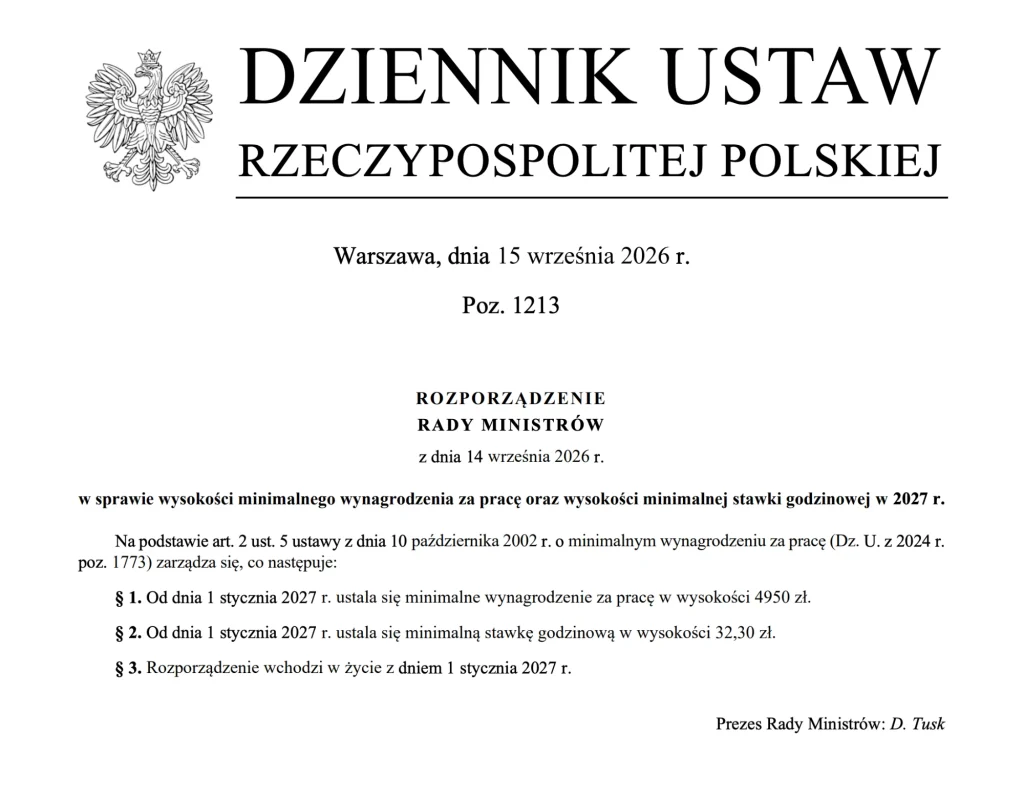
The new rates come from a regulation of the Council of Ministers (rozporządzenie Rady Ministrów) dated 14 September 2026 and published in the Journal of Laws (Dziennik Ustaw) on 15 September 2026. The key provisions read:
§ 1. Od dnia 1 stycznia 2027 r. ustala się minimalne wynagrodzenie za pracę w wysokości 4950 zł. § 2. Od dnia 1 stycznia 2027 r. ustala się minimalną stawkę godzinową w wysokości 32,30 zł.
Dz.U. 2026 poz. 1213
In plain English: from 1 January 2027 the minimum monthly pay for work is 4950 PLN, and the minimum hourly rate is 32.30 PLN. The regulation takes effect on the same day.
2026 vs 2027 at a glance
The table compares this year with next year. Net figures assume a full-time contract of employment (umowa o pracę), standard tax-deductible costs and no reliefs other than the one for under-26s.
| Item | 2026 | 2027 | Change |
|---|---|---|---|
| Monthly minimum wage (gross) | 4806 PLN | 4950 PLN | +144 PLN |
| Net pay, aged 26 and over | about 3605.85 PLN | about 3703.93 PLN | +98.08 PLN |
| Net pay, under 26 (no income tax) | about 3773.85 PLN | about 3886.93 PLN | +113.08 PLN |
| Minimum hourly rate (gross) | 31.40 PLN | 32.30 PLN | +0.90 PLN |
| Total monthly cost to the employer | about 5790 PLN | about 5963.77 PLN | about +173 PLN |
How much you take home
Polish salaries are quoted gross (brutto), so the number in your contract is not what reaches your bank account. Three deductions come off first: social security contributions paid to ZUS, the national social insurance institution; the health insurance contribution (składka zdrowotna); and an advance on income tax (PIT). Here is how 4950 PLN gross turns into net (netto) pay in 2027:
| Deduction | Rate | Amount in 2027 |
|---|---|---|
| Pension contribution | 9.76% | 483.12 PLN |
| Disability contribution | 1.5% | 74.25 PLN |
| Sickness contribution | 2.45% | 121.28 PLN |
| Health insurance | 9% of 4271.35 PLN | 384.42 PLN |
| Income tax advance | 12% minus 300 PLN tax-free allowance | about 183 PLN |
| Net pay | aged 26 and over | about 3703.93 PLN |
Employee ZUS contributions total 13.71%, or 678.65 PLN. The tax figure assumes standard work-related costs of 250 PLN a month. If you are under 26, the youth tax relief (ulga dla młodych) means no income tax is deducted, so you keep about 3886.93 PLN.
Minimum hourly rate in 2027
The 32.30 PLN hourly rate protects people working under civil law contracts rather than employment contracts. In practice this means a contract of mandate (umowa zlecenia) and a contract for the provision of services (umowa o świadczenie usług), which are very common among foreign workers in warehouses, logistics, hospitality and cleaning. Every hour you work must be paid at no less than 32.30 PLN gross.
What it means for foreigners
For many non-EU workers, the minimum wage is also a legal threshold in the residence process. When you apply for a temporary residence permit based on work, your employer fills in Annex No. 1 (Załącznik nr 1), which describes your job and pay. According to the Office for Foreigners’ MOS guidance, the salary shown there must not be lower than the minimum wage, whatever your working hours. That applies to a contract of mandate too. If you work for more than one employer, the amounts are added together. Your pay also cannot be lower than that of Polish staff in the same role.
In 2026 the threshold is 4806 PLN gross. From 1 January 2027 it becomes 4950 PLN. That has a few practical consequences:
- If your contract or Annex No. 1 states exactly the 2026 minimum, we recommend updating it with an amendment to the contract (aneks do umowy) effective from 1 January 2027.
- If your residence card case will be decided in 2027, it is safer to show pay of at least 4950 PLN in advance. This helps you avoid a request for further documents (wezwanie) or a refusal.
- Raising your pay to the new minimum does not require a new procedure. Changing your conditions against the terms of your permit decision (decyzja) is a different matter and needs to be agreed in advance.
- If you are changing employer while holding a residence card, check that the new offer meets the 2027 minimum before you sign.
If you are preparing an application now, our guide on how to fill in a residence application in MOS 2.0 shows where the salary details go. Workers whose route requires a work permit should check the figure in that document as well.
Check the salary in your contract and in Annex No. 1 before 1 January 2027. If it matches the 2026 minimum exactly, ask your employer for an amendment now rather than after an official letter arrives.
ONE PLUS editorial team
Checklist for employers
From 1 January 2027 every employer must pay at least the new minimum. With employer contributions of 20.48% (assuming a 1.67% accident insurance rate), one full-time minimum-wage employee costs about 5963.77 PLN a month, roughly 173 PLN more than in 2026. Before the new year, HR teams should:
- Find every employment contract and mandate contract set at 4806 PLN or 31.40 PLN per hour and prepare amendments.
- Update payroll so pay for January 2027 already reflects 4950 PLN and 32.30 PLN, even if it is paid out in February.
- Review Annex No. 1 for foreign employees with pending residence cases.
- Check pay in job offers for new foreign hires, so the documents stay consistent from the start.
If you manage a larger team of foreign staff, our employee legalisation service for employers covers permits, annexes and changes to employment terms.
Minimum wage history
Poland’s minimum wage has grown from 1750 PLN in 2015 to 4950 PLN in 2027, more than 2.8 times. In 2023 and 2024, when inflation was high, it was raised twice a year, in January and July. Since 2025 there has been a single increase each January, and the rises have become smaller.
| Year | From 1 January (gross) | From 1 July (gross) |
|---|---|---|
| 2027 | 4950 PLN | none |
| 2026 | 4806 PLN | none |
| 2025 | 4666 PLN | none |
| 2024 | 4242 PLN | 4300 PLN |
| 2023 | 3490 PLN | 3600 PLN |
| 2022 | 3010 PLN | none |
| 2021 | 2800 PLN | none |
| 2020 | 2600 PLN | none |
| 2019 | 2250 PLN | none |
| 2018 | 2100 PLN | none |
| 2017 | 2000 PLN | none |
| 2016 | 1850 PLN | none |
| 2015 | 1750 PLN | none |
Hourly rate history
The minimum hourly rate has existed since 1 January 2017. It started at 13.00 PLN and is now almost two and a half times higher.
| Year | From 1 January (gross) | From 1 July (gross) |
|---|---|---|
| 2027 | 32.30 PLN | none |
| 2026 | 31.40 PLN | none |
| 2025 | 30.50 PLN | none |
| 2024 | 27.70 PLN | 28.10 PLN |
| 2023 | 22.80 PLN | 23.50 PLN |
| 2022 | 19.70 PLN | none |
| 2021 | 18.30 PLN | none |
| 2020 | 17.00 PLN | none |
| 2019 | 14.70 PLN | none |
| 2018 | 13.70 PLN | none |
| 2017 | 13.00 PLN | none |
Keep in mind that the minimum wage is a floor, not a typical salary. The average salary in Poland is noticeably higher and varies by sector and region, so a job offer at the minimum is the lowest legal level, not a market benchmark.
How the 2027 rate was set
Each year the government proposes a minimum wage to the Social Dialogue Council (Rada Dialogu Społecznego), where trade unions and employer organisations negotiate. For 2027 the Council did not reach an agreement, so the Council of Ministers set the rate itself in the September 2026 regulation. Only one increase is planned for 2027, from 1 January.
Need help checking your documents?
ONE PLUS helps foreigners and employers in Poland with residence and work legalisation, from a single consultation to full support with your case. If you are unsure whether your contract or Annex No. 1 meets the 2027 requirements, see our price list or get in touch with our team.
Updated: 18 October 2026. Sources: Dz.U. 2026 poz. 1213, Dz.U. 2025 poz. 1242.

Frequently asked questions
On a full-time employment contract, a worker aged 26 or over receives about 3703.93 PLN net from 4950 PLN gross. This assumes standard work-related costs and no extra tax reliefs. Workers under 26 pay no income tax thanks to the youth relief, so they take home about 3886.93 PLN.
From 1 January 2027. Work done in January must be paid at the new rate, even if your January salary is paid in February. Hourly work under a mandate contract is also paid at 32.30 PLN from that date.
No. The regulation for 2027 provides for one increase only, on 1 January. Two increases a year, in January and July, last happened in 2023 and 2024. For the whole of 2027 the monthly minimum remains 4950 PLN gross and the hourly minimum remains 32.30 PLN gross.
Yes. A contract of mandate (umowa zlecenia) is covered by the minimum hourly rate of 32.30 PLN gross. For residence permit purposes, the MOS guidance also expects the total monthly pay shown in Annex No. 1 to reach at least the minimum wage, even when you work under a mandate contract or for several employers.
If your case is still open and will be decided in 2027, check the salary in Annex No. 1. Pay below 4950 PLN gross may lead to a request for further documents or a refusal. Ask your employer to confirm the new amount early. Our residence card (karta pobytu) service can review your documents before you submit them.
If your contract states exactly 4806 PLN or 31.40 PLN per hour, an amendment (aneks do umowy) from 1 January 2027 is the cleanest solution. Your employer must pay the new minimum anyway, but an amendment keeps your contract, payslips and residence documents consistent. If you already earn above 4950 PLN, nothing needs to change.


