
Permanent Residence Based on Polish Ancestry
ONE PLUS helps foreign nationals apply for permanent residence in Poland based on Polish ancestry. We handle cases in Wrocław and throughout Poland, from the initial review of family records to the final administrative decision.
We assess eligibility, trace the documentary link between generations, arrange sworn translations and prepare the electronic application through MOS 2.0. We also manage correspondence, respond to requests for additional evidence and prepare the applicant for the interview with the immigration officer.
With full legal support, a ONE PLUS representative attends the interview with the client. The representative monitors the procedure, helps the applicant work with the case documents and checks the written interview record before it is signed.
A Polish surname or a family story is not enough to obtain a permanent residence permit. The applicant must prove the Polish nationality of an ancestor, document the family relationship and show a genuine intention to settle in Poland permanently.
Who can apply based on Polish ancestry?
A foreign national may qualify for a Polish permanent residence permit if at least one parent or grandparent was of Polish nationality. Where the relevant ancestor is from an earlier generation, the applicant will generally need to prove that two great-grandparents were of Polish nationality.
The family relationship must be supported by official civil status records. A document stating that a grandmother was Polish will not be sufficient if the file does not contain the birth and marriage records needed to connect her to the applicant.
The applicant must also declare Polish nationality and demonstrate a genuine connection with Polish identity. Language, family history, cultural ties, Polish traditions and the applicant’s current life in Poland may all be considered.
A Card of the Pole, also known as Karta Polaka, is not required for an application based directly on Polish ancestry. If the applicant does not hold one but has suitable records confirming the Polish nationality of their ancestors, permanent residence based on Polish origin may still be possible.
Before starting the procedure, it is worth arranging individual legal advice. We will explain what the existing records prove, which links are missing and whether the case is ready for submission.
What is a Polish permanent residence permit?
A permanent residence permit gives its holder the right to live in Poland indefinitely. The legal status does not expire, although the physical residence card issued as proof of that status is valid for 10 years.
When the residence card expires, the holder applies for a replacement document. Polish ancestry does not have to be proved again solely because the physical card needs to be renewed.
Permanent residence is not tied to a particular employer, employment contract or university. Its holder may work in Poland without a separate work permit and does not have to renew a temporary residence status every few years.
The permit and the residence card are therefore different. The permit is the indefinite legal status, while the card is the document used to prove that status in Poland and when travelling with a valid passport.
What must the application prove?
A strong Polish ancestry case contains three connected parts. It establishes the ancestor’s Polish nationality, proves an unbroken family relationship and explains why the applicant intends to make Poland their permanent home.
Each part must support the others. An archive certificate may prove the ancestor’s nationality but not the relationship to the applicant, while birth certificates may prove the family line without showing that the ancestor was Polish.
The immigration officer will compare names, dates, places of birth and family relationships across the entire file. Any differences should be explained and supported rather than left for the officer to interpret.
ONE PLUS reviews the evidence as a complete legal case. This approach helps identify missing documents and inconsistencies before the application is submitted.
Documents proving Polish origin
The strongest evidence is usually an official document that expressly records the Polish nationality of the ancestor. Depending on the family history, this may be a civil status record, archive certificate, old identity document, church register, military record or census entry.
Records concerning displacement, deportation, resettlement, political repression or rehabilitation may also be relevant. Their value depends on what they state, who issued them and whether the person named can be connected to the applicant.
A Polish surname does not prove Polish nationality by itself. Birth in territory that historically belonged to Poland, membership of the Catholic Church or a family tradition may provide context, but these facts do not normally replace official evidence.
Polish nationality and Polish citizenship are not always interchangeable for evidential purposes. A citizenship record may be important, but it must be assessed in its historical and legal context.
One clear archive record can sometimes be more useful than several indirect documents. We examine what each record actually proves and how it contributes to the legal basis of the application.
How to document the family line
The family line must connect the qualifying Polish ancestor to the applicant without unexplained gaps. Birth certificates, marriage certificates and records of name changes usually provide the links between generations.
If the relevant ancestor is the applicant’s grandmother, the file may require proof of her Polish nationality, the parent’s birth certificate and the applicant’s birth certificate. If a surname changed following marriage, the relevant marriage certificate will usually be required as well.
Older records often contain different spellings of the same name. Details may have been recorded in Polish, English, Ukrainian, Russian, Belarusian or another language, producing differences in spelling and transliteration.
Dates and place names may also vary between documents. These discrepancies do not necessarily prevent a successful application, but they should not remain unexplained.
Depending on the issue, the case may require another civil status record, a fresh archive extract, correction of an official entry or a written explanation. ONE PLUS checks the complete family line so the immigration officer can follow it without guesswork.
Required documents for permanent residence based on Polish ancestry
There is no universal document package for every applicant. The final set depends on the generation involved, the countries in which the records were issued and the applicant’s personal circumstances.
A typical application may include:
- a valid passport, compliant digital photograph and electronic application through MOS 2.0;
- an official document confirming the Polish nationality of the relevant ancestor;
- birth and marriage certificates linking each generation to the next;
- documents confirming changes of name or surname;
- archive certificates, church records, old identity documents and military records;
- records relating to displacement, deportation, resettlement, repression or rehabilitation, where relevant;
- sworn translations into Polish of documents issued in other languages;
- evidence of the applicant’s connection with Poland and intention to settle permanently;
- confirmation that the required government fees have been paid;
- a power of attorney where the applicant is represented in the proceedings.
This is a practical starting point rather than a final checklist. One case may depend on a single archive record, while another may require extensive work to establish the family relationship or explain changes in personal data.
Every scan should be complete and legible. A missing reverse page, cropped stamp or unreadable handwritten entry may result in a request for a better copy or the original document.
More documents do not automatically make an application stronger. Every item should prove a relevant fact and fit logically into the case.
Finding missing family records
Evidence of Polish ancestry may be held by state archives, church archives, civil registry offices, military institutions or local authorities. The correct place to search depends on the year, location and type of event being researched.
The search does not always begin in Poland. A birth or marriage certificate issued in another country may contain a former surname, place name or parental detail needed to locate the next record.
ONE PLUS assists with obtaining and restoring official documents. We help identify what is missing, where the record may be held and whether the document obtained is suitable for use in the permanent residence case.
Archive searches can take several weeks or months. The family evidence should therefore be reviewed well before the applicant’s current legal stay is due to expire.
Apostilles and sworn translations
Documents issued outside Poland will normally need to be translated into Polish by a Polish sworn translator. An ordinary commercial translation may not meet the formal requirements of the immigration office, even if it was prepared by a professional translator abroad.
Some foreign records must also be authenticated before they can be used in Poland. ONE PLUS can check whether an apostille for a foreign document or another form of legalisation is required.
Names, dates and geographical terms require particular care during translation. If a passport uses one transliteration and an archive record uses another, the difference should be handled consistently and explained where necessary.
We arrange sworn translations of documents and review the completed set for consistency. This reduces the risk of the same relative appearing to be a different person across several records.
Proving your intention to settle in Poland
Polish ancestry is not the only matter examined in the proceedings. The applicant must also demonstrate a genuine intention to settle in Poland permanently.
The office considers the person’s actual circumstances rather than relying on one prescribed document. Relevant factors may include residence, employment, business activity, education, family ties, knowledge of Polish and the time already spent in the country.
The appropriate evidence differs from one applicant to another. An employment contract and tenancy agreement may be useful in one case, while family connections, university enrolment or business activity may be more important in another.
ONE PLUS selects evidence that reflects the applicant’s real situation. The purpose is to explain why Poland is the person’s permanent home, not simply to add more pages to the file.
The permanent residence interview
Applicants should be prepared for an interview as part of the assessment of Polish origin. In Wrocław and other cities, the meeting may take the form of an interview or a formal statement recorded in writing.
The officer will usually ask about the Polish ancestor, the applicant’s relationship to that person and the source of the documents submitted. Questions may also cover places of birth and residence, family traditions and the way Polish identity was maintained within the family.
The applicant may also be asked about their current life in Poland. This may include where they live, work or study, why they want to remain in Poland and what plans they have for the future.
There is no separate state history examination for this type of permanent residence permit. However, the interview is generally conducted in Polish, so the applicant should understand the questions and be able to explain their family history in their own words.
Applicants are not expected to memorise every date. If a precise fact is genuinely unknown, it is better to say so than to guess and create a contradiction with the documents.
Preparing for the interview
ONE PLUS prepares each client using the facts and evidence in their own case. A generic list of interview questions cannot reflect the differences between families and does not replace individual preparation.
We begin by reviewing the family chronology and identifying the people, places and events that matter most. We then consider which parts of the evidence are likely to lead to questions from the officer.
The next stage is a practice interview conducted in Polish. The client learns what to expect, how to ask for clarification and how to answer naturally without adding information that is not supported by the records.
The goal is not to memorise a script. The applicant should understand the case and be able to give a truthful, consistent account of their background and connection with Poland.
Representation at the interview
With full legal support, a ONE PLUS representative attends the interview with the client. The representative monitors the procedure, helps the applicant locate relevant documents and checks the written record of the meeting.
The applicant must answer questions about ancestry, family history and personal circumstances directly. The representative cannot answer on the applicant’s behalf, but may identify an inaccurate entry or a procedural issue.
The interview record should be read carefully before it is signed. Errors in names, dates or the meaning of an answer should be corrected while the applicant is still at the office.
If further evidence is requested after the meeting, we review the request and prepare the response. The client receives a clear explanation of what must be provided and when it is due.
Applying through MOS 2.0
Since 27 April 2026, standard applications for permanent residence have been submitted electronically through MOS 2.0. The applicant creates a personal account, completes the form, uploads the supporting documents and signs the application electronically.
Login details and access to the electronic signature must not be given to a representative. ONE PLUS helps prepare the permanent residence application through MOS 2.0, checks the form and attachments, and supports the client during submission.
Once the application has been sent correctly, the system produces an official electronic confirmation of receipt. The office may then arrange an in-person appointment to inspect the passport and original records, collect fingerprints and complete the remaining formalities.
The application must be submitted no later than the final day of the applicant’s legal stay in Poland. An incorrect passport number, missing attachment or unreadable file may result in a formal request and delay the next stage.
Where an application is filed on time and formal deficiencies are corrected within the deadline, the applicant’s stay in Poland may remain legal while the proceedings are pending. A pending application does not, by itself, guarantee re-entry into Poland after travel abroad or create unrestricted travel rights within the Schengen Area.
What happens after submission?
The office first checks whether the application meets the formal requirements. If information or evidence is missing, the applicant receives a written request explaining what must be supplied and the deadline for doing so.
Official correspondence should not be ignored. A late or incomplete response can delay the case and may affect whether the application is fully examined.
ONE PLUS monitors correspondence and prepares responses to requests for documents or explanations. We make sure that the response addresses the issue raised without creating new inconsistencies elsewhere in the file.
Support continues until the decision is issued within the scope agreed with the client. We also explain the practical steps required after a positive decision and before the residence card can be collected.
Common causes of delay
Delays often occur because the evidence does not clearly connect the Polish ancestor to the applicant. Missing civil status records, unexplained surname changes and conflicting dates commonly lead to requests for additional documents.
Poor scans and inaccurate translations can cause the same problem. Time may also be lost when the applicant cannot explain where an archive record came from or which relative it concerns.
Another common issue is starting the process too late. Obtaining a replacement birth certificate or archive document may take months, especially where the family lived in several countries or borders changed over time.
ONE PLUS cannot control the office’s workload or guarantee a decision by a particular date. We can prevent avoidable delays by checking the legal basis, family line and documentary evidence before submission.
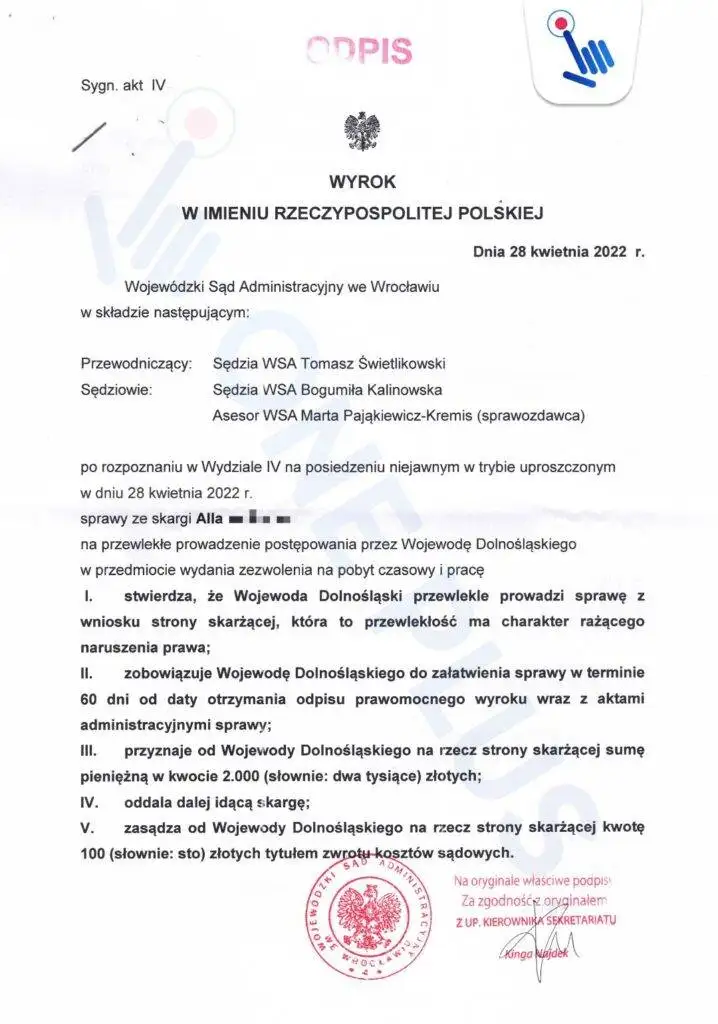
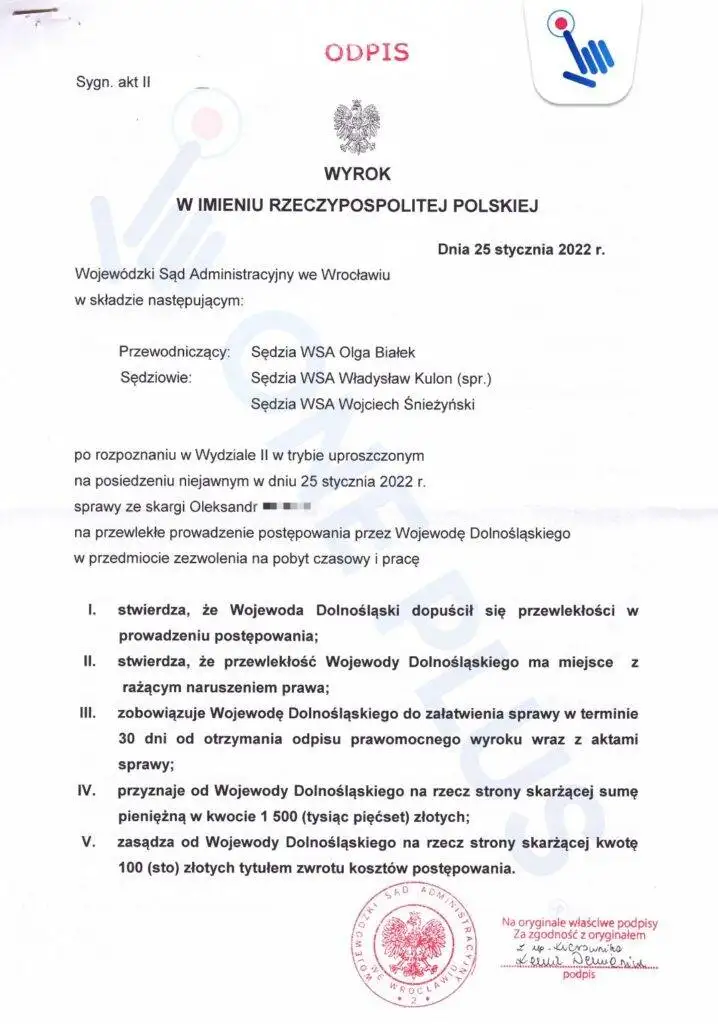
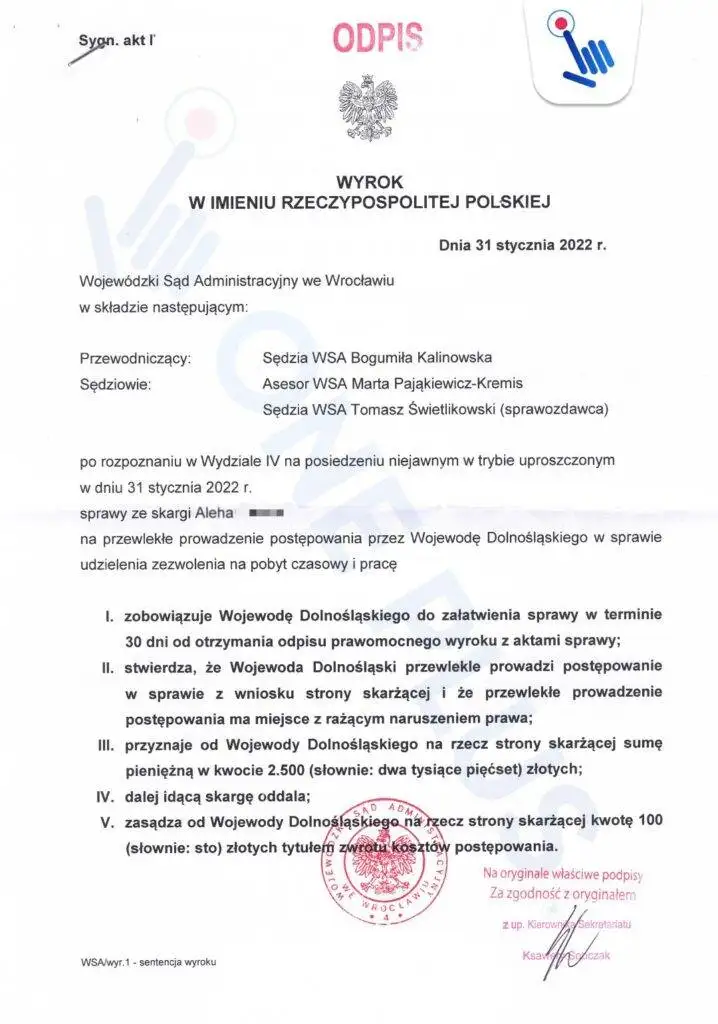
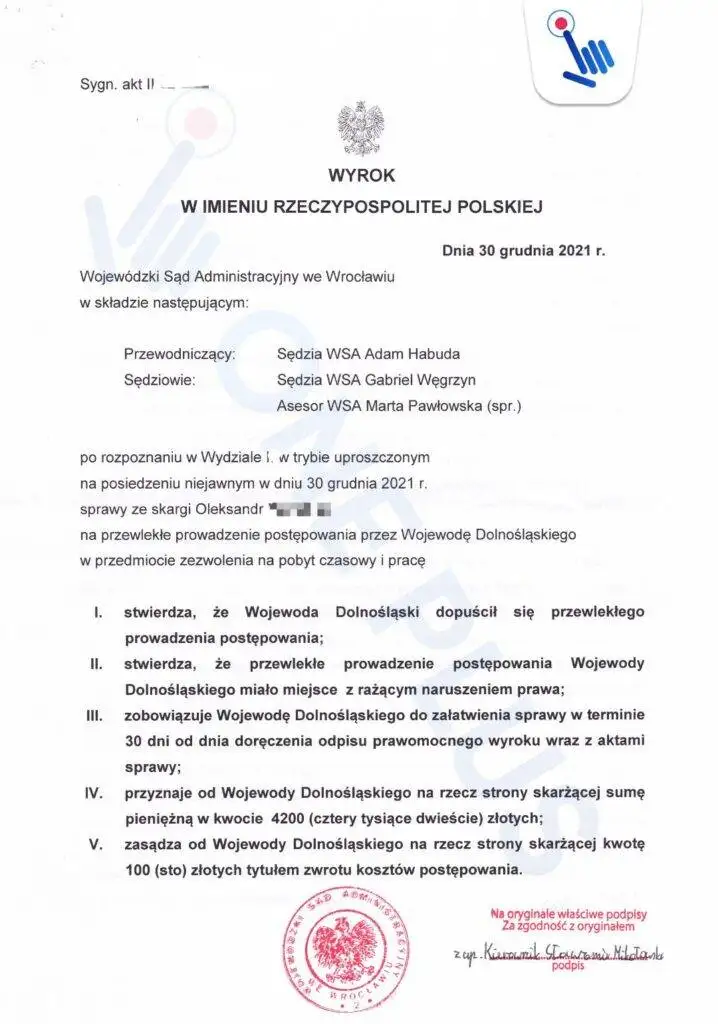
Where proceedings remain inactive for an excessive period, formal remedies may be available. The correct step depends on the procedural history, so the case file should be reviewed before any request to expedite the decision is made.
Processing time for permanent residence
The statutory period for deciding a permanent residence case is up to six months. This period does not necessarily begin on the date the electronic application is submitted.
The starting point may depend on personal attendance, fingerprint collection, correction of formal deficiencies and submission of the evidence needed to establish eligibility. A request for further documents may therefore extend the actual waiting time.
Processing times also vary according to the workload of the office and the complexity of the family history. It is not possible to promise an exact decision date at the beginning of the case.
After a positive decision, the applicant must complete the required formalities and pay for the physical residence card. Production and collection times depend on the current queue.
What does permanent residence in Poland allow you to do?
A permanent residence permit allows its holder to live in Poland indefinitely. The underlying immigration status does not need to be renewed every few years.
The holder may work in Poland without obtaining a separate work permit. Permanent residence is not connected to one employer, position or employment contract.
The status also allows its holder to conduct business under the rules applicable to permanent residents. Long-term plans do not have to depend on continued employment, study or another temporary residence ground.
When used with a valid passport, the residence card permits short visits to other Schengen countries under the applicable travel rules. It does not give an unrestricted right to live or work in another country, so the requirements of the destination must be checked separately.
Permanent residence may also help with future applications involving close family members, although every person requires an individual legal basis. The circumstances of each relative must therefore be reviewed separately.
A person who has lived in Poland continuously and legally for at least one year on permanent residence granted because of Polish origin may qualify to apply for recognition as a Polish citizen, provided the remaining conditions are met. These include official proof of Polish language ability at a minimum B1 level.
Permanent residence in Wrocław and throughout Poland
Applications are handled according to the applicant’s place of residence. A person living in Wrocław or elsewhere in Lower Silesia will normally deal with the immigration office in Wrocław.
Local practice matters because offices may organise correspondence, appointments and interviews differently. We prepare clients for the electronic application, explain which original documents to bring and attend the interview when full support has been agreed.
ONE PLUS is based in Wrocław but handles permanent residence applications throughout Poland. We adjust the preparation to the office responsible for the client’s place of residence.
Much of the document review and application preparation can be completed remotely. The client needs to attend in person only where the law or the procedure requires it.
How ONE PLUS handles your case
We begin with a legal and documentary assessment. The client receives a practical explanation of what the current records prove, which links are missing and what risks should be addressed before submission.
We then prepare a plan tailored to the family history. Where necessary, we help obtain civil status records and archive certificates, arrange sworn translations and draft explanations for differences in personal data.
Once the evidence is ready, we complete the MOS 2.0 application and check every attachment. The form, passport, family records, archive documents and translations should all present the same consistent history.
We also prepare the applicant for the interview and, with full representation, attend the meeting. After submission, we monitor correspondence, answer official requests and keep the client informed until the decision is issued.
Our work is not limited to uploading documents. We prepare a coherent, evidence-based case that the immigration officer can understand without having to reconstruct the family history from disconnected records.
Cost of legal support
Partial support costs PLN 1,000 excluding VAT, which is PLN 1,230 including VAT. This option is suitable for applicants who intend to manage the proceedings themselves but need a professional review of eligibility, ancestry records, family lineage or the MOS 2.0 application.
Full legal support costs PLN 2,700 excluding VAT, which is PLN 3,321 including VAT. It includes an eligibility assessment, a personalised document plan, review of the family line, preparation of the MOS 2.0 application, interview preparation, attendance by a representative, correspondence management and responses to official requests until the decision.
The exact scope is agreed before the service contract is signed. Government fees, archive searches, replacement documents, notarial work, apostilles and sworn translations are charged separately unless the contract states otherwise.
Experience behind your application
Every Polish ancestry case is different. Families may have lived in several countries, used different versions of the same surname and preserved very different types of records.
The ONE PLUS team is led by Tatiana Vyborna, President of the Management Board and a specialist in Polish administrative and immigration procedures. She has more than 11 years of experience assisting foreign nationals with residence legalisation and proceedings before public authorities in Poland.
This practical experience helps us identify weaknesses before an application is filed. We understand what may raise questions, how discrepancies can be explained and how an applicant should prepare for the interview.
We do not promise a positive result before reviewing the evidence. We first assess the legal basis and documents, then provide a clear and realistic plan for the case.
Legal support for permanent residence based on Polish ancestry
If you have documents relating to a Polish parent, grandparent or great-grandparent, begin with a professional review. We will determine whether the records establish Polish nationality, whether the family line is complete and what additional evidence may be required.
ONE PLUS can prepare the application and attachments, arrange sworn translations and guide you through electronic submission. With full support, our representative will prepare you for the interview, attend the meeting and continue managing the proceedings until the decision.
Contact ONE PLUS if you need help obtaining a Polish residence permit based on Polish ancestry. After reviewing the documents, we will provide a practical action plan, a clear assessment and professional support in Wrocław or elsewhere in Poland.






 4,7
4,7