
TRC Applications Frozen in Poland Until March 4, 2026

Poland freezes residence card (TRC) processing: applications frozen until March 4, 2026
In recent weeks, social media and online forums have been flooded with claims that until March 4, 2026, Polish Voivodeship Offices (Urząd Wojewódzki) will not process any cases related to foreigners — including residence cards (karta pobytu) and extensions of residence permits. According to these reports, all proceedings concerning residence cards in Poland have been temporarily suspended until that date.
Let’s take a closer look at what the law actually says, why it was introduced, what it really means, and what every foreigner waiting for their residence card should know.
This information circulating online is not accurate.
The law indeed introduces a temporary suspension of administrative deadlines (in Polish: zawieszenie biegu terminów) for certain immigration-related procedures.
However, this does not mean that offices have stopped working or that your case is “on hold.”
Authorities still accept, register, and process applications, though under a different legal timeline.
Legal Background
What the Amendment of September 12, 2025 Regulates
On September 12, 2025, the Polish Parliament (Sejm) adopted a new amendment regulating matters related to foreigners’ legalization of stay and assistance to Ukrainian citizens.
This law extends the suspension of administrative time limits until March 4, 2026, covering a wide range of immigration procedures.
Which Cases Are Affected
The suspension applies mainly to the following types of cases:
- granting or withdrawing temporary residence permits;
- permanent residence permits;
- EU long-term resident permits;
- modification of temporary residence and work permits;
- permits for highly qualified workers (Blue Card holders).
It also includes cases related to international protection (asylum procedures).
The key point is:
These cases are still being processed.
The Voivodeship Offices are open, applications are being accepted, and cases are not “stored away until 2026.”
The only change is that the official time limits defined in administrative law are not counted during this period.
Historical Context: From COVID-19 to the War in Ukraine
It’s important to understand that zawieszenie biegu terminów is not new.
This legal mechanism was first introduced during the COVID-19 pandemic, when public institutions were overwhelmed by thousands of pending cases.
Later, after the Russian invasion of Ukraine in 2022, the number of foreigners applying for residence in Poland multiplied dramatically.
The Polish administrative system could not handle this sudden wave efficiently, so the suspension of deadlines became a necessary measure — it allowed offices to continue processing cases legally, without violating statutory time limits.
What It Means for Foreigners
Many foreigners mistakenly believe that Voivodeship Offices have stopped processing residence cases.
That is not true.
The suspension of deadlines does not prohibit the authorities from reviewing or finalizing your case.
It simply removes their obligation to meet the usual statutory deadlines for issuing decisions.
In practical terms — if the Voivode normally had to review your case within 60 days, that countdown is now paused until March 4, 2026.
However, this does not mean your application is forgotten.
Offices continue working, decisions are still being issued, and residence cards are still printed and delivered.
Legal Consequences
1. No “Inactivity of the Authority” (Bezczynność organu)
Until March 4, 2026, the usual rules holding public offices accountable for delays or inactivity do not apply.
This means that:
- the office will not send you notifications about delayed decisions;
- there are no penalties for missed deadlines;
- you cannot claim compensation for administrative delays;
- and you cannot file a complaint for excessive duration (skarga na przewlekłość postępowania) to seek financial reimbursement.
2. No Financial Compensation
Before this change, foreigners — including many clients of ONE PLUS — successfully received compensation ranging from 1,000 to 4,000 PLN for long waiting periods.
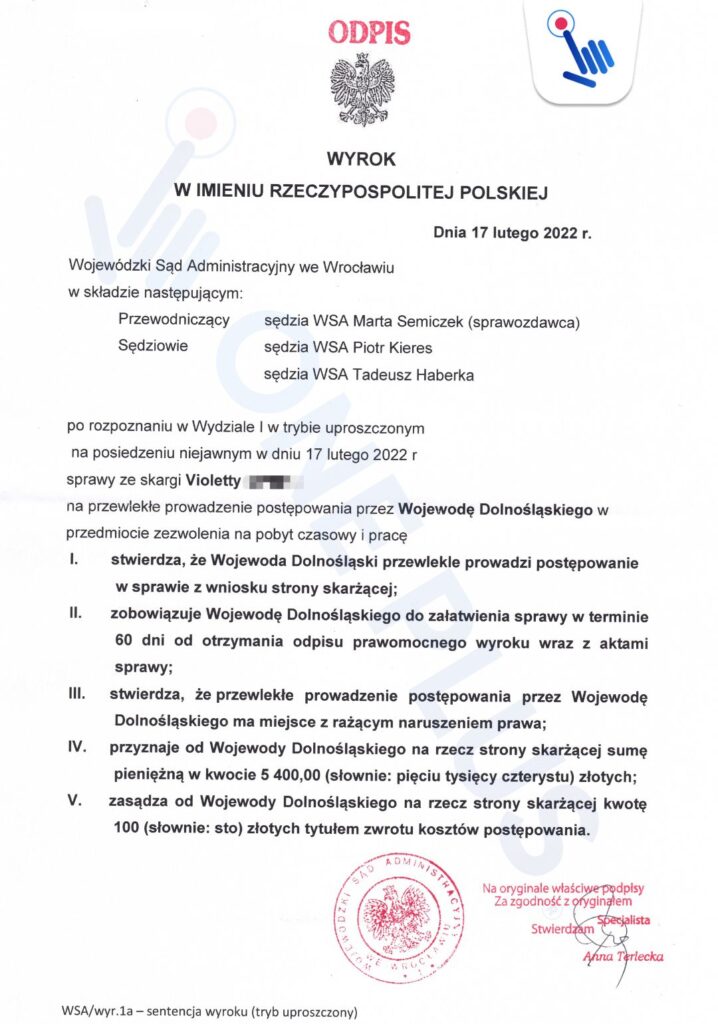
Now, even if your case takes much longer than expected, the court will not award any payment for the delay.
This temporary measure, valid until March 4, 2026, helps protect the system from overload and an avalanche of complaints.
Why the Government Introduced These Rules
Poland remains one of the most attractive EU destinations for foreigners seeking legalization.
The surge of applications from citizens of Ukraine, Belarus, India, Vietnam, the Philippines, Colombia, Canada, and many other countries caused a serious administrative backlog.
The government introduced zawieszenie to:
- keep the public administration stable,
- prevent system collapse,
- allow modernization of internal procedures and IT systems,
- and maintain priority for urgent or humanitarian cases.
How It Affects Your Application
The law clearly states that all actions taken by the authorities during this suspension remain valid and lawful.
If an inspector continues to process your file, requests additional documents, or issues a decision — everything remains legally binding.
However, if your case is delayed, you can no longer rely on traditional legal tools such as:
- ponaglenie (a formal reminder),
- skarga na bezczynność (a complaint about inactivity),
- wniosek o odszkodowanie (a claim for compensation).
How ONE PLUS Supports Its Clients
Despite the restrictions, our legal team continues to file complaints in court — not to demand compensation, but as a strategic legal tool to push the office to act.
Court proceedings usually force the authority to:
- reopen and review your case,
- re-examine the documentation,
- and explain to the court why the inspector hasn’t issued a decision yet.
In practice, several outcomes are possible:
- The inspector issues a retroactive decision. The office sometimes finalizes the case and reports to the court that it’s resolved — and the court dismisses the complaint.
- The inspector admits system overload. The office explains that the delays result from excessive workload and limited staff. In such cases, the court acknowledges the delay but doesn’t impose compensation. Usually, after court involvement, the case moves faster.
In other words, even without financial awards, judicial pressure works.
Inspectors prefer to close pending files to avoid court hearings and further bureaucracy.
Who Is Affected by the Suspension
These rules apply to all foreigners, regardless of nationality.
Whether you are from Canada, the UK, South Africa, India, Ukraine or Colombia, your case may fall under the suspension if it concerns the listed types of residence permits.
However, not every procedure is affected.
For example, matters related to invitations, PESEL numbers, or company registration are not subject to this suspension.
Practical Advice for Foreigners
- Don’t believe the myths. Residence card applications are still being processed — just without formal time counting.
- Stay proactive. Submit missing documents and check your case status regularly.
- Work with a legal expert. Only a qualified lawyer can evaluate your situation and take effective steps before the office or in court.
- Use complaints strategically. Even without compensation, they can motivate the office to act.
- Stay calm. The government did not introduce this law against foreigners — it’s designed to keep the system functioning.
Final Thoughts
The statement “residence cards will not be processed until March 4, 2026” is a myth.
Applications are still being reviewed and decisions are being made — just within a legally suspended timeframe.
This means that officials are not bound by statutory deadlines, not penalized for delays, and not required to pay compensation — but the process continues.
Poland’s immigration system is adapting to extraordinary challenges — the pandemic, war, and massive migration.
The suspension of deadlines is a temporary legal measure that keeps the system operational, even if slower than usual.
At ONE PLUS, we continue to assist clients through every stage of their legalization process — from application to court representation — ensuring that every case moves forward lawfully, efficiently, and strategically, despite temporary administrative suspensions.